With their large sunny faces and towering stature, sunflowers (Helianthus annuus) are one of the most
well-loved and well-known members of the Asteraceae family. The bright yellow fringe around the center of the
sunflower, often to referred to as petals, are bracts, cleverly colored to entice bees and other pollinators.
In the center are hundreds of tiny flowers which, when pollinated, become sunflower seeds. Sunflower seeds are
also called achenes and are composed of a hard outer shell surrounding the softer seed inside. The outer shell
(or pericarp) is tough and generally considered inedible, but the seed which it holds is high in beneficial fats
and protein as well as essential minerals.
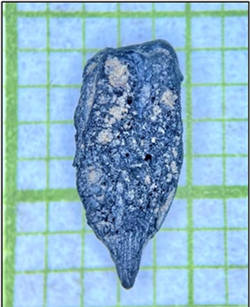 Figure 1. Charred sunflower seed from the Rosenstock Village Site (18FR18),
Figure 5. 1mm scale.
Figure 1. Charred sunflower seed from the Rosenstock Village Site (18FR18),
Figure 5. 1mm scale.
The small, carbonized sunflower seed pictured to the right was recovered from a large pit feature at the Rosenstock
Village Site (18FR18), a Late Woodland period (950-1600 AD) precontact site in Frederick County, Maryland. Radiocarbon
dating of other charcoal within the feature suggests the sunflower seed dates to the 12th century (Curry and Kavanaugh
2004: 24). In addition to the sunflower seed, over 100 other seed and nut fragments were identified, including
maize (Zea mays), Sumac (Rhus sp.), blackberry or raspberry (Rubus sp.), and many
grasses and small-seeded weedy plants. The presence of these species tells archaeologists that the residents of
Rosenstock Village lived in an open environment where plants requiring full sun could thrive, but also that nearby
forested areas provided the opportunity to forage nuts and fruits to supplement agriculturally sourced foods. Many
of these species also ripen in the late summer to autumn and may suggest the pit was filled with refuse during
these periods of the year. Both archaeological and genetic studies have confirmed that sunflowers were domesticated
between 5,000 and 3,800 years ago in central North America, well before maize agriculture became dominant, and
are one of a group of crops archaeologists refer to as the Eastern Agricultural Complex (Smith 2014: 57).
Records written by Europeans describe sunflowers growing interspersed with maize (Heiser 1951) while other accounts
depict sunflowers growing near the village periphery (Hulton 1972). Aside from the aesthetic and nutritional value,
it is not surprising sunflowers became a standard component in indigenous agriculture and gardens. In recent decades
sunflowers have increasingly been recognized for the beneficial roles they can play in commercial agriculture.
Sunflowers have a deep taproot which can help improve soil by encouraging the development of beneficial bacteria,
fungi, and microbes (Vollmer-Sanders 2018). Sunflowers also provide a habitat in which beneficial predatory insects
and pollinators can flourish, resulting in increased crop yield and decreasing the damaging effects of other pests.
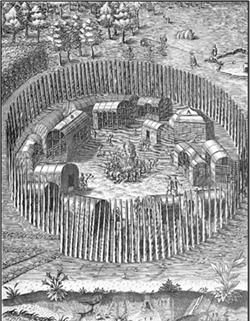 Figure 2. Town of Pomeiooc as illustrated by Thoeodor de Bry (Harriot 1590 in Hulton 1972).
Although small, the sunflower and other plant remains provide an importance source of data for understanding how the
occupants of Rosenstock lived. Aside from being a pretty garden plant, sunflowers fulfilled multiple functions within
indigenous agriculture and people benefited, and continue to benefit, in multiple ways from their cultivation.
References
Curry, Dennis, and Maureen Kavanaugh
2004 Excavations at the Rosenstock Village Site (18FR18), Frederick County,
Maryland: A Preliminary Report. Maryland Archaeology Vol. 40 (1), pp.1-38.
Heiser, Charles B.
1951 The sunflower among the North American Indians. Proceedings of the
American Philosophical Society, 95(4), pp.432-448.
Hulton, Paul
1972 Introduction to the Dover Edition: A brief and true report of the new
found land of Virginia: the complete 1590 edition with the 28 engravings by Theodor de Bry after the
drawings of John White and other illustrations. Dover Publications, Inc. New York.
Smith, Bruce D.
2014 The domestication of Helianthus annuus L.(sunflower).
Vegetation History and Archaeobotany, 23(1), pp.57-74.
Vollmer-Sanders, Carrie
2018 Sunflowers Enrich Soil Health and Communities.
Electronic document, https://www.nature.org/en-us/what-we-do/our-priorities/provide-food-and-water-sustainably/food-and-water-stories/sunflowers-enrich-soil-health-and-communities/,
accessed June 18, 2021.