Today, if you are caught spitting in pubic, you can get a ticket but back in the nineteenth and earty twentieth centuries, the
practice was much more widely accepted. Before the automated production of cigarettes began to become more common in the
earty 20th century, chewing tobacco was one of the most common means of enjoying this drug. Not only would partakers in this
practice not want to swallow the tobacco leaves, the chewing generated a lot of fluid which would also need to be spit out.
Thus, a common sight, both in private homes and in public spaces like saloons, banks, office buildings, barber shops and
courtrooms, were receptacles for receiving these expectorations (Figure 1).
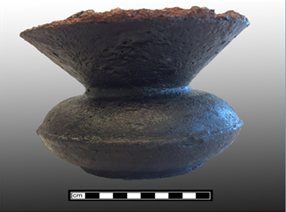 Figure 1. Cast iron self-righting cuspidor from Baltimore's North Exeter site
(18BCl35).
Figure 1. Cast iron self-righting cuspidor from Baltimore's North Exeter site
(18BCl35).
These receptacles were called spittoons and cuspidors. The English language use of the term cuspidor dates back to the
early 18th century, from the Portuguese word cuspidouro, meaning "place for spitting." Today, the terms spittoon and cuspidor
have become largely interchangeable (Owlcation 2020), but as recently as the late 19th century, the terms referred to
very differently shaped vessels. The 1893 Handlan Company catalog (Figure 2) shows a spittoon as a low circular
vessel with an integrated top that sloped towards a small central hole. Spat tobacco juice would run down the sides
and into the spittoon. Rockingham, a ceramic with a mottled brown and yellow glaze, were popular as spittoons, since
the glaze helped mask the spit (Figure 3). An oval opening along the side of the vessel was used to empty the tobacco
juice. A cuspidor had a taller profile, with a bowl-shaped base, a funnel-shaped opening and a pinched neck.
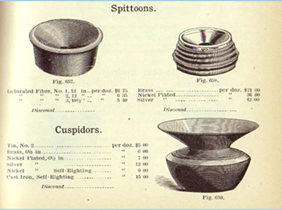 Figure 2. Catalog page from 1893 Handlan Company catalog, illustrating the difference in
shape between a spittoon and a cuspidor.
Figure 2. Catalog page from 1893 Handlan Company catalog, illustrating the difference in
shape between a spittoon and a cuspidor.
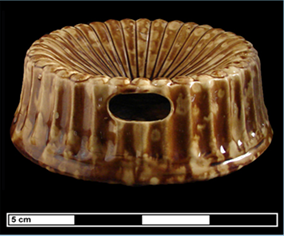 Figure 3. Rockingham earthenware spittoon owned by the author. The mottled glaze on this
type of ceramic was good at hiding spit stains.
Figure 3. Rockingham earthenware spittoon owned by the author. The mottled glaze on this
type of ceramic was good at hiding spit stains.
The cast iron cuspidor shown in Figure 1 was found in an early 20th-century privy in Baltimore at the North
Exeter site (18BC135). The base of this cuspidor is very heavy to keep it from being easily tipped and spilling its
disgusting contents. This so-called "self-righting" cuspidor is the most expensive cuspidor offering in the 1893 catalog.
References
Handlan Company
1893 Handlan Company catalogue.
https://commons.wikimedia.org/wiki/File:Handlan_Spittoons_1893.jpg
Owlcation
2020 Spitting in America – Spittoons of Yesterday, a Photo
Gallery. Owlcation.com. https://owlcation.com/humanities/Spitting-in-Amercia-Spittoon-Photo-Gallery.
See the blog The Rise of "Smallish Cigars" – How Cigarettes Became the World's Most Popular Tobacco
Product for more about the history of automation in the cigarette industry,
https://jeffersonpatterson.wordpress.com/2020/02/12/the-rise-of-smallish-cigars-how-cigarettes-became-the-worlds-most-popular-tobacco-product/