This largely comprete wheelengraved decanter, found in a Baltimore privy, may have been a product of one of
North America's most famous glass manufacturers. German immigrant John Frederick Amelung opened the New
Bremen Glass Manufactory near Frederick, Maryland in 1785. At the time, the United States was a new
nation anxious to promote industry. Encouraged in his endeavor by George Washington, Benjamin Franklin,
and Thomas Jefferson, Amelung brought 68 experienced German glass workers to staff the new factory
(Lanmon and Palmer 1976). Within five years, Amelung employed between 400 and 500 workers and was
producing a range of glass vessels, including "1/2 gill to quart tumblers, ½ to 1quart Decanters…
Wines, Goblets, Glass Cans with Handles, different sizes." (Maryland Journal and Baltimore Advertiser 1788).
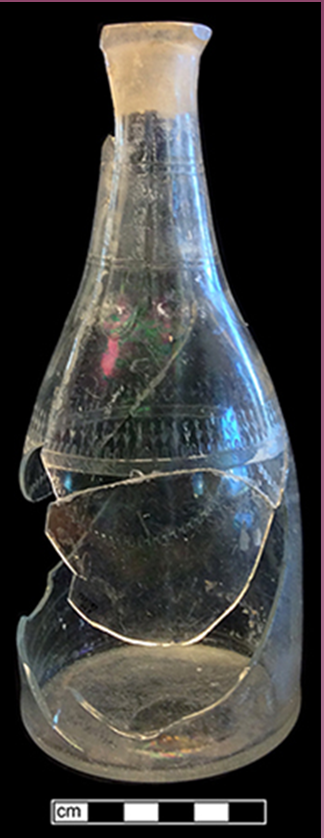 Decanter discovered in a Baltimore privy filled around the time of the Civil War. Attribution to
the Amelung New Bremen Factory is not certain, but it did produce similar decanters in the late 18th
century.
Decanter discovered in a Baltimore privy filled around the time of the Civil War. Attribution to
the Amelung New Bremen Factory is not certain, but it did produce similar decanters in the late 18th
century.
Unfortunately, Amelung's ambitious project did not prosper, prompting him in 1790 to seek financial assistance
from Congress. His petition, however, failed to convince Congress and the New Bremen industry collapsed around
1795 (National Register 1972).
Today, Amelung glass is considered "the most refined and distinguished glass made in America until the 19th century
(Corning 1963). Only a few authenticated pieces of Amelung glass are known today; institutions like Winterthur
Museum and the Corning Museum of Glass own pieces of Amelung glass.
The closing of the New Bremen Glass Manufactory did not spell the end of Amelung's career in glassmaking. Moving
to Baltimore in late 1796 or early 1797, he began an operation that produced container glass and flat glass.
Although Amelung died in 1799, his son Frederick continued operating the business (Ruckert 1980:63). The
company lasted less than three years before going bankrupt.
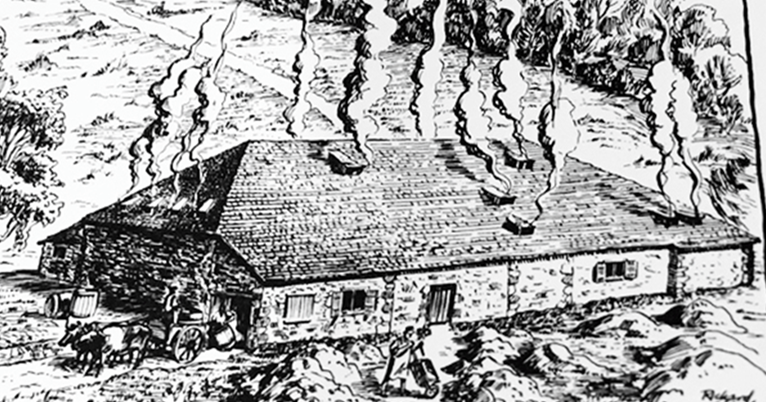 Tentative reconstruction of the Amelung glasshouse, as suggested by archaeological excavations
(from Lanmon and Palmer 1976).
Tentative reconstruction of the Amelung glasshouse, as suggested by archaeological excavations
(from Lanmon and Palmer 1976).
This wheel-engraved decanter would have been used to hold alcoholic beverages. The inside of the upper neck
of the bottle has been ground to help secure the stopper, which was usually made from glass. Decanters can
be dated by their body shapes and decoration. This particular decanter appears to have been made in the late
18th century.
References
Corning Museum of Glass
1963 Corning Museum of Glass Press Release, October 18, 1963, Corning New
York. Cited in National Register of Historic Places Inventory Nomination.
Lanmon, Dwight P., and Arlene M. Palmer
1976 The New Bremen Glass Manufactory. Journal of Glass Studies. Vol. 18,
pp. 25-38.
Maryland Journal and Baltimore Advertiser.
March 14, 1788.
National Register
1972 Amelung House and Glassworks. National Register of Historic Places
Inventory Nomination Form. http://msa.maryland.gov/megafile/msa/stagsere/se1/se5/011000/011000/011008/pdf/msa_se5_11008.pdf.
Accessed August 17, 2017.
Ruckert, Norman G.
1980 Federal Hill; A Baltimore National Historic District. Bodine and Associates, Inc.,
Baltimore.