This rather unusual ceramic vessel (Figure 1), curated at the Maryland Archaeological Conservation Lab, never fails
to fascinate people when I show it during tours. The straight sided canister was manufactured in England's Staffordshire
pottery district sometime between around 1790 and 1820 (Rickard 2006). Since this humble utilitarian storage vessel did
not have any maker's marks, the color and style of its decoration was used to assign its production date range.
.jpg) Figure 1. This refined white earthenware canister from the North Pearl Street site (18BC162) was recovered from a
privy filled during the first three decades of the nineteenth century.
Figure 1. This refined white earthenware canister from the North Pearl Street site (18BC162) was recovered from a
privy filled during the first three decades of the nineteenth century.
What makes this canister and other similarly decorated ceramics in the lab collections, so fascinating was how the
fernlike decoration was accomplished. These motifs were created using a "tea" solution containing ingredients such as
urine, tobacco juice, ground iron scale and hops. The potter released drops of the “tea” onto the wet surface of a
vessel coated with a solution of water and clay colored with metallic oxides (Figure 2). The design spread instantly
when the acidic solution came into contact with the slip (Sussman 1997). The tree or fernlike designs, were supposed
to resemble agate, also known as “mocha stone”—hence the popular name of this ceramic type as mochaware (Priddy 2004:171).
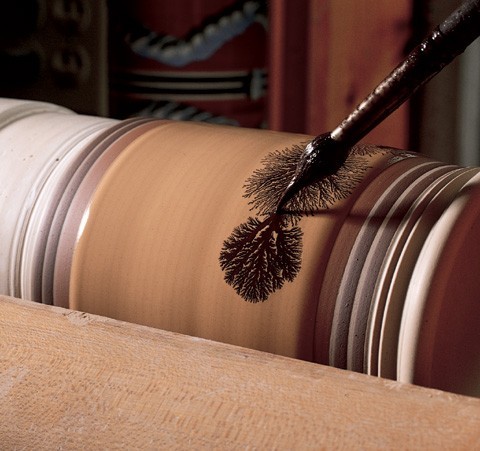 Figure 2. Mocha tea spreading out in branching patterns after being applied to a vessel. Image taken from
Carpentier and Rickard 2001, courtesy of The Chipstone Foundation.
Figure 2. Mocha tea spreading out in branching patterns after being applied to a vessel. Image taken from
Carpentier and Rickard 2001, courtesy of The Chipstone Foundation.
Archaeologists working on North Pearl Street in Baltimore discovered this 5.5 inch tall canister in a privy filled in the
early 1800s by the household of Bernard Zell. Zell operated a soap and candle manufactory nearby and, in 1830,
submitted a patent application to use steam in the candle and soap making process (Child 2007:71; Jones 1830).
The interior of the canister is heavily stained and its exterior glaze is flaking, suggesting that Zell may have stored
soft soap made with wood ash lye in it. Before Zell made soap and candles, he was listed in the 1803 Baltimore business
directory as a butcher. He may have become interested in this line of work as a way to use the quantities of animal
fat left over after butchering. Tallow, or rendered bovine fat, was a key component in both soap and candle making.
References
Carpentier, Donald, and Jonathan Rickard
2001 Slip Decoration in the Age of Industrialization. In Ceramics in
America 2001. Edited by Robert Hunter. Chipstone Foundation, Milwaukee, pp. 115-134.
Child, Kathleen M.
2007 "Phase I Archeological Investigations and Data Recovery of Feature 2-03,
UMB Block 25 (200 Block of North Pearl Street), University of Maryland, Baltimore, Baltimore, Maryland." R.
Christopher Goodwin and Associates, Inc. Report on file, Maryland Historical Trust, Crownsville.
Jones, Thomas P.
1830 Journal of the Franklin Institute of the State of Pennsylvania
Devoted to the Mechanic Arts, Manufactures, General Science and the Recording of American and Other Patented
Inventions. Volume V. Philadelphia: Franklin Institute.
Priddy, Sumpter
2004 American Fancy; Exuberance in the Arts, 1790-1840.
Chipstone Foundation, Milwaukee.
Rickard, Jonathan
2006 Mocha and Related Dipped Wares, 1770-1939. University
Press of New England, Lebanon, NH.
Sussman, Lynne
1997 Mocha, Banded, Cat’s Eye, and Other Factory-Made Slipware.
Studies in Northeast Historical Archaeology. Number 1. Boston University, Boston.