Some artifacts that pass through the Maryland Archaeological Conservation Laboratory (MAC Lab) remind us of the power of
x-rays! Archaeologists excavated this intriguing watch fob accessory at the Robinson Terminal South Site (44AX235,
Feature 104, Block 3, Fill 5) in Alexandria, VA (Figure 1), and it came to the MAC Lab for conservation treatment.
Before treatment, the artifact poked out from the voluminous corrosion of a strip of iron alloy. The chalcedony stone
oval is flat on both faces, engraved on one side with a figure, and set in a metal frame. The original size and shape
of the fob and its relation to the iron were unclear. The artifact was x-rayed at the MAC Lab to help answer these
questions and to aid conservators in cleaning.
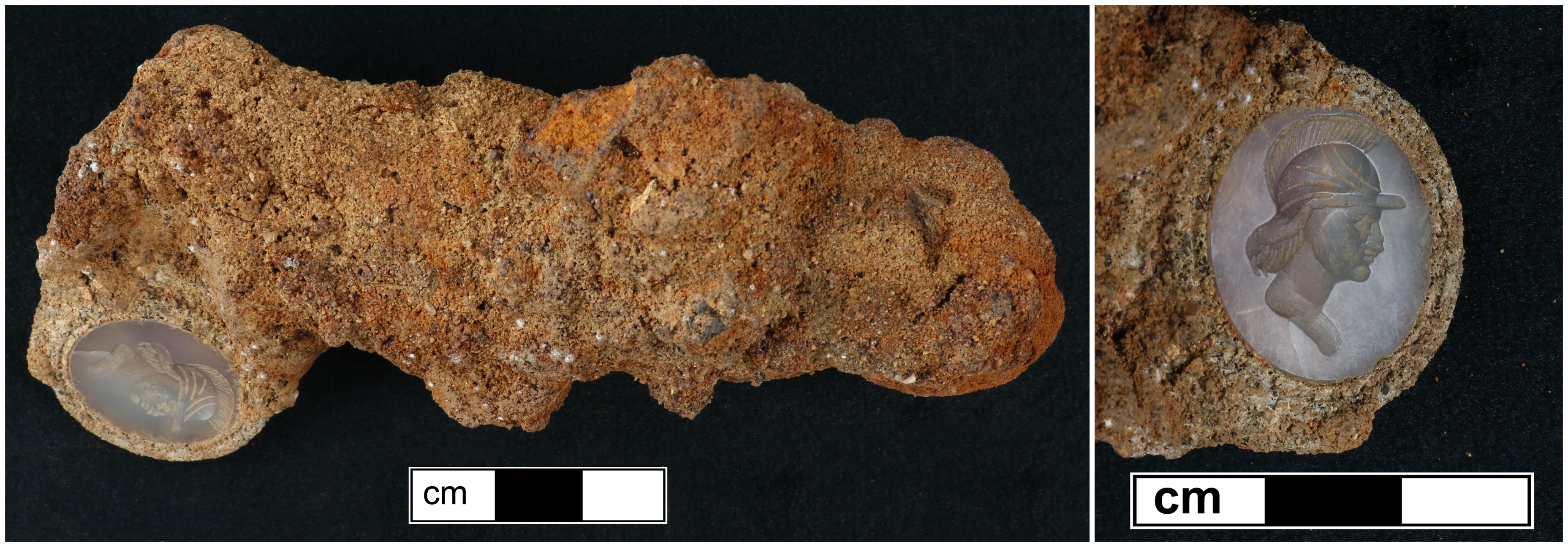 1. Chalcedony watch fob accessory and detail of engraving before treatment. Photos by Arianna
Johnston.
1. Chalcedony watch fob accessory and detail of engraving before treatment. Photos by Arianna
Johnston.
The radiograph shows a complete watch fob accessory with delicate openwork along the top of its frame (Figure 2). The
bright contrast in the radiograph indicates a denser metal than the surrounding corrosion and iron; the metal is
presumed to be predominately copper alloy, though gilding may be present. The radiograph also shows pins at the top
and bottom of the chalcedony frame that indicate the stone could spin. The iron is a thin folded sheet that is
severely corroded. No chain or jump ring attaches the iron to the seal frame, so their association remains unclear.
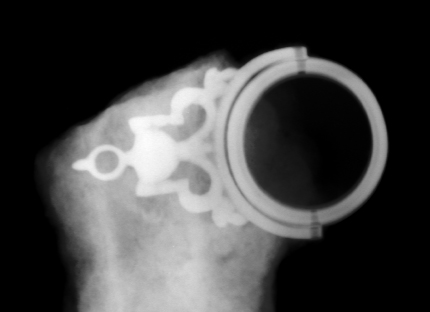 2. Radiograph shows intricate openwork and a spinning frame. X-ray taken by Arianna
Johnston.
2. Radiograph shows intricate openwork and a spinning frame. X-ray taken by Arianna
Johnston.
Watch fobs and their accessories were popular for both men and women in the late 18th and 19th centuries. Watch fobs
were worn at the waist, and while the watch may be tucked into a pocket, the accessories would hang from chains on
display. Accessories included seals, which were stone or glass set in a decorated metal bezel (Figure 3). The stones
were often engraved with initials or a family crest. Fob seals were sometimes used as a seal for documents, like a
signet ring, but more often, they were decorative, displaying status or wealth.
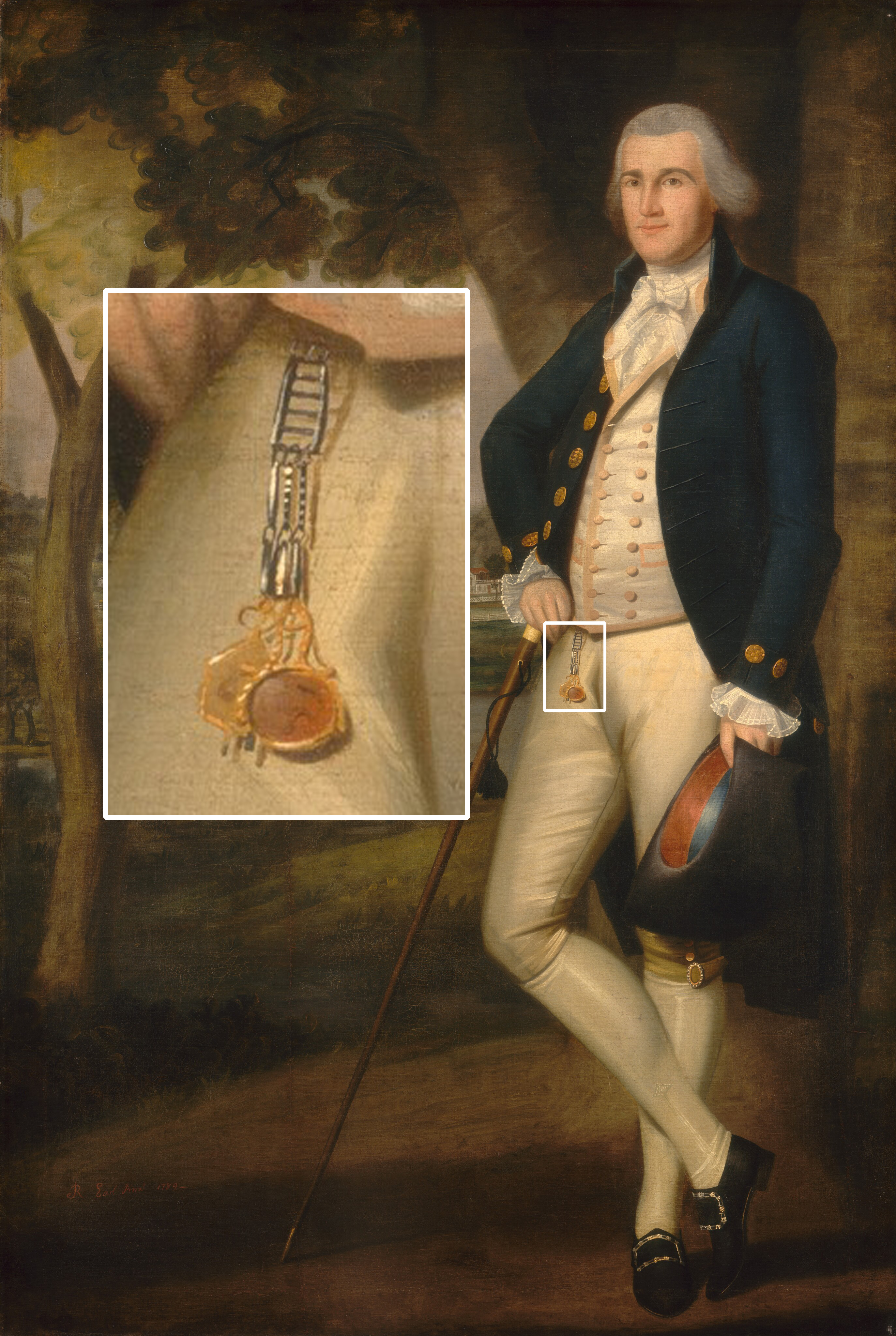 3. Daniel Boardman, 1789, wears a similar spinning fob seal. Painted by Ralph Earl. Image
courtesy National Gallery of Art, Washington.
3. Daniel Boardman, 1789, wears a similar spinning fob seal. Painted by Ralph Earl. Image
courtesy National Gallery of Art, Washington.
The conservation treatment for this artifact is ongoing. The next steps include freeing the fob from its iron alloy
companion and reducing the corrosion using mechanical cleaning methods. The metal will be treated with corrosion
inhibitors and a protective coating. Watch our social media for more updates!
References
Fales, Martha Gandy
1995 Jewelry in America: 1600-1900. Woodbridge, Suffolk:
Antique Collectors' Club.
Lester, Katherine Morris, Bess Viola Oerke, and Helen Westermann
2004 Accessories of Dress: An Illustrated Encyclopedia.
Mineola, NY: Dover Publications.
White, Carolyn L.
2005 American Artifacts of Personal Adornment: 1680-1820; A
Guide to Identification and Interpretation. Lanham, MD: Altamira Press.