Tortoise shell is a beautiful material. The color, translucence, and patterning continue to inspire its
imitation in modern accessories. Historically tortoise shell is produced from the shells of large sea
turtles, primarily the hawksbill and green turtle. The shell of the hawksbill turtle (Figure 1) is
particularly prized, and hunting of these animals drove them onto the endangered species list. Genuine
tortoise shell use has been greatly restricted following the ban under the Convention on International
Trade in Endangered Species (CITES) in 1973.
 Figure 1. Hawksbill sea turtle swimming. Image courtesy of the U.S. Fish
and Wildlife Service.
Figure 1. Hawksbill sea turtle swimming. Image courtesy of the U.S. Fish
and Wildlife Service.
The shell is made of keratin. As the turtle grows, new layers of keratin are added under the existing layers
creating growth rings. Keratin is a thermoplastic material, meaning that it can be shaped with heat. When
the keratin is removed from the bony under shell, it is then heated (boiled) and flattened under pressure. It
can then be molded and lathed into the desired form. Due to its thin construction, tortoise shell was used
as decorative inlays in furniture, snuff boxes, mirrors, and personal adornment such as jewelry and combs.
Tortoise shell is a luxury material. By the late 19th century, synthetic tortoise shell objects made of
celluloid were made widely available to supply the demanding market at a fraction of the price.
As an organic protein, keratin doesn’t survive well in most archaeological environments, and it is exciting
when tortoise shell artifacts are recovered, as in the cases of these 19th-century hair combs. These
artifacts were recovered from the Federal Reserve (18BC27) and Ruth Saloon (18BC79) sites in Baltimore
(Figures 2 and 3). Upon excavation, the layers of keratin had started delaminating and were very brittle.
Conservators at the Maryland Archaeological Conservation Laboratory took advantage of the thermoplastic
properties of the material and used heat together with a heat sensitive adhesive to reassemble the
layers and return the tortoise shell comb to an approximation of its original shape. Following the
elaborate hair stylings of the late 18th century, the Victorian period of fashion admired neat updos
and combs became a popular and fashionable styling accessory (Figure 4).
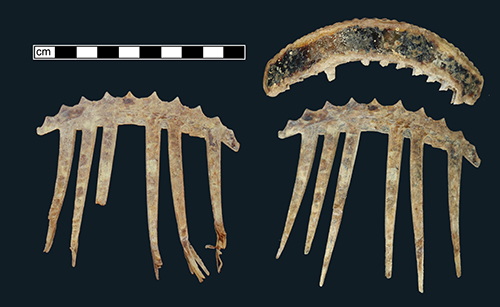 Figure 2. Before and after treatment photographs of a tortoise shell comb from Federal
Reserve (c. 1850-1870 context).
Figure 2. Before and after treatment photographs of a tortoise shell comb from Federal
Reserve (c. 1850-1870 context).
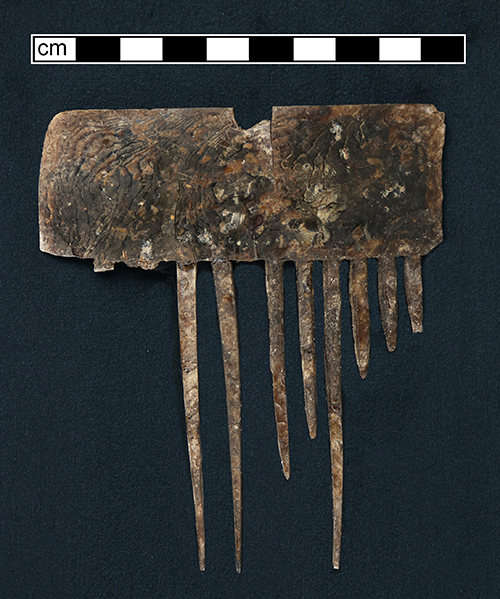 Figure 3. Tortoise shell comb from Ruth Saloon (late 1830s context).
 Figure 4. Onésipe Aguado de las Marismas [Woman Seen from the Back], c. 1862. Image
courtesy of the Metropolitan Museum of Art.
Figure 4. Onésipe Aguado de las Marismas [Woman Seen from the Back], c. 1862. Image
courtesy of the Metropolitan Museum of Art.
References Cited
Mossman, Susan
2008 Fantastic Plastic: product design and consumer culture.
London: Black Dog Publishing.
NOAA Fisheries' Species Directory
n.d. Available online (https://www.fisheries.noaa.gov/species/hawksbill-turtle).
O'Connor, Sonia, Caroline Solazzo, and Matthew Collins
2015 Advances in identifying archaeological traces of horn and other
keratinous hard tissues, Studies in Conservation, 60:6, pp. 393-417.