Iron is one of the more problematic materials for archaeologists and curators. After being
preserved beneath the ground for hundred of years, it becomes very unstable once removed and
quickly begins to deteriorate. Conserva-tors use techniques to reveal and preserve iron
artifacts that can be labor intensive, need specialized chemicals and equipment, and expensive.
Everyone would like an inexpensive, quick method of preservation but it doesn't currently
exist. Unfortunately, the internet has promoted a method, Electrolysis, as a magic treatment
without understanding how it works or the damage that it can inflict.
Electrolytic reduction (ER) is a type of electrolysis using an electrolytic cell which converts
electrical energy into chemical energy to drive a non-spontaneous redox reaction. The artifact
serves as the positively charged cathode and the negatively charged chloride ions migrate away
from the arti-fact into the solution or toward the anode. When excess energy is applied to the
electrolytic cell, the water in the solution will decompose and produce hydrogen gas. ER can be
used in very specific applications for desalinating iron as well as an aid in corrosion removal.
It is NOT a recommended tech-nique for most archaeological artifacts as chemical reactions can
be difficult to control and artifacts can be easily damaged. ER does not differentiate between
the bulky outer corrosion products and the dense corrosion layers that make up the object's
original surface. Without close controls, it is easy to strip artifacts so that only the core
metal remains while destroying surface detail.
The example provided by this archaeologically recovered horseshoe illustrates the damage and loss
of information that can occur when an arti-fact is subjected to electrolysis. Upon visual
inspection the object is robust (Figure 1), but x-radiography shows a different story. The
object is more heavily degraded than it initially appeared. The original surface of the object
is suspended in the corrosion products and visible only in outline (Figure 2). The rope-like
structure of the wrought iron is an indicator of the deteriora-tion. While the metal core is
present in some areas of the object, one quarter of the horseshoe has been completely replaced
by corrosion product (Figure 3). Any treatment would be more damaging to the artifact than
preserving the corrosion product that is providing protection to the remaining metal. This
horseshoe was exposed to ER to illustrate the extent of loss and damage this process can incur.
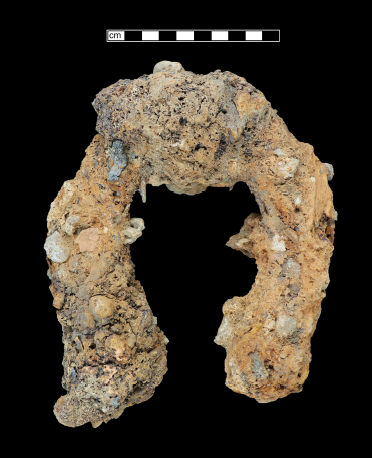 Figure 1. Horseshoe before treatment.
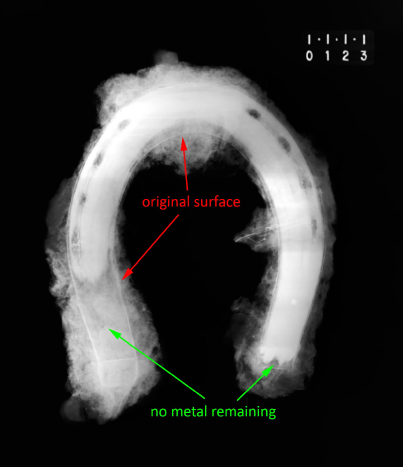 Figure 2. X-ray of horseshoe showing outline of original surface and material
loss.
Figure 2. X-ray of horseshoe showing outline of original surface and material
loss.
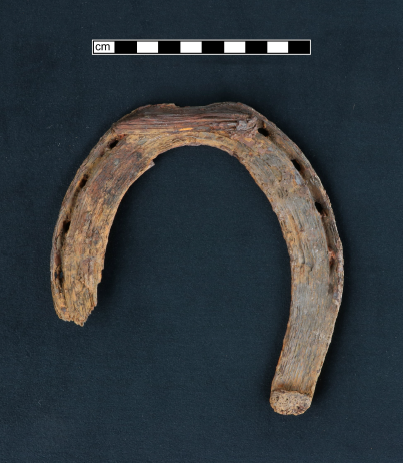 Figure 3. After electrolytic reduction which destroyed all origi-nal surfaces
and exposes metal core.
Figure 3. After electrolytic reduction which destroyed all origi-nal surfaces
and exposes metal core.
Without the x-ray images, archaeologists would have lost all the original dimensional and surface
information. The x-ray also indicates to conservators that this object is not a good candidate
for an expensive treat-ment process. X-radiography is a very good, inexpensive means to survey
metal collections. It can provide accurate identifications, provide diagnostic measurements,
and record preservation conditions. The MAC Lab is an excellent resource for x-radiography
services, but you can also build relation-ships with local doctors, dentists, security
offices (i.e., courthouses), large an-imal veterinarians, etc. to help image your artifacts.
Accurate recording of ar-tifacts is a superior option to destroying data with inappropriate
preservation methods.