Old Baltimore (18HA30) was the first county seat of Baltimore County in the 17th century, and the site
is currently located on the U.S. Army Garrison Aberdeen Proving Ground. In the late 1990s archaeology
conducted by R. Christopher Goodwin and Associates at the Old Baltimore site resulted in the discovery
of a bottle seal with an elaborate coat of arms (Figure 1).
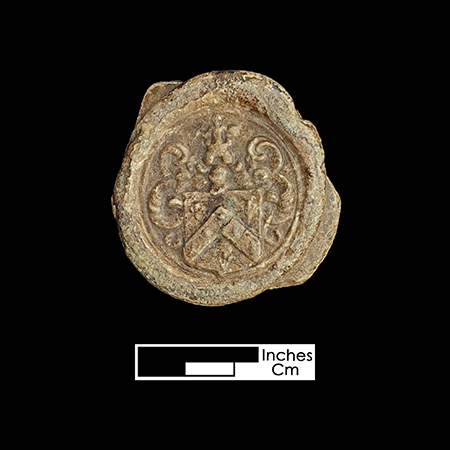 Figure 1: Heraldic bottle seal from Old Baltimore (18HA30/180). Courtesy U.S. Army Garrison Aberdeen
Proving Ground.
Figure 1: Heraldic bottle seal from Old Baltimore (18HA30/180). Courtesy U.S. Army Garrison Aberdeen
Proving Ground.
Bottles made of thick dark green glass were adopted in the 17th century to help store, serve, and ship wine.
Some bottles were "sealed" by having a personal identifier such as initials, a full name, a coat of arms, or
a merchant mark impressed into a blob of hot glass affixed to the bottle (Figure 2). This mark of ownership
was symbolic of status, but also helpful when bottles were shipped long distances. Plain bottles were cheaper,
but personalization was on trend for those who could afford it. For this bottle seal, the coat of arms and
family crest are clear, but archaeologists and historians have yet to determine what family they represent.
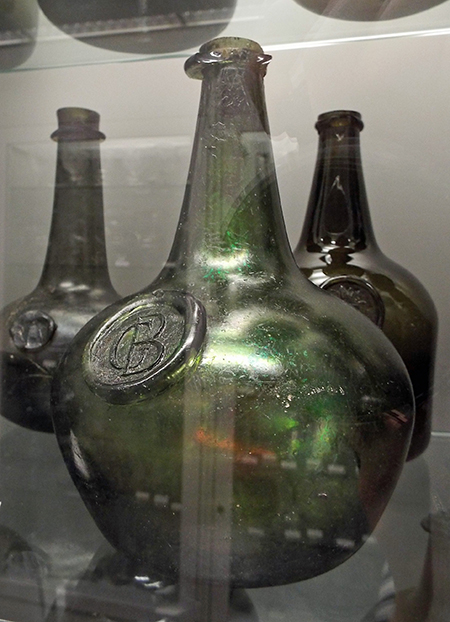 Figure 2: 18th-century sealed wine bottles on display in visible storage at the Corning Museum of
Glass.
Figure 2: 18th-century sealed wine bottles on display in visible storage at the Corning Museum of
Glass.
Excavations at Old Baltimore focused on a residence occupied by James and Susan Phillips and their children James,
Anthony, Margaret, and Martha. James Phillips came to own the property in 1678 by marrying Susan Orchard, widow
of the previous owner William Orchard.
James Phillips was born in Sedgeley, Staffordshire England in 1642 to Anthony and Joyce Parks Phillips. Emigration
to Maryland apparently helped him make his fortune, because when he died in 1689, he was one of the wealthiest
men in Baltimore County with an estate worth £426. Five unnamed enslaved individuals and an unnamed English woman
who was an indentured servant appeared in Phillips’ probate inventory as part of the household. The estate was
divided among the children, with the bulk going to James Phillips (II), especially after Anthony Phillips died
in 1699.
Most of the artifacts recovered at Old Baltimore likely represent the domestic life and work of the Phillips family,
slaves, and servants, but they also hosted a lot of visitors. The Phillips’ home was a public house or "ordinary"
that lodged people passing through on the ferry or convening at Baltimore Town for court sessions. Phillips held an
ordinary license by 1683, meaning that he was required to provide food, beverages, and sleeping accommodations at
prices fixed by legislation. So many people stayed with the Phillips family that by the time James (I) died, at
least 240 people owed him a total of 269,502 pounds of tobacco— the equivalent of £1,123! Nearly half of these
debts were unenforceable because the debtors died insolvent or ran away.
Why is this relevant to the bottle seal? Well, I have looked for a Phillips family crest that resembles this seal
with no luck, making me wonder if it is from one of the lodgers instead. Robust personalized bottles were great
for shipping wine, but once the initial beverage was gone, they would be ripe for reuse. It might be handy to have
one's own marked bottle to refill from available casks when visiting the local ordinary.
The bottle seal shows a "heraldic achievement" with a shield representing a coat of arms, a left-facing helmet with
the visor closed, and a crest above the helm that depicts a tower or rampart guarded by a human figure holding an
arrow and a shield (Figure 3). The closest match to the coat of arms I have found is that of the surname Arnold,
which has three downward pointing arrows around a chevron with an ermine pattern (Figure 4). Unfortunately, it is
the crest over the helmet that helps specify the family group, and I have been unable to find any crest specific
to Arnolds who emigrated to Maryland in the 17th century. Arnolds were certainly here, both in Anne Arundel County
in the 17th century and in Baltimore County by the early 18th century, but so far, I’ve seen no evidence of their
connection to Phillips family. Were Arnolds among the people who stayed at the Phillips public house? Or is the
coat of arms a match for another family?
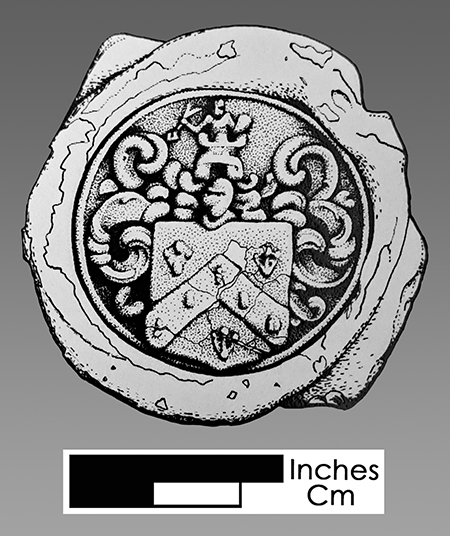 Figure 3: Drawing of the Old Baltimore bottle seal, 18HA30/180. Adapted from Davis et. al. 1999.
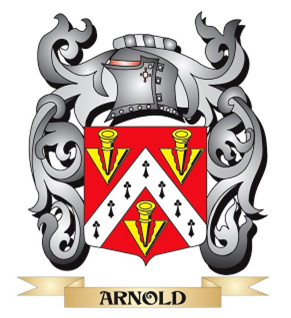 Figure 4: Example of an Arnold coat of arms from cafepress.com.
For now, this heraldic bottle seal remains a mystery. If you’ve read this far and want to try your hand at heraldic
research, maybe you can crack the case! If anyone out there has seen this crest, let me know
at [email protected].
References Cited
Davis, Thomas W., Martha R. Williams, William H. Lowthert, Andrew Madsen, S. Fiona Bessey, and
Anthony Randolph
1999 Archeological investigations at the site of Old Baltimore, Aberdeen
Proving Ground, Harford Co., Md. Report on file with the Maryland Historical Trust.