Each day brings new discoveries in archaeological collections. While rehousing the Poplar
Island Reclamation Project artifacts, I came across an intriguing medical bottle. Bottles
rarely survive intact in archaeological collections as they are often discarded after being
broken, so they end up in the archaeological record. Otherwise, post-depositional processes
break the bottle. This bottle was a unique case as it was collected from the surface of the
beach on North Point Island (18TAX5). Imagine my excitement when I pulled an intact, aqua
glass bottle embossed with “Dr. Pierce’s Golden Medical Discovery.” The bottle has a Davis
lip finish, and the principal investigator’s lab dated it to 1874-1894 (Fehr et al. appendix V
1996, 7). I was curious who this Dr. Pierce was and whether his medicine was snake oil or an
effective drug.
.jpg) Figure 1. Aqua medical bottle collected in North Point Island survey. The face
is embossed "DR. PIERCE'S GOLDEN MEDICAL DISCOVERY." The sides are embossed "BUFFALO N.Y."
and "R.V. PIERCE M.D.," respectively.
Figure 1. Aqua medical bottle collected in North Point Island survey. The face
is embossed "DR. PIERCE'S GOLDEN MEDICAL DISCOVERY." The sides are embossed "BUFFALO N.Y."
and "R.V. PIERCE M.D.," respectively.
It turns out Dr. Pierce was an innovator in the field of early American patent medicine. As
the name suggests, patent medicine originally referred to medical products that individuals
patented to protect their formulations. The term now refers to the numerous proprietary medicines
hawked in America once English imports no longer brought in enough profits compared to American
formulas (Tharp 1988, 7). Dr. Pierce took advantage of a gap in the market to great success.
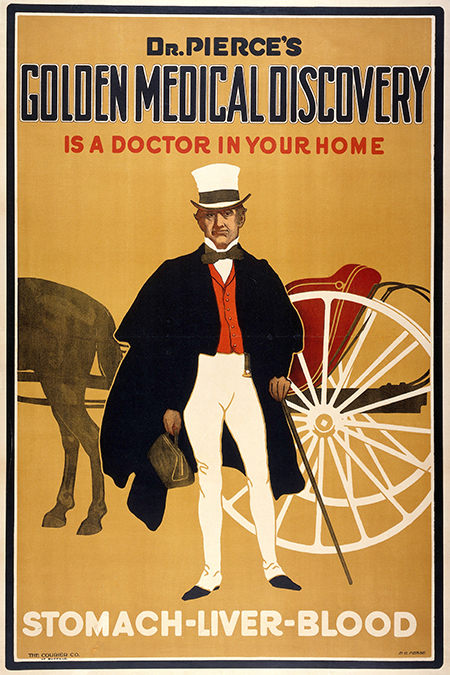 Figure 2. A 1910 color lithograph by E.C. Pease for Dr. Pierce's Golden Medical Discovery.
The ad underscores Pierce’s belief that people should have the choice to treat their medical
conditions at home. Courtesy of the Wellcome Collection.
Figure 2. A 1910 color lithograph by E.C. Pease for Dr. Pierce's Golden Medical Discovery.
The ad underscores Pierce’s belief that people should have the choice to treat their medical
conditions at home. Courtesy of the Wellcome Collection.
Ray Vaughn Pierce began his career producing patent medicine in Buffalo, New York in the late
1860s. The so-called doctor may not have earned a medical degree! He alleged that he graduated
from the Philadelphia University of Medicine and Surgery despite not completing the necessary
coursework. Evidently in 1865, he did earn an MD from the Eclectic Medical Institute of
Cincinnati. Pierce, like other eclectic practitioners, believed that traditional medical
interventions were not safe, and that people should turn to natural remedies (Gevitz 1990,
164-5). His Golden Medical Discovery purportedly cured any number of chronic conditions,
including tuberculosis, arthritis, and malaria. He provided no scientific evidence of these
"cures" besides user testimonies which were always positive (Gevitz 1990, 167). It seems
likely that the medicine was useful only as placebo. In addition to patient testimonies,
Pierce wisely employed newspaper and magazine advertisements to spread the word about his
products (Gevitz 1990, 165). Much like drug companies today create commercials advertising
their medications, Pierce’s creations entered the public consciousness through his ubiquitous
advertisements. And his legacy lives on, at least in the archaeological records, through the
embossed bottles. This bottle shows how practicing good museum collections management allows
for new discoveries, even in 25+ year old collections!
References Cited
Fehr, April, David S. Robinson, Martha Williams, John L. Sediel, Jack Irion,
and Donald Maher
1996 Phase I Terrestrial and Marine Archeological Surveys
for the Poplar Island Reclamation Project and Phase II Investigations of Site 18TA237 and Six
Marine Anomalies, Talbot County, Maryland. Prepared for GBA-M&N A Joint Venture.
Gevitz, Norman
1990 "Dr. Pierce's 'Golden Medical Discovery': A 'Prince
of Quacks' in the 'Queen City.'" The Journal of Medical Humanities 11, no. 4 (December):
163-177. https://doi.org/10.1007/BF01138999.
Tharp, Brent W.
1988 "Elixirs, Drops, Powders, and Pills: The Origins and
Foundations of the American Patent Medicine Industry." MA thesis, The College of William and Mary, VA.