“Play is often talked about as if it were a relief from serious learning. But for children, play is
serious learning.” - Fred Rogers
In 1869, Malinda Adams Jackson purchased the 8.2-acre tract where she and her family had lived while they were enslaved by the Downs family.
She, and then her descendants, lived there for roughly the next 45 years, building and adding additional structures to the property.
In 1915, the house burned down and shortly after the property was sold. Since the structure had accidentally burned down,
many of the artifacts recovered during excavations would have been in use while it had been occupied by the Jackson family (Furgerson et al 2011).
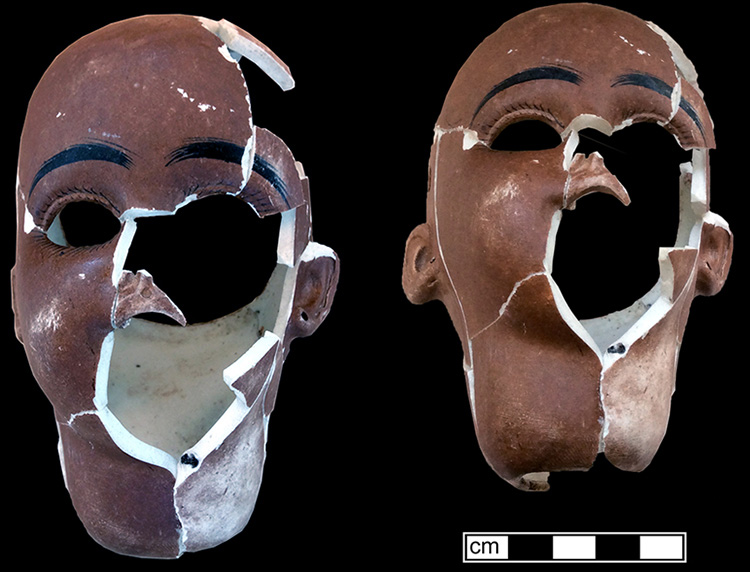 Figure 1. Painted bisque porcelain doll head from the Jackson Homestead Site (18MO609).
These mended doll head fragments are made of painted bisque porcelain and were recovered in the upper layers of the cellar associated with the Jackson’s dwelling (Figure 1).
Since the fragments were in the upper layers of soil, the doll may have been in an upper level of the house that collapsed over the cellar after or during the fire.
Doll parts are not uncommon on later 19th and early 20th century sites, but the Jackson homestead doll is unique in that it had colored skin.
European mass-produced porcelain dolls became popular during the mid-19th century and were primarily made in Germany and France. While dolls were available in a wide variety
of sizes and styles, of the millions of dolls produced from the second half of the 19th century and into the early 20th century, a very small percentage of these featured skin tones other than White.
When Black dolls were produced, they often had exaggerated and caricatured features that reflected racialized stereotypes of the era.
In response to this, Black entrepreneur, Richard Henry Boyd, commissioned a German doll company to create dolls that, “truly convey, not caricaturize, the likeness of their black subjects”.
Boyd’s company, the National Negro Doll Company, was rooted in activism and sought to combat racist depictions of Blacks during the Jim Crow era (Figure 2). ). In its inaugural holiday season
(1908-1909) the National Negro Doll Company sold 3,000 dolls to consumers across the country (Gordon 2017). Boyd and his stakeholders understood that play is how children learn what behavior is acceptable,
how to communicate, to negotiate, and about the place they occupy and will someday occupy in society. His goal was to provide dolls which conveyed, “that there is some pride, some merit, some worth and something to be admired in dark skin.” (Gordon 2017) (Figure 3).
Recent neuroscience has shown, in the brain, what Boyd knew to be true. That doll play, in particular, activates, “parts of children’s brains involved in empathy and social processing skills” and highlighting the importance of diversity in dolls (Cardiff University 2023).
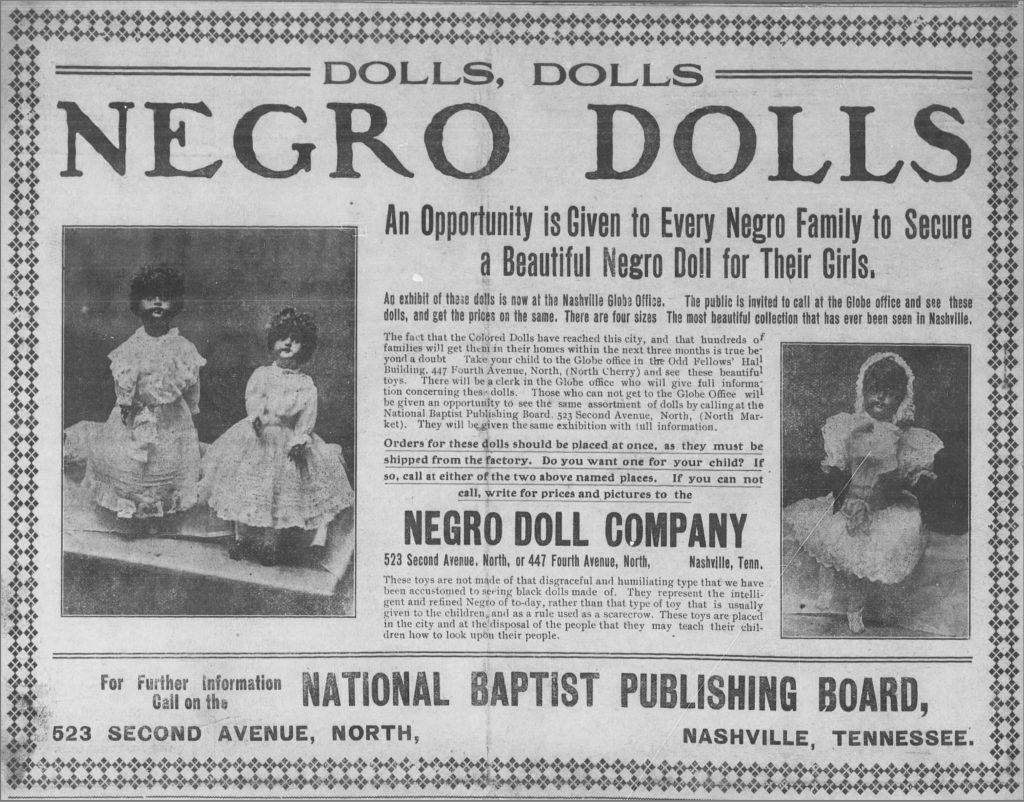 Figure 2. Advertisement for Boyd's porcelain dolls. Nashville Globe, 28 August 1903 (image from Gordon 2017).
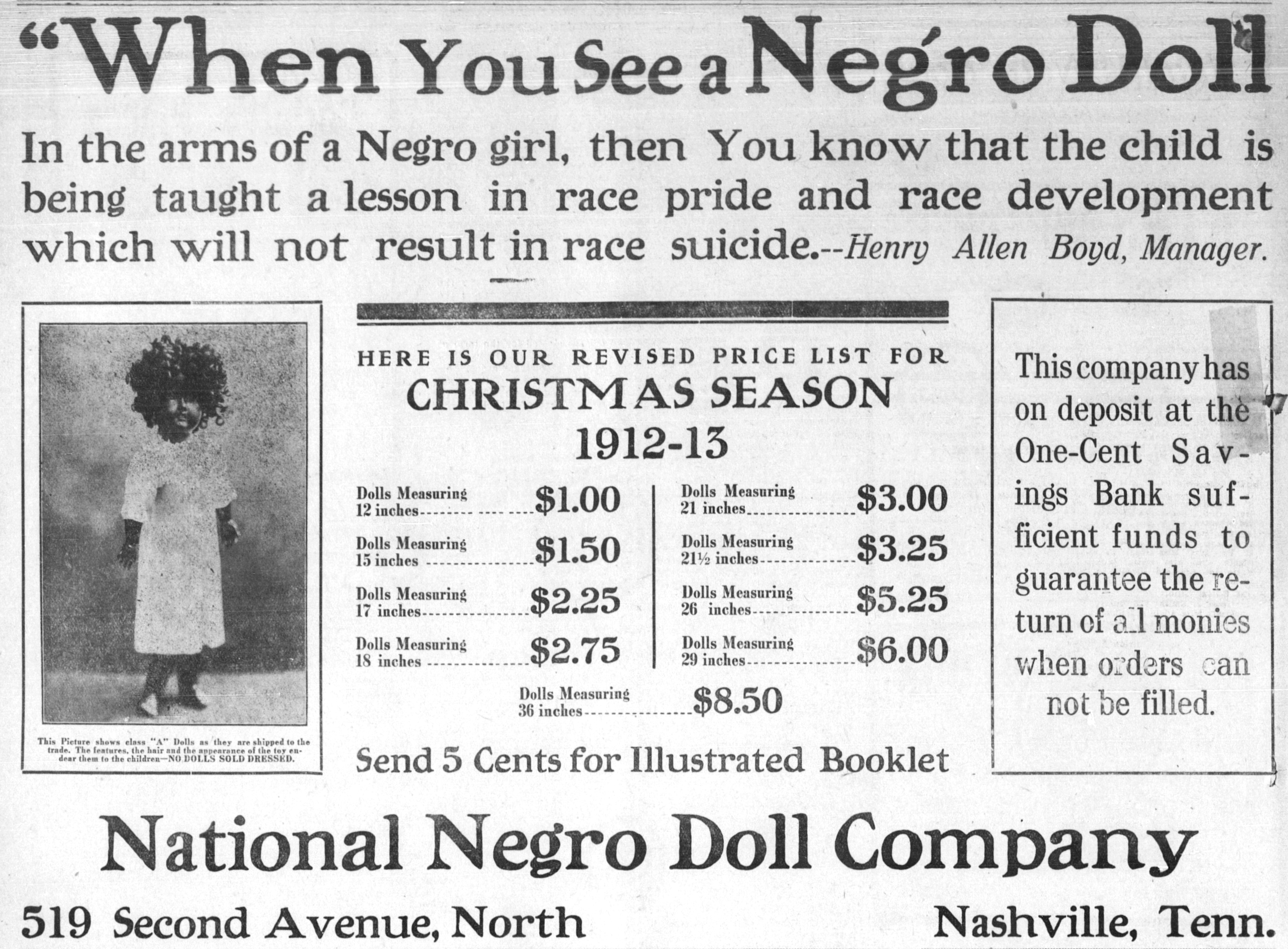 Figure 3. Newspaper advertisement for National Negro Doll Company for the 1912-1913 holiday season. A 12" doll cost $1.00 in 1912 and was roughly equivalent to $32 in 2024 (US Bureau of Labor Statistics)
References
Ferguson, Kathleen, Varna Boyd, Carey O'Reilly, Justin Bedard, Tracy Formica, and Anthony Randolph, Jr.
2011 Phase II and III Archaeological Investigations of the Fairland Branch Site and the Jackson Homestead (Site 18MO609),), Intercounty Connector Project, Montgomery County, Maryland.
Prepared by the URS Corporation for the Maryland State Highways Administration. SHA Archaeological Report No. 426. MHT Report #MO 278.
Gordon, Skyler
2017 The National Negro Doll Company. Tennessee Historical Society Blog,
https://tennesseehistory.org/national-negro-doll-company/ accessed online, 27 January, 2025.
Cardiff University
2023 “Doll play allows children to develop and practice social skills regardless of their neurodevelopmental profile” Cardiff University News,
https://www.cardiff.ac.uk/news/view/2767392-doll-play-allows-children-to-develop-and-practice-social-skills-regardless-of-their-neurodevelopmental-profile#:~:text=The%20findings%20build%20on%20previous,about%20others'%20thoughts%20and%20emotions
,accessed online, 27 January 2025.
US Bureau of Labor Statistics
2025 CPI Inflation calculator,
https://www.bls.gov/data/inflation_calculator.htm