The Stearns site (18CV17) is a multi-component pre-Contact site located here at
Jefferson Patterson Park and Museum. The site gets its name from Richard Stearns,
who was the curator for the Department of Archaeology at the Natural History Society
of Maryland in the early 20th century. Stearns located the site by boat in the 1930s
because of the presence of an expansive and thick shell midden (Stearns 1943).
Stearns only visited the site once and collected a curious decorated stone artifact.
First believing it to be a broken bannerstone, what he actually found was part of a
carved stone pipe stem. He described the material as “a brownish stone with a very
gritty texture, somewhat like sandstone.” On the bottom were four engraved rectangles,
which he noted were similar to examples found in the Shenandoah Valley, though he did
not elaborate further (Figure 1). The object is currently curated at the Smithsonian.
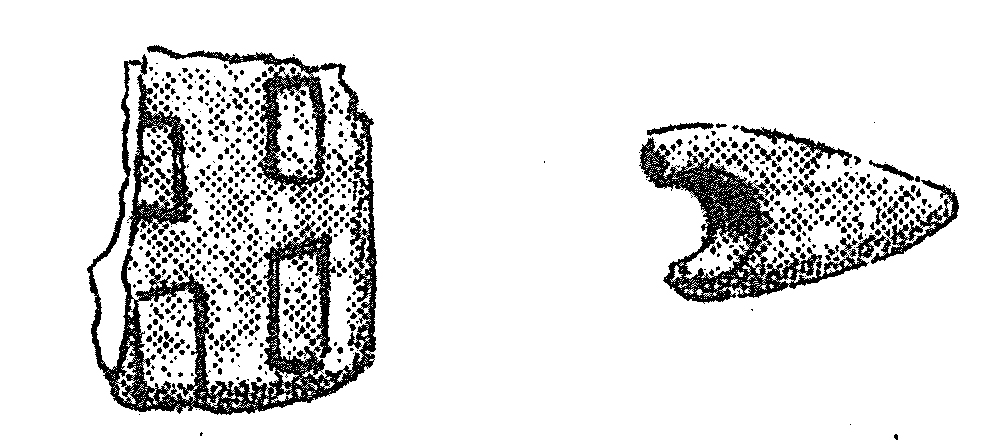 Figure 1: Drawing of the decorated base (left) and profile (right) of the
stone pipe found by Richard Stearns (Stearns 1943).
Figure 1: Drawing of the decorated base (left) and profile (right) of the
stone pipe found by Richard Stearns (Stearns 1943).
Fast-forward to 1980 when Lana Brown, a tenant living on the Patterson’s Point Farm,
found a number of artifacts from the same site (Clark and Smolek 1981). A curious
pipe collected by Brown was found along a stretch of beach that had eroded out of
an exposed storage pit feature. This pipe was different, as it was made of red clay,
and more elaborately decorated using cord-wrapped stick impressions (Figure 2). Like
the stone pipe found by Stearns about 50 years prior, this example had a series of
rectangles along the bottom.
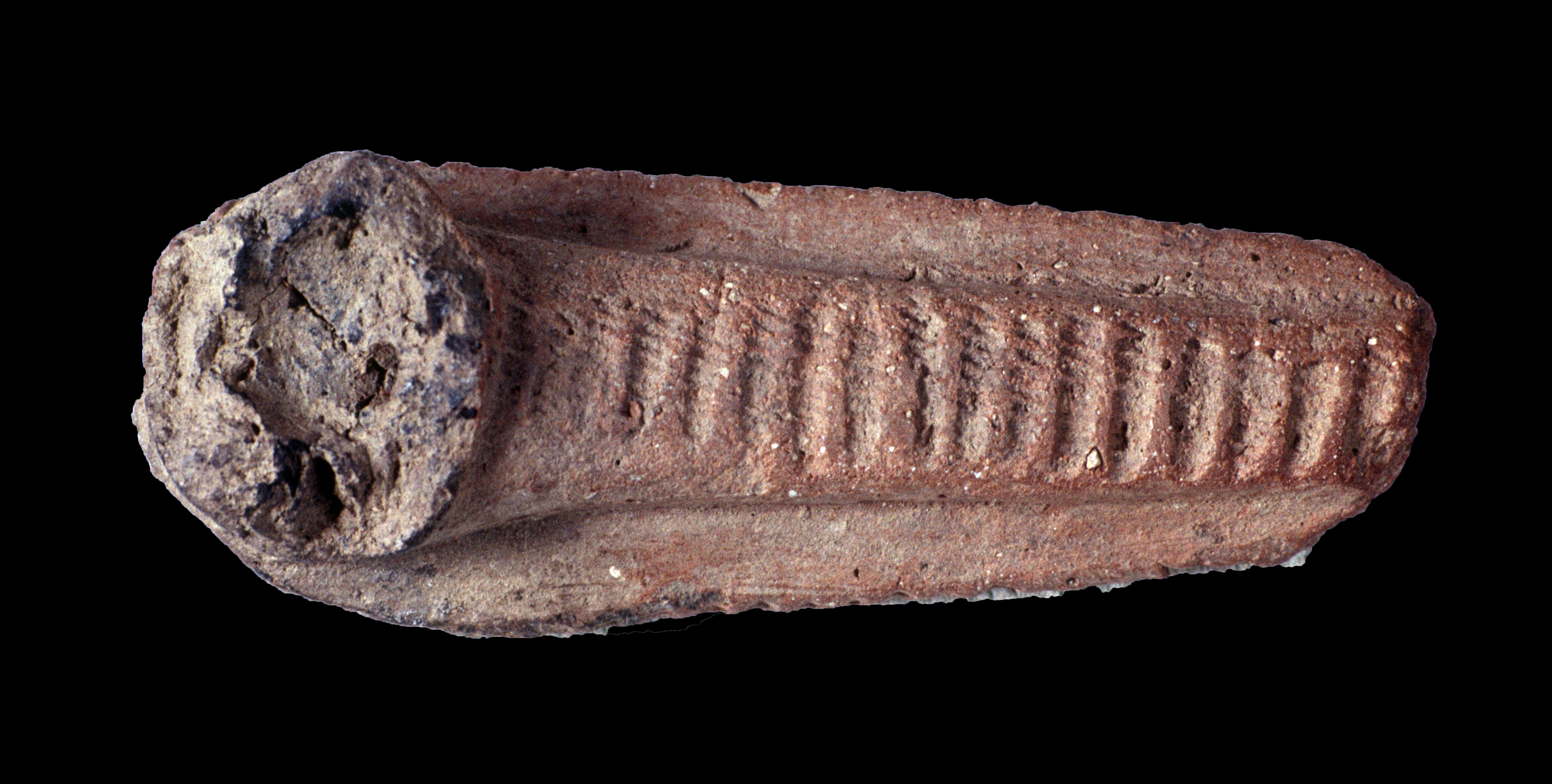 Figure 2: Photo of red clay pipe recovered by Lana Brown with impressed
decoration and alate or winged platform.
Figure 2: Photo of red clay pipe recovered by Lana Brown with impressed
decoration and alate or winged platform.
What is particularly notable about each pipe is its form. These pipes were either a style
known as a platform or bent tube pipes. Platform pipes are most often associated with
the Hopewellian tradition (known as “mound builders”) of the Middle Woodland period
in the Ohio Valley (roughly 100 BC to 500 AD).East of the Ohio Valley this style has
been found in contexts that extend well into the Late Woodland period (900 to 1600 AD).
The clay pipe found by Brown is likely a variation of an alate (meaning “winged”
or “wing-like”) stemmed platform or bent tube pipe. Bent tube pipes have been
reported as appearing primarily on sites dating to the first part of the Late Woodland
period (Bollwerk 2012).
Both styles are considered precursors to the more commonly found Late Woodland period pipes
where the bowls bend away from the base at an obtuse angle known as elbow pipes. Bent
tube style pipes have been described as a transitional style between platform and
elbow pipes (MacCord 1966). Both styles have been interpreted as being items of prestige,
due in part to their rarity and that they have been found in mound contexts at sites
further to the west. At the Stearns site, these items were recovered from eroding
shell middens and storage pits, and were likely items acquired through trade (Figure 3).
How they were used when the site was occupied is unclear.
 Figure 3: Archaeologists Paula Mask (left) and Gretchen Seielstad (right)
excavating above an eroding storage pit feature at the Stearns site in the 1980s.
Figure 3: Archaeologists Paula Mask (left) and Gretchen Seielstad (right)
excavating above an eroding storage pit feature at the Stearns site in the 1980s.
References
Bollwerk, Elizabeth Anne
2012 Seeing What Smoking Pipes Signal(ed):
An Examination of Late Woodland and Early Contact Period (A.D. 900-1665) Native
Social Dynamics in the Middle Atlantic. Dissertation, Department of Anthropology,
University of Virginia.
Clark, Wayne E., and Michael A. Smolek
1981 The Patterson Estate on St. Leonard
Creek: An Archeological Site Inventory. Maryland Historical Trust Manuscript
Series No. 16.
MacCord, Howard A., Sr.
1966 The Mclean Mound, Cumberland County,
North Carolina. In Southern Indian Studies, XVIII: 3-45.
Stearns, Richard E.
1943 Some Indian Village Sites of Tidewater,
Maryland. In The Natural History of Maryland, Proceeding No. 9, Baltimore.