The Maryland Archaeological Conservation Laboratory (MAC Lab) curates over 10 million
artifacts, but I am still surprised by the unique artifacts that are in our collections.
When our staff visited the Doepkens family farm in 2024 to evaluate the Middle Plantation
(18AN46) collection, I saw stunning fragments of amber glass with light blue marbling
(Figure 1). I was immediately intrigued. Upon returning to the Lab and investigating our
type collections, I discovered that kind of glass was not represented. While we do have
a fragment of black glass with a white trailed pattern from the Angelica Knoll (18CV60)
collection, the design is not the same nor is the color of the glass (Maryland Archaeological
Conservation Laboratory, 2002).
The fragments come from an intricate type of glasswork known as façon de Venise, French
for “in the Venetian style.” Venetian artisans originated this technique during the
Renaissance. However, glassworkers in other locations replicated the style so exactly
that it is difficult to know whether the glass originated in Venice or elsewhere in Europe.
Hence why archaeologists use the term façon de Venise to encompass that uncertainty
(Grulich 2004, 4). Façon de Venise was imported to the Colonies from Europe.
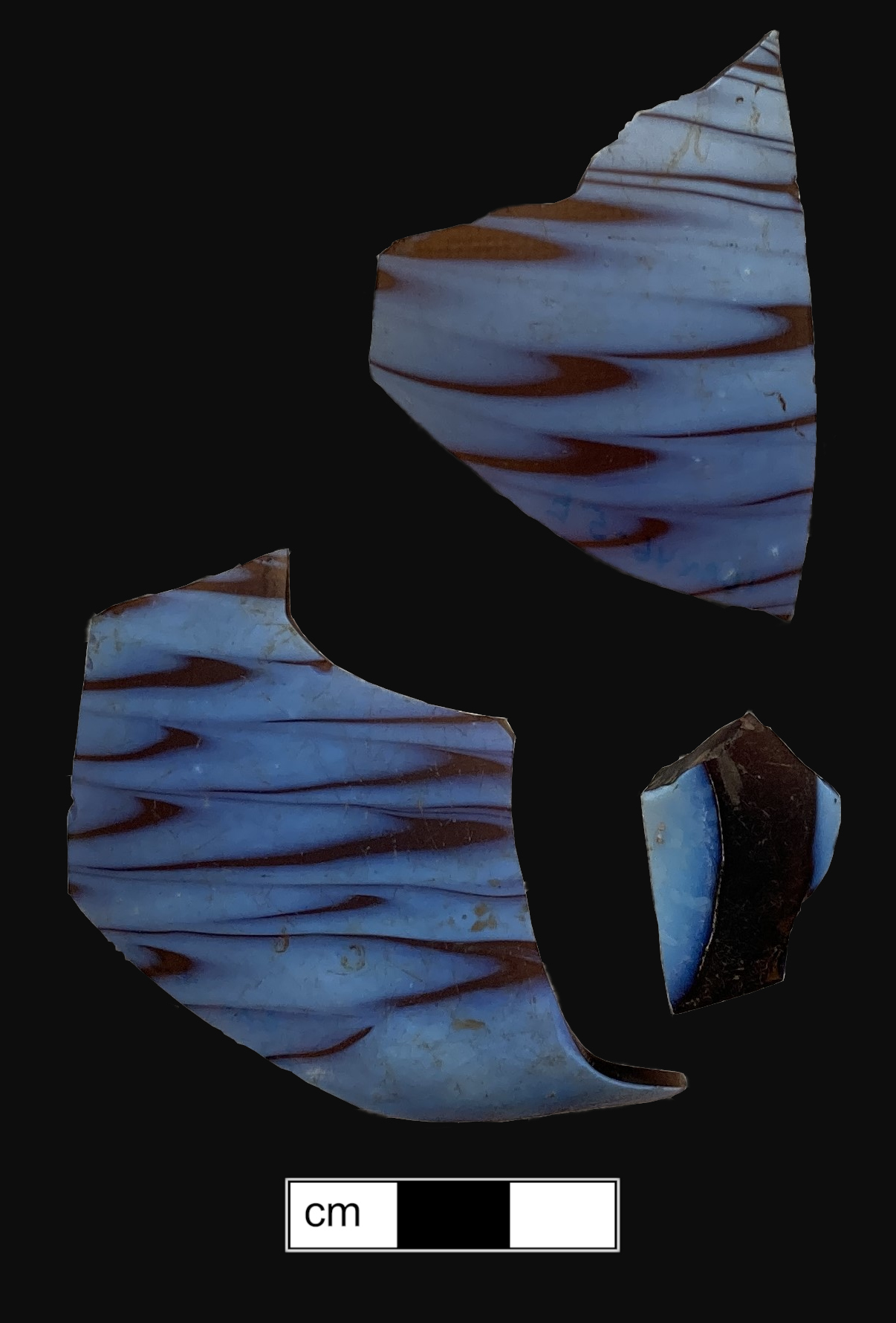 Figure 1: Fragments of amber glass with blue combed decoration from 18AN46.
The bottom right piece from 5NN is a base fragment. The other fragments come from 5E.
Figure 1: Fragments of amber glass with blue combed decoration from 18AN46.
The bottom right piece from 5NN is a base fragment. The other fragments come from 5E.
William Doepkens identified these as bottle fragments, but he did not specify the type of bottle
(Doepkens 1991, 149). MAC Lab staff believe the fragments may be from an oblong bottle,
such as a snuff bottle (Figure 2). The thicker piece from 5NN is a base fragment.
The glass is so thin and delicate in the fragments from 5E, much thinner than typical
bottle glass and characteristic of façon de Venise. As is often the case in archaeology,
we may never know definitively the sort of vessel these fragments were once a part of.
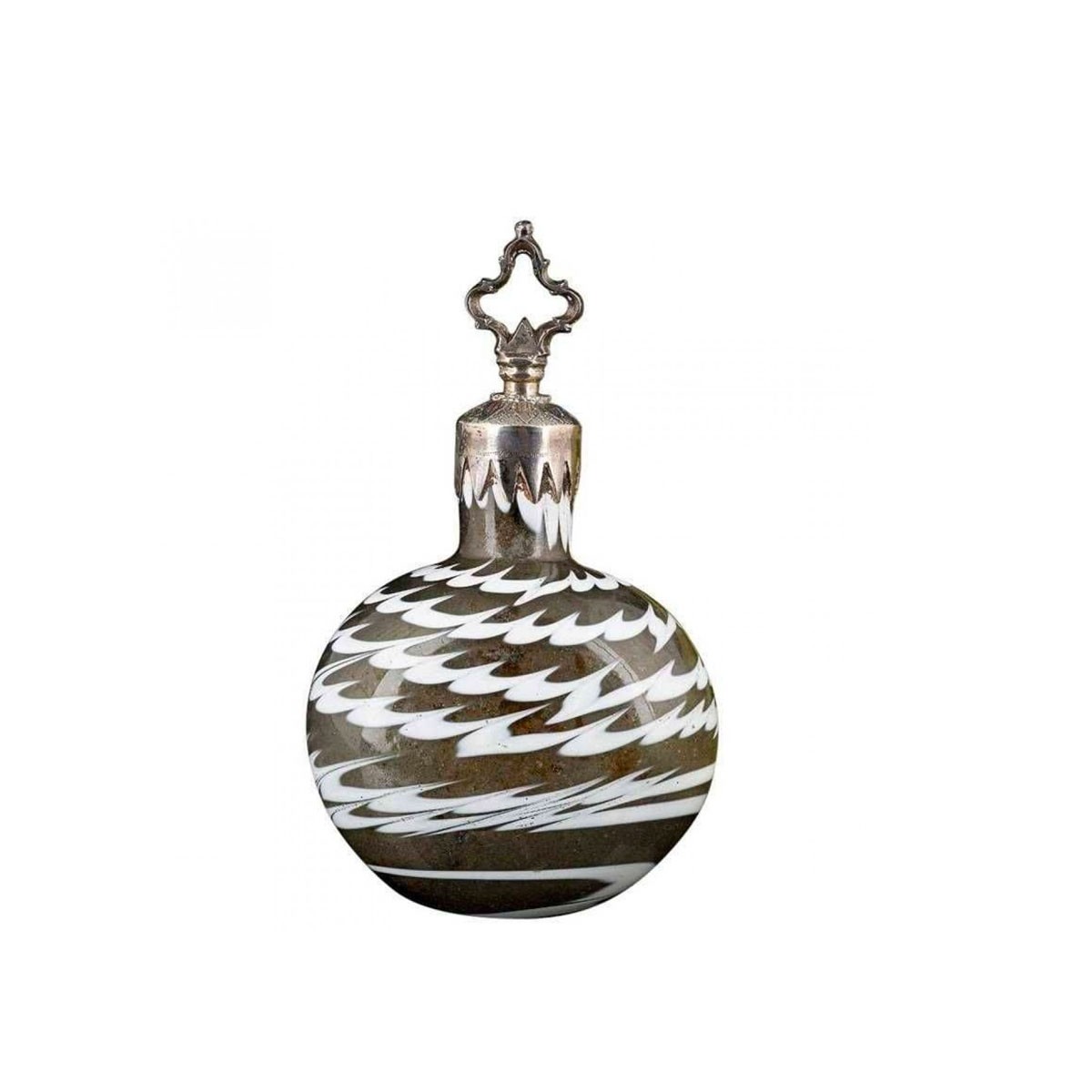 Complete 17th century snuff bottle with a silver stopper. Black glass with white
combed decoration.
Complete 17th century snuff bottle with a silver stopper. Black glass with white
combed decoration.
Façon de Venise is known for its detailed decorations that require great technical skill to
execute. The Middle Plantation fragments show a decorative technique called vetro a penne,
Italian for “feathered glass”. Artisans created the combed pattern by applying a colored
glass (in this case blue) onto the blown glass object while it was still hot. Then, they
smoothed the glass to adhere the two colors together. The object was then placed in a mold
that produced the combing (Grulich 2004, 37-38). A penne became popular in the 17th and
18th centuries, which aligns with the period when Middle Plantation was active (Tait
1979, 50).
In 1893, William Britain developed a process for hollow casting toy soldiers in lead and
this process remained popular into the mid-20th century, when the production of plastic
soldiers became standard (Brown 2026). The hollow, or slush, casting method
used less lead than the solid cast figures and were less expensive to produce. In
the twentieth century, simple home casting kits (Figure 4) imported from Germany were
available in the United States for the home production of toy soldiers (Wisconsin
Historical Society 2007).
The a penne fragments in the MAC Lab’s collections are not the only ones found in the region.
Historic St. Mary’s City (HSMC) found similar pieces during their excavations. The HSCMC
glass fragments are black glass with a blueish white combed design similar to the Middle
Plantation examples. Archaeologists discovered the fragments at the sites of two public
drinking establishments owned by a Dutchman, Garret Vansweringen. Given that black table
glass was only created in the Netherlands, England, and Venice at the time, it seems
likely that since Vansweringen was from the Netherlands, he may have had connections to
a Dutch glassmaker who could supply him with this black façon de Venise glass (Grulich
2004, 19). Smith’s Ordinary (18ST1-13) was an inn built in 1667, and it burned down in
1678 (Ibid, 5). One of the fragments from the Ordinary appears to be a similar shape and
thickness to the base fragment from Middle Plantation. The other fragments came from
the Vansweringen site (18ST1-19). He used the site as his home and “the most elegant
inn in early Maryland” iin the late 1670s (Ibid). Patrons of Vansweringen likely
included the government officials as St. Mary’s City was the capital until 1695 when
it moved to Annapolis (Ibid, 22). They enjoyed the use of façon de Venise vessels,
even in a relatively remote place such as St. Mary’s City.
References
Doepkens, William P.
1991 . Excavations at Mareen Duvall’s Middle
Planation of South River Hundred. Gateway Press, Inc.
Grulich, Anne Dowling
2004 Façon de Venise Drinking Vessels on
the Chesapeake Frontier: Examples from St. Mary’s City, Maryland. Historic
St. Mary’s City.
Maryland Archaeological Conservation Laboratory
2002 “Table Glass – Decoration.” Diagnostic
Artifacts in Maryland. Last modified July 24, 2018.
https://apps.jefpat.maryland.gov/diagnostic/TableGlass/thumbnails-TableGlassDecoration.html.
Tait, Hugh
1979 The Golden Age of Venetian Glass.
The British Museum.