I wished I lived in a caravan,
With a horse to drive like a pedlar-man,
Where he comes from nobody knows,
Or where he goes to, but on he goes!
Chairs to mend and delf to sell!
He clashes the basins like a bell;
Tea-trays, baskets ranged in order,
Plates with the alphabet round the border!
- Excerpt from “The Pedlar’s Caravan” by William Brighty Rands (1823-1882)
William Brighty Rands’ 1868 poem skillfully captured the roving world of English
peddlers, travelling the countryside in caravans filled with colorful merchandise.
One of the wares sure to capture the eyes of young customers were earthenware
plates decorated with child-friendly scenes and alphabets. English potters
manufactured these vessels in hundreds of patterns, exporting them to the
United States and British colonies worldwide.
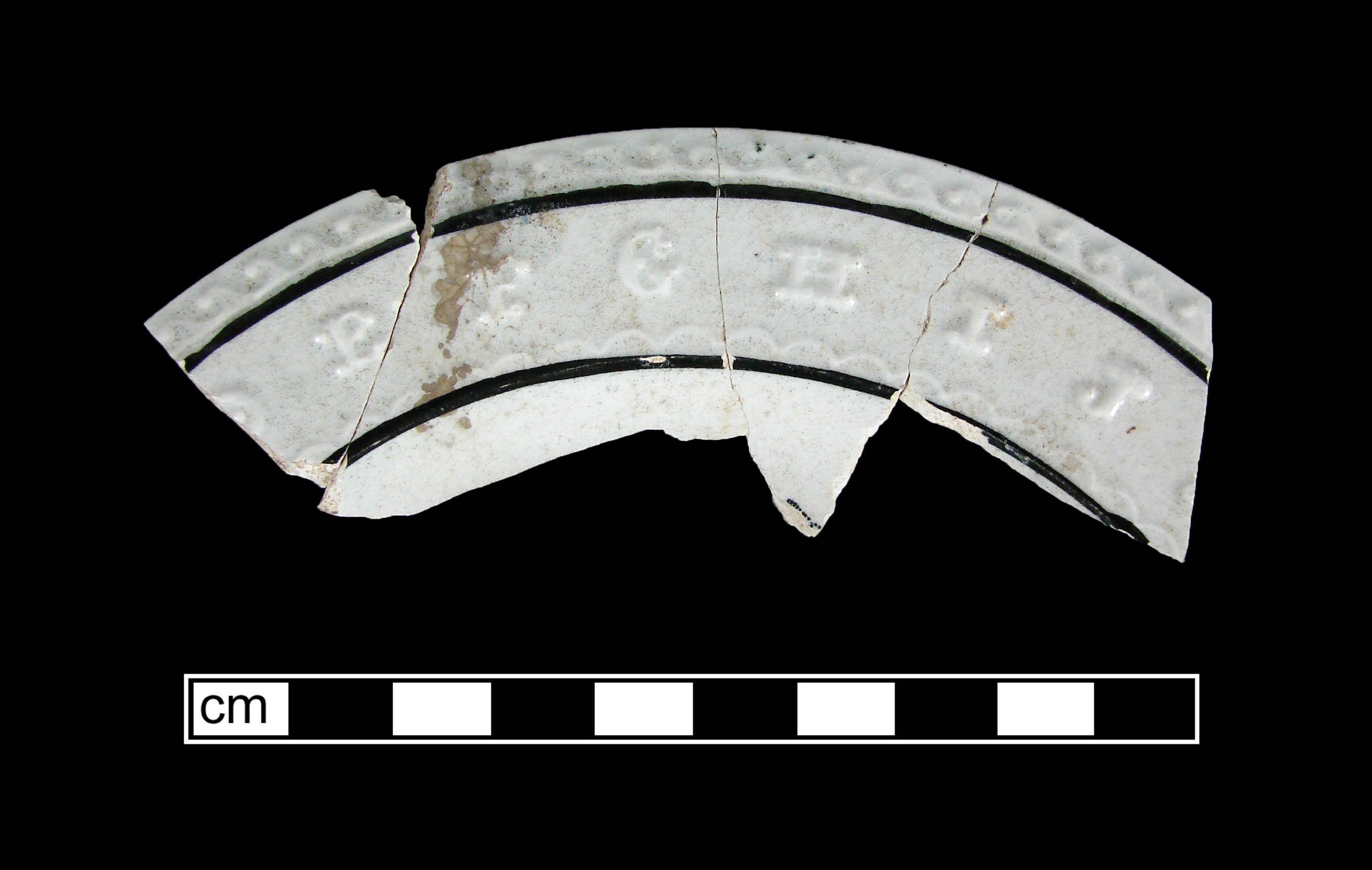 This molded rim alphabet plate was recovered from a Baltimore privy
associated with the household of Jacob Grafflin and James & Phoeba Taylor,
filled around 1840.
This molded rim alphabet plate was recovered from a Baltimore privy
associated with the household of Jacob Grafflin and James & Phoeba Taylor,
filled around 1840.
The aptly named alphabet (or ABC) wares include an alphabet as a component of
their decoration (Figure 1). First manufactured in England’s Staffordshire
district in the late eighteenth century, these wares are still produced today
and were created as educational tools, primarily for children. Plates and mugs
in white bodied earthenware were the most common vessel forms for alphabet wares,
although bowls, cups, and saucers were also made. Since they were intended for
children, they are typically small; plates range in diameter from 4 to 8½ inches.
Plates contained the entire alphabet, usually molded or printed clockwise around
the rim (Lindsay 1998; Riley 1991). Child-friendly scenes decorated plate centers,
which were either printed under the glaze or, beginning in the 1890s, on lithographic
decals. These scenes fell into several decorative themes, including household pets,
barnyard animals, children’s activities, riddles, Aesop’s Fables, and more
(Chalala and Chalala 1980; Shipkowitz and Shipkowitz 2002). Children’s books
published in the second half of the nineteenth century appear to have been most
often used as source materials for designs.
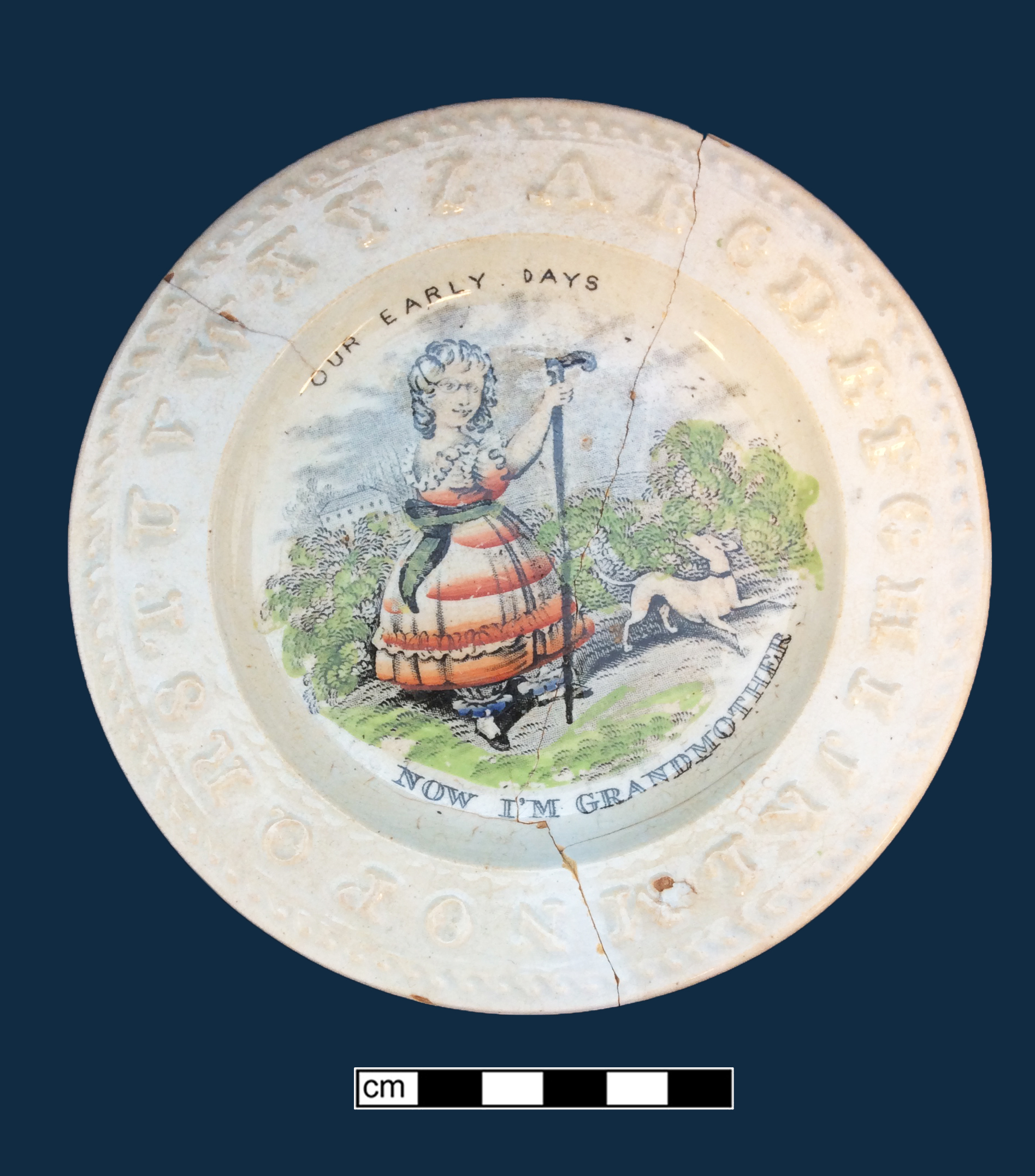 Figure 2. The “Now I’m a Grandmother” plate has nicely painted detailing in
green, red and pink.
Figure 2. The “Now I’m a Grandmother” plate has nicely painted detailing in
green, red and pink.
Printed designs were produced in one color, usually black, and infilled with painted
enamels in pink, green, yellow, red, orange, brown and blue (Figure 2). Color choice
varied by individual enameller, as did the quality of the painting, which could be very
poor. Lithographic decals replaced underglaze printed designs by around 1905. While
decals allowed the production of more detailed designs in a greater range of colors,
they were prone to cutlery damage.
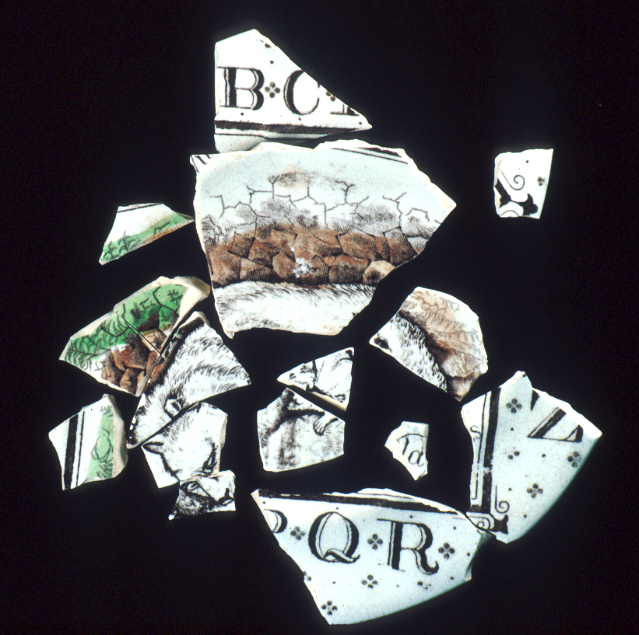 Figure 3. These sherds from a “Bears with Cubs” plate were discovered at
the late 19th-century Sukeek’s Cabin site (18CV426), a Black homestead located in
Calvert County, Maryland.
Figure 3. These sherds from a “Bears with Cubs” plate were discovered at
the late 19th-century Sukeek’s Cabin site (18CV426), a Black homestead located in
Calvert County, Maryland.
Alphabet wares were produced in England, the United States, and Germany. Since many
alphabet plates were not marked with manufacturers or registry marks, they are difficult
to date with certainty. Analysis of marked pieces, however, suggests that British
alphabet wares were produced in greater numbers in the last quarter of the nineteenth
century. British pieces tend to date earlier than American examples, with American
wares produced most frequently in the first quarter of the twentieth century.
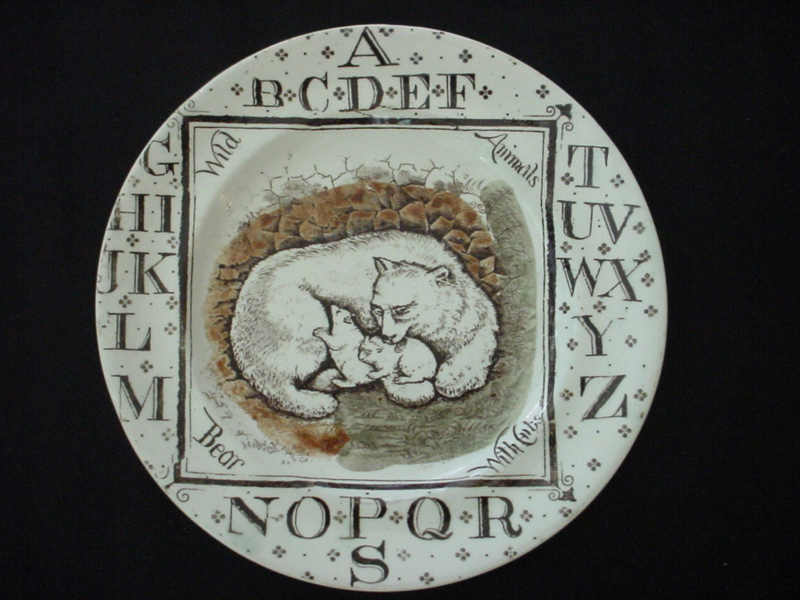 Figure 4. Complete example of "Bears with Cubs" plate, part of the
Wild Animals Series produced by Brownhills and Company (1872-1896).
Figure 4. Complete example of "Bears with Cubs" plate, part of the
Wild Animals Series produced by Brownhills and Company (1872-1896).
In Maryland it is common for archaeologists to find alphabet plates on post-Emancipation
Black home sites (Figures 3 and 4). While alphabet wares were envisioned as a teaching
tool for children, their presence on these sites suggests they were used to teach reading
and writing to the formerly enslaved after the end of the Civil War.
References
Chalala, Mildred, and Joseph Chalala
1980 A Collector’s Guide to ABC Plates, Mugs
and Things. Pridemark Press, Lancaster, PA.
Lindsay, Irene, and Ralph Lindsay
1998 ABC Plates and Mugs; Identification and
Value Guide. Collector Books, Paducah, KY.
Rand, William Brighty
1868 “The Pedlar’s Caravan”, taken from
Lilliput Levee: Poems of Childhood, Child-fancy, and Child-like Moods, by
Wynkoop and Sherwood, New York.
Riley, Noel
1991 Gifts for Good Children; The History
of Children’s China, Part I 1790-1890. Richard Dennis, Ilminster,
Somerset, England.
Shipkowitz, Davida, and Irving Shipkowitz
2002 The ABC’s of ABC Ware. Schiffer
Books, Atglen, PA.