By Caroline Bland and Ashley Endrusick, students of Huntingtown High School's
Historical Investigations Class
Tuberculosis, also known as consumption, was an infectious and often lethal disease in the 1800s.
Tuberculosis was the cause of more deaths in industrialized countries than any other disease during the 19th
and early 20th centuries. People in the 1800s that didn't have tuberculosis were scared of getting it.
Doctors and scientists wanted to continue to learn about the disease to find a cure.
For people with tuberculosis, some symptoms include coughing, weight loss, fevers, night sweats, coughing up blood, chest
pain and fatigue. Until the development of antibiotics in the 1940s, patients with tuberculosis just had to live
with the symptoms and pray that the available tuberculosis remedies would help to give relief.
Doctor J.A. Brown was a root beer manufacturer in Baltimore, Maryland before he moved his operations to New York.
Like many other pharmacists in the 19th century he tried to sell his version of root beer as medicine. He would
promote his remedy to individuals with tuberculosis and try to sell them his product. The remedy provided some relief
for tuberculosis; however, it was not a cure.
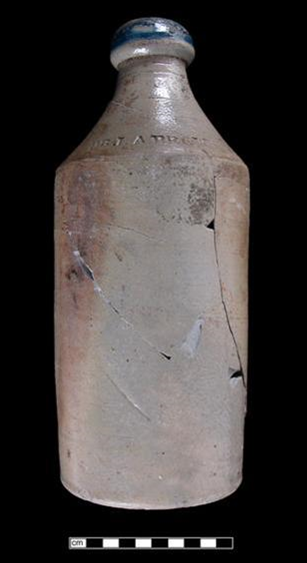 Dr. J.A. Brown bottle found in privy during an archaeological investigation in Baltimore, mended
by Huntingtown High School's students in Historical Investigations Class.
Dr. J.A. Brown bottle found in privy during an archaeological investigation in Baltimore, mended
by Huntingtown High School's students in Historical Investigations Class.
People with tuberculosis usually would get their remedy from the local pharmacies. The pharmacies were nothing like
they are today. There were not sections that had different and specific medication. The pharmacies back then had
bottles of medicine, remedies and other things that doctors thought would cure or help with diseases. The "root beer
remedy" was probably one of the many bottles that was in the mix with all of the medicine for other diseases in
the pharmacies. The pharmacies back then also would mix their remedies in the pharmacy instead of having them
premade and waiting for pick up. This process was called compounding.
The name on the bottle, "J.A. Brown," is the person who created and manufactured this remedy for tuberculosis.
We don't know how the patient obtained this bottle of tuberculosis remedy. We can only say that it as discarded
in a backyard privy where it was later discovered by archaeologists.
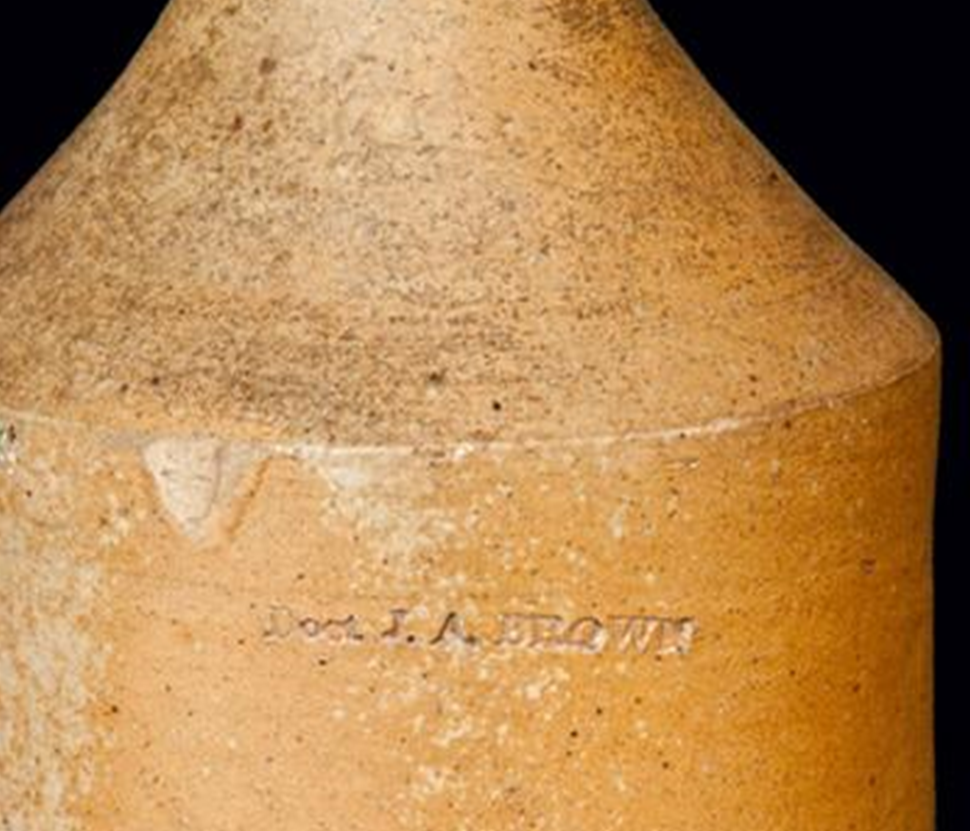 Close-up of the name Dr. J.A. Brown stamped onto another bottle similar to the mended bottle found in
privy.
Close-up of the name Dr. J.A. Brown stamped onto another bottle similar to the mended bottle found in
privy.
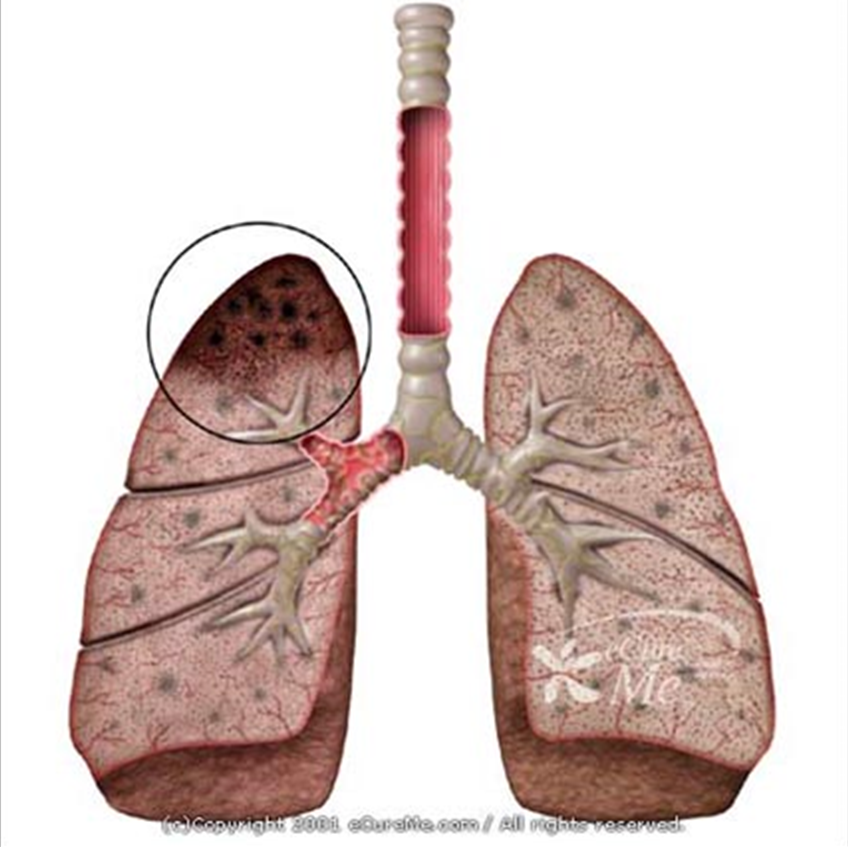 On the left is a tubercular lung and on the right is a normal lung.
References Cited
Root Beer. Wikipedia, 27 Apr. 2013. Web. 16 May 2013. http://en.wikipedia.org/wiki/Root_beer. "Tuberculosis in Europe and North America, 1800–1922."
Contagion. Harvard University Library, n.d. Web. 12 May 2013.
http://ocp.hul.harvard.edu/contagion/tuberculosis.html.
Worth Point. N.p., n.d. Web. 12 May 2013. http://www.worthpoint.com/worthopedia/pair-circa-1845-46-baltimore-21803426.