By Brigit Gilvary, Marissa Hill, and Sabrina Parker, students of Huntingtown High School's
Historical Investigations Class
In 1980, prior to building the Federal Reserve Bank, an archaeological dig was performed in which artifacts were
found that originated in the 1830s to 1850s. In the privy found near Sharpe Street many artifacts were
recovered, with one of the better preserved being a spittoon.
The spittoon found in the privy was 4 3/4" tall, 10" in diameter and made with a gray salt glazed clay body. The clay
body would first be fired to 1600 to 1800 degrees, and then have salt glaze applied. The designs were painted on before
firing, using a cobalt mixture.
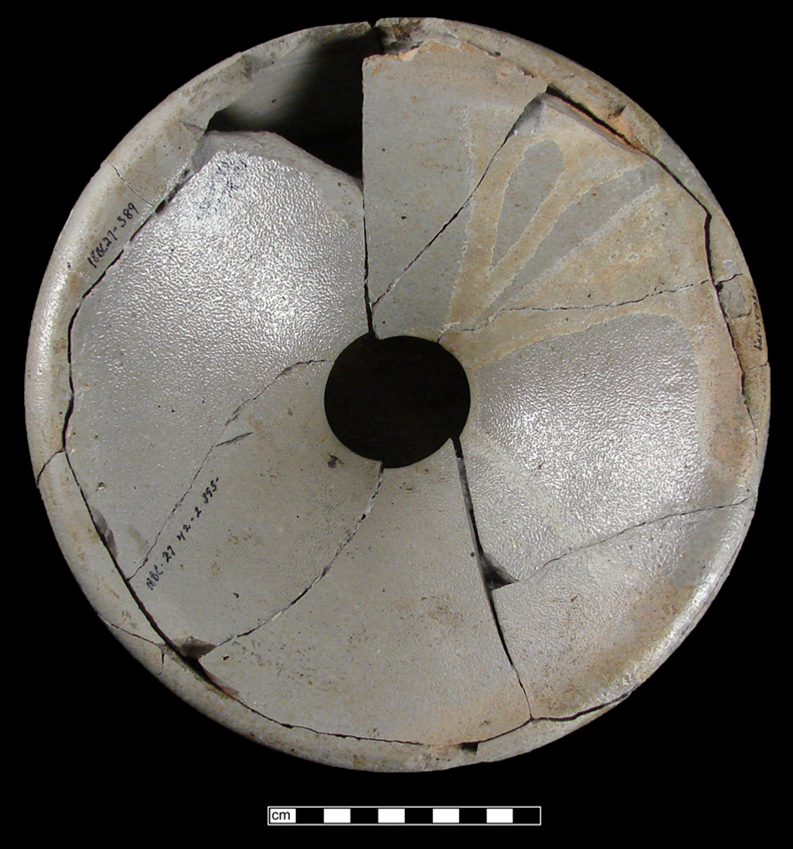 Top view of the mended spittoon found in a privy at the Federal Reserve Bank Site.
The late eighteenth and early nineteenth centuries marked an increased glorification of the rural, natural man and a
rejection of sophisticated, industrial society. Consequently, the "pretentious culture of dainty boxes" -- snuff --
was rejected and dipping tobacco became extremely popular. By the mid nineteenth century, it was very common for
public places -- saloons, stairways, court rooms, etc. -- to have spittoons. In fact, Charles Dickens, while visiting
America in 1842, described a court room where a spittoon could be found by the feet of almost everyone in the room,
including the judge, the lawyer, the jury, and all of the spectators. Spittoons were found in the stairways of a medical
college accompanying signs requesting that students use spittoons as to not "discolour the stairs." It would come as
no surprise that Dickens would later refer to Washington as "the headquarters of tobacco tinctured saliva."
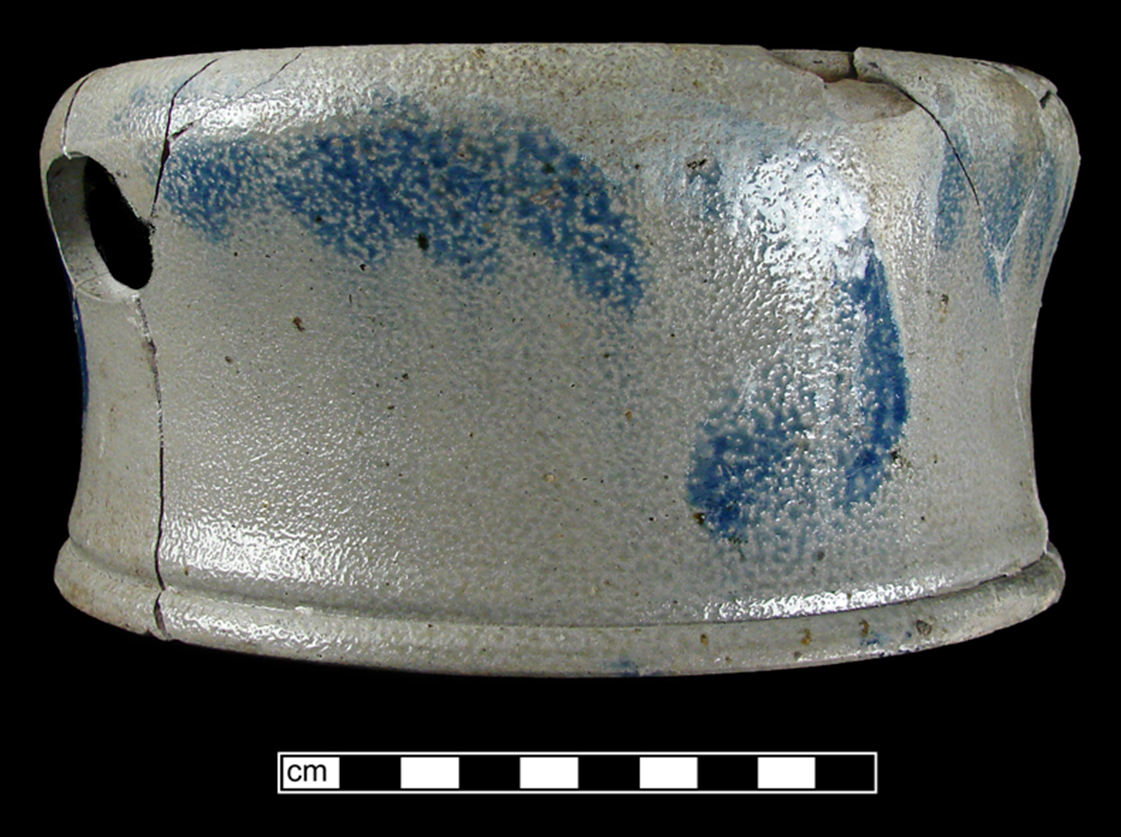 Side view of the mended spittoon found in a privy at the Federal Reserve Bank Site.
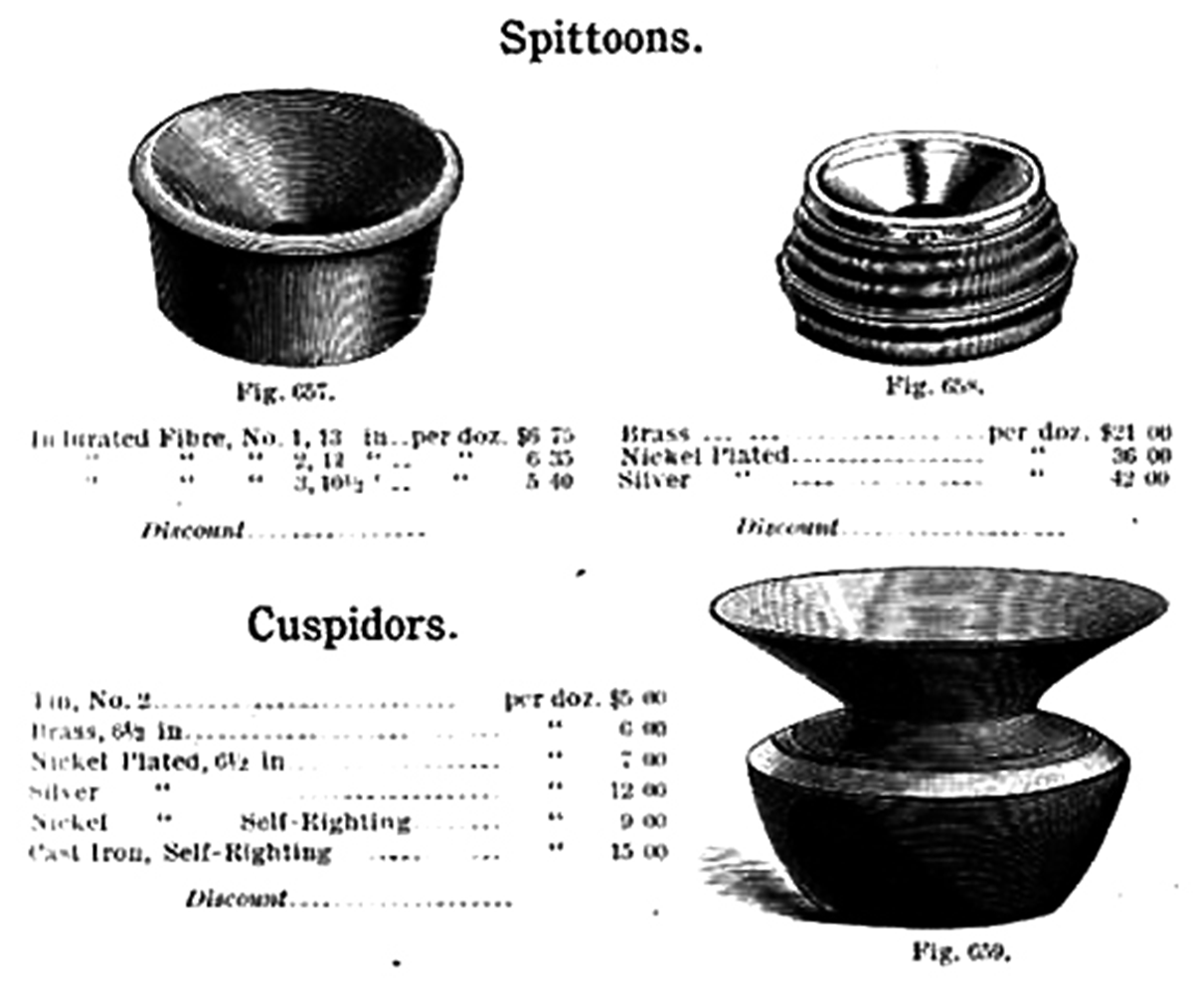 Examples of spittoons and cuspidors from a sales catalog.
Chewing tobacco was even more popular among baseball players. Players found that chewing increased saliva, helping to
lubricate mouths that had become dry in the dusty diamond. And when the leather glove became popular in the 1870s
and 1880s, the players also found that spitting could be used to soften the leather (1). Pitchers believed that
spitting on baseballs before pitching would decrease the air drag, in turn improving their aerodynamics and speed.
These notorious pitches were referred to, quite appropriately, as "spitballs" and were permitted up until 1920 (2).
Chewing tobacco hit its height in popularity by 1890 when the average American chewed more than 3 pounds per year. But
what rises eventually falls. Chewing tobacco was no exception. German microbiologist Robert Koch showed that spitting
contributed to the spread of consumption, or tuberculosis. With that, chewing tobacco slipped from popularity and by
the turn of the century, anti-spitting laws were passed in major cities, removing spittoons from public places (1).
References Cited
1. http://www.slate.com/articles/news_and_politics/explainer/2009/11/why_do_so_many_baseball_players_chew_tobacco.html
2. http://www.baseball-reference.com/bullpen/Spitball