By Kody Powers, Emily Wilson, and Madison Wilson, students of Huntingtown High School's
Historical Investigations Class
Torpedo bottles are known by many names, such as Hamilton bottles, round bottom bottles, or ballast bottles. Jacob Schweppes
from Bristol, England, in 1794, was one of the first manufacturers of mineral water. He saw that gas seeped from the bottle,
resulting in the loss of carbonation. As a result, he created the torpedo bottle. They were designed to lie on their side
to keep the cork moist, and prevent carbonation from escaping. It was also designed with a round bottom to make the consumer
finish the drink before setting it down. He created the J. Schweppes and Company in 1798 that is still in existence. In
1809, William F. Hamilton patented the torpedo bottle and it became common in the 1840s when the manufacturing of mineral
water became very popular. Before, carbonated water was only sold on a small scale. Torpedo bottles were later used to
hold carbonated sodas such as ginger ale, and the Schweppes Company became the largest soda manufacturing company in Britain.
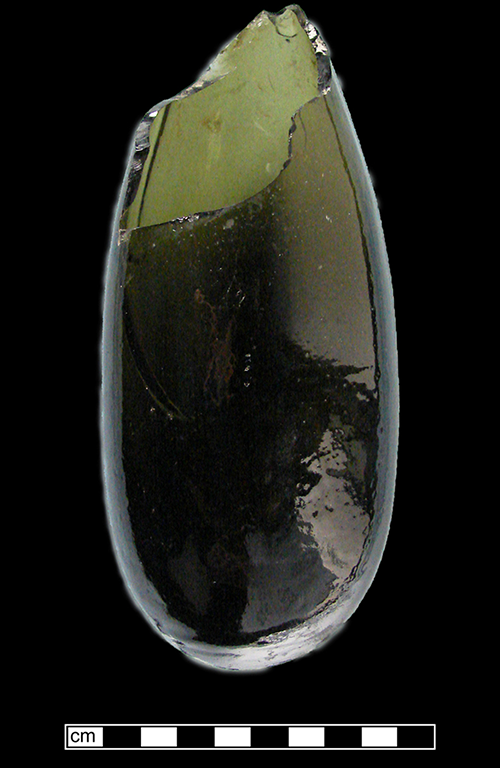 View of torpedo bottle found in a privy at the Federal Reserve Bank Site.
The torpedo bottle was usually made of glass, but sometimes was made of stoneware. The mold-embossed glass Hamilton bottles,
used in the 1830s, had a very thin neck with a thin ring lip. By 1850, the glass of the bottle was made much thicker to
hold the carbonated drinks and a blob top was added. The blob top was a thick piece of glass around the lip of the
bottle. Torpedo bottles were usually produced in a two-piece mold where the neck, shoulder, body, and entire base (and sometimes
all or a part of the finish) were produced by the two halves of the mold. These types of bottles are a rounded base version of
the "hinge" mold (had overlapping seams) and exhibit one continuous mold seam that runs from one side of the body, around the
base, and then up the other side. Other bottles similar to Hamilton's were created, leading to competition. In 1870, the
flat egg, which stood upright or on its side, replaced the Hamilton bottle.
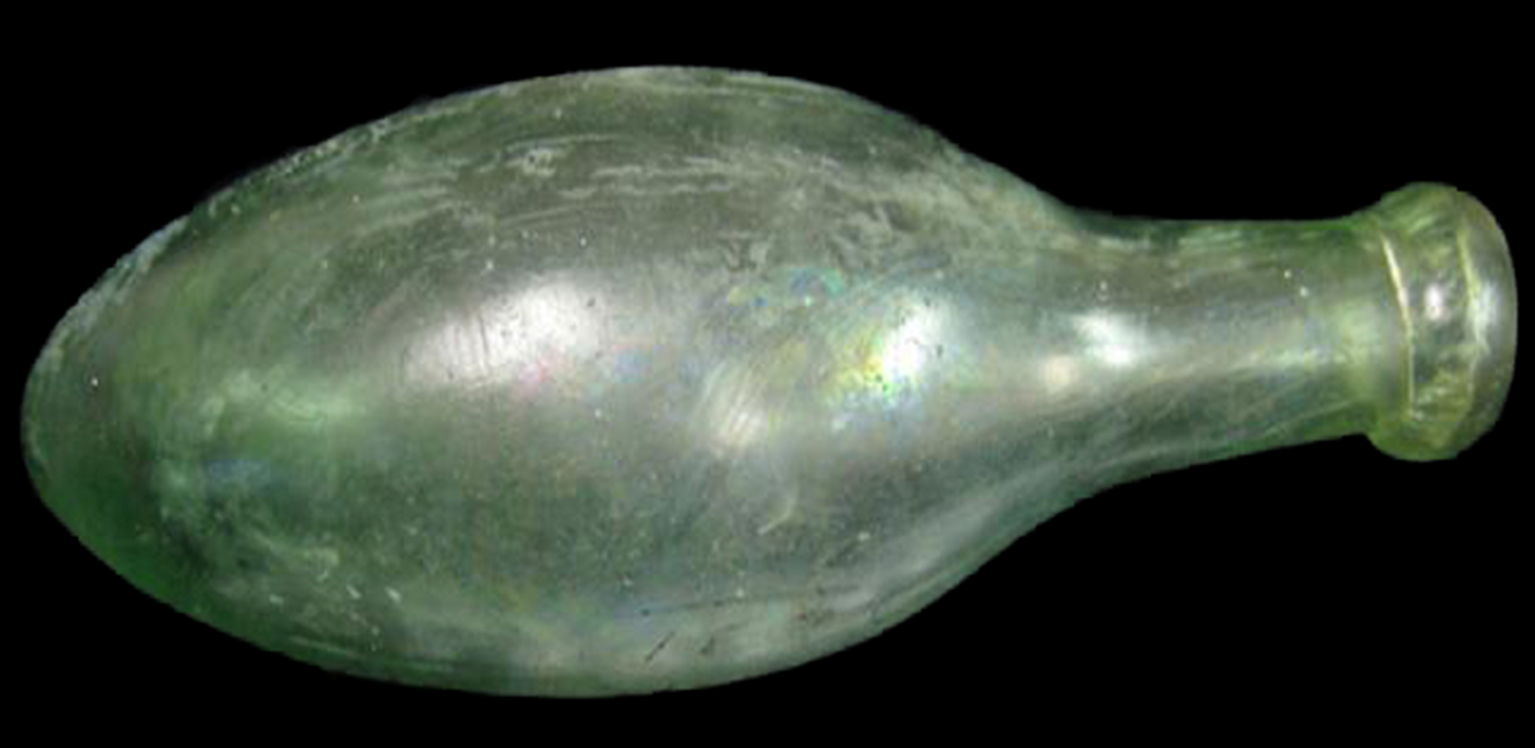 An example of a complete torpedo bottle from a private collection, similar to the one found at the Federal
Reserve Bank site.
An example of a complete torpedo bottle from a private collection, similar to the one found at the Federal
Reserve Bank site.
Stoneware Hamilton bottles in the early decades of the 19th century were widely used in Britain. For example, a salt glazed
bottle was used in Derbyshire, England for the Calcutta chemists Bathgate & Co. The bottle has the Denby & Codnor Park pottery
mark that dates it back to 1833 – 1834. Stoneware Hamilton bottles are rare today, but are known from companies in London,
St. Ives, Chesterfield, Sheffield and many other British towns. Examples with no markings at all turn up
occasionally in 1850s-era sites throughout Britain. Torpedo bottles were also imported from Britain to the United States.
Torpedo bottles in the United States date from the 1870s to the 1910s, although some American-made torpedo bottles date back
as early as the 1840s. Hamilton bottles were mostly bought and used by middle and upper class families. Other types of
bottles eventually replaced them and plastic lids replaced the stoppers. Today, we have plastic bottles that replaced the
era of the torpedo bottle.
References Cited
Hannon, Tom, and Andrea Hannon
Bottles Found in St. Thomas, Virgin Islands Waters. Journal of the Virgin Islands Archaeological
Society Volume 3, 1976; pp. 29-46.
Lindsey, Bill
"‘Round Bottom' Bottle Bases." Bottle Bases. Bill Lindsey, 2013.Web. 4 May 2013.
http://www.sha.org/bottle/bases.htm.
http://www.stcroixarchaeology.org/files/Bottles_Found_in_St_Thomas_-_Hannon.pdf
"Schweppes." Wikipedia. N.p., n.d. Web. 14 May 2013.
http://en.wikipedia.org/wiki/Schweppes.