By Christy Ims, Christiana Nisbet, and Laura Osborne, students of Huntingtown High School's
Historical Investigations Class
During the 1800s many different beverages were popular. In the northern states of America, cider was a popular drink due
to the vast number of apple orchards (Holt 2006). However, the stronger drinks of this period included rum and gin, which
were shipped to the Americas. In the early 1800s, new beverages were becoming popular, such as carbonated drinks, Guinness,
vermouth, and bourbon whiskey (Schulman 2013). Whiskey was made from the rye grown by the farmers in the Midwest. Our
green glass bottle, however, most likely contained wine or soda.
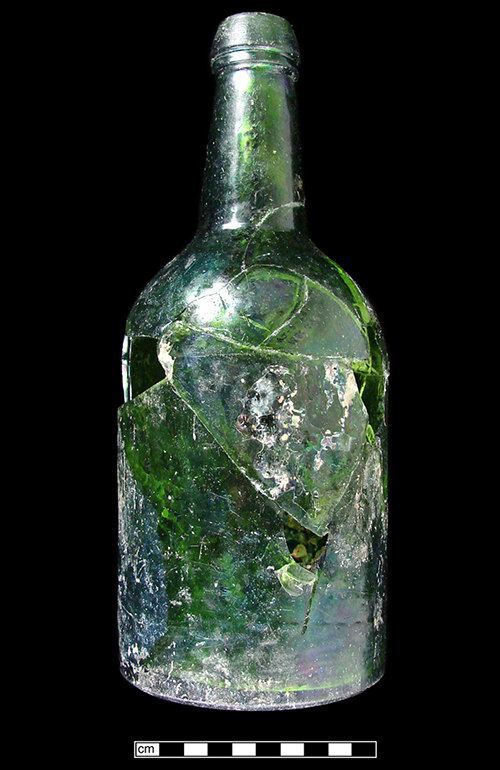 Mended green glass bottle found in a privy at the Federal Reserve Bank Site.
The bottle has a pontil mark on the base, a two-part finish, down--tooled lip, V-shaped string rim, and slope down shoulders.
It is ten inches tall with a rounded heel and tapered neck. The bottle is an emerald green, which was a common glass color
during the 1850s. It is dipped molded, meaning it was made with a simple open top mold that was used to gain uniformity and
consistency (and likely increased production) in the shaping of the bottle body and base (Bottle Den 2013).
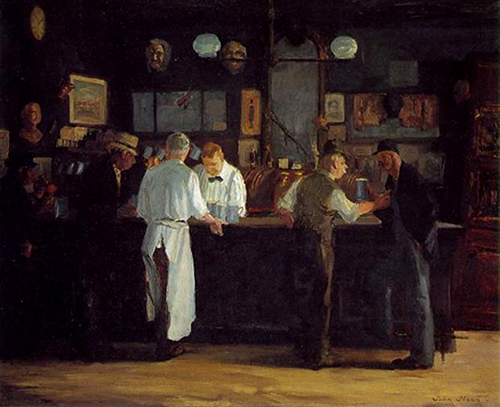 McSorley's Bar (1912) by John French Sloan.
During the 1800s, bottles were used to store many liquids. This green glass bottle in particular was used to store wine in
the kitchen area or in a cellar.
During the 19th century, many Americans were known to have hearty drinking traditions. Americans drank alcohol in two different
ways. One way was in small amounts daily, and the other was drinking a lot during times of celebration or neighborhood
festivities (Rorabaugh 1981).
References Cited
Bottle Den
"Early Maryland Black Glass..." N.p., n.d. Web. 14 May 2013.
.
Holt, Mack P., ed.
Alcohol: A Social and Cultural History. Berg Publishers 2006.
Rorabaugh, W.J.
The Alcoholic Republic: An American Tradition. Oxford University Press. 1981.
Schulman, Marc.
"Food." History Central. N.p., n.d. Web. 25 Apr. 2013.
(http://www.historycentral.com/NN/America/food.html).