By Kari Crandell and Amy Chaffee, Huntingtown High School's
Archaeology Class
Relief Molded Stoneware jugs were used from the 1830s until the 1870s and were
known for their artistic qualities and inexpensive manufacturing, making middle
class families the primary owners. The jugs had several different designs and the
style changed throughout the decades. They are made of highly vitrified clay press
molded to hold up its shape. The potters took sheets of clay and scored the edges,
joining them at the seams. They then gently smoothed the seams out, deleting all
flaws and rough spots.
Relief molded jugs were a type of thinly potted stoneware with complex molding and
decorative motifs, including religious designs, geometric designs, and floral
patterns. These jugs were ideal for middle class families, being easy to produce
and inexpensive to manufacture. Certain characteristics of the jug's design
changed every year. These characteristics can be used in dating the jugs. As
time went on, the quality of the jugs declined. Industrialized mass production put
potters out of commission. Other potters competed with each other, lowering the
prices of their jugs, which also lowered the quality of the designs and decorations.
The sherds of the jug found at the Otterbein neighborhood site originate roughly from
around the 1860s. They have both a geometric and naturalistic style, which was
common around this time period. Although jugs from the 1830s depicted designs in
crisp, deep relief, jugs from later times had lower quality. By the 1860s, the
designs were usually shallow, with a stippled background, like these artifacts.
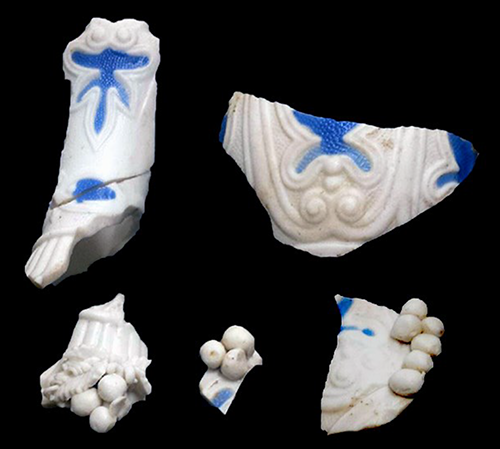 Sherds of the jug found at the Otterbein neighborhood site in Baltimore and
originating roughly around the 1860s.
Sherds of the jug found at the Otterbein neighborhood site in Baltimore and
originating roughly around the 1860s.
People use similar jugs today for decoration in a curio or china cabinet. People might
have used it in the mid-1800s for having lunch, or tea, or any important family and
friend gathering. Now, anyone who collects antiques and priceless artifacts can
collect or possess this instead of just the middle class. In today's society most
of our jugs are plastic or glass, and they are used to hold milk, water, or soft
drinks. Clay pots now are mostly used for plants or other outdoor uses such as
bird baths. Society's need for art in everyday life is still very much as present
as it was nearly 150 years ago in the Otterbein neighborhood of Baltimore, Maryland.
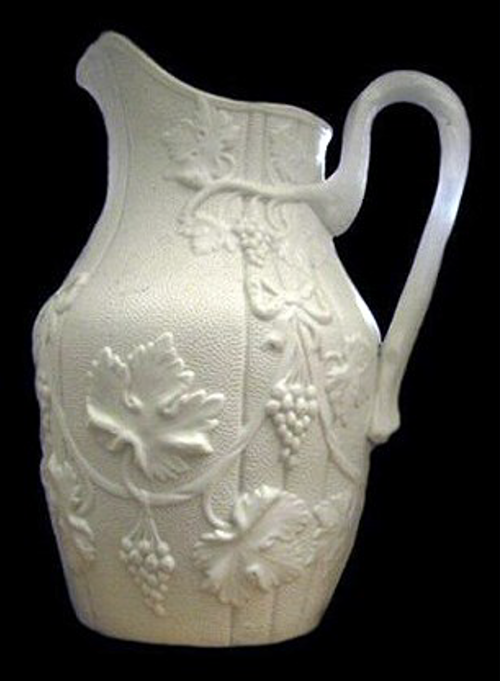 This jug depicts naturalistic forms, common from the 1840s to the 1860s.
Courtesy of Diagnostic Artifacts in Maryland website.
This jug depicts naturalistic forms, common from the 1840s to the 1860s.
Courtesy of Diagnostic Artifacts in Maryland website.
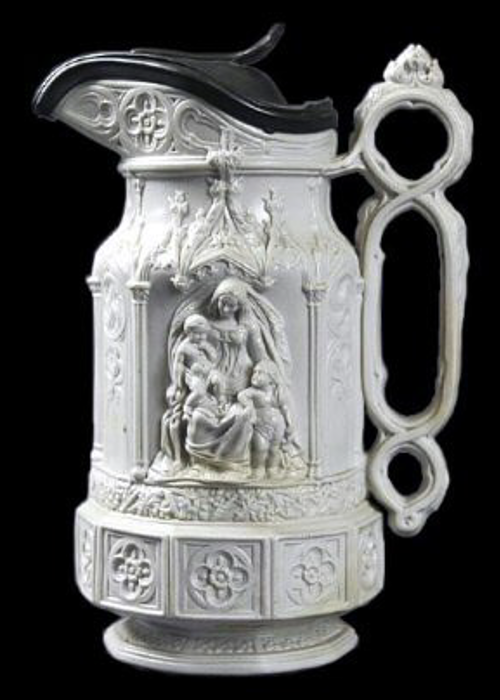 This Apostle jug by Charles Meigh depicts religious themes, which began to appear
in the 1840s. Courtesy of Diagnostic Artifacts in Maryland website.
This Apostle jug by Charles Meigh depicts religious themes, which began to appear
in the 1840s. Courtesy of Diagnostic Artifacts in Maryland website.
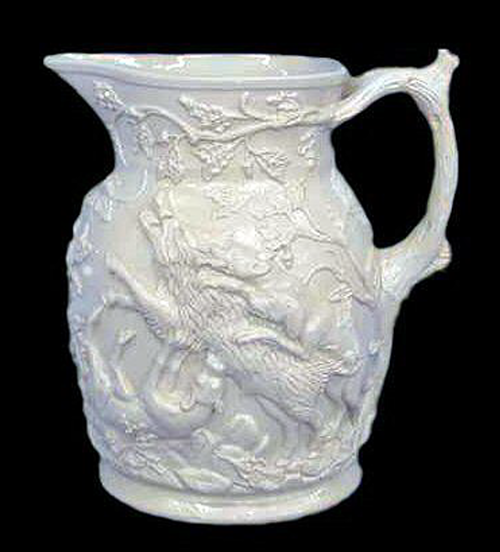 Boar and Stag Hunt (c. 1845) jug by Masons depicts hunting scenes typical of the
1830s and 1840s. Courtesy of Diagnostic Artifacts in Maryland website.
Boar and Stag Hunt (c. 1845) jug by Masons depicts hunting scenes typical of the
1830s and 1840s. Courtesy of Diagnostic Artifacts in Maryland website.
References Cited
"Diagnostic Artifacts in Maryland." Jefferson Patterson Park & Museum,
Post Colonial Ceramics: Relief Molded Stoneware Jugs N.p., n.d. Web. 30 Apr. 2014.
(http://www.jefpat.org/diagnostic/post-colonial%20ceramics/Less%20Commonly%20Found/Relief%20Molded%20Stoneware%20Jugs/relief%20molded%20stoneware%20jugs.htm).