In addition to serving a wide array of uses in the industrial world, Charles Goodyear's 1839 invention
of vulcanized rubber revolutionized the toy manufacturing process. The rubber ball was among the products
of this transformation. It epitomized the material's malleability and dexterity as a round, bouncy, and
elastic toy which could be used in a wide variety of street games, from jacks and stickball to catching
and bouncing.
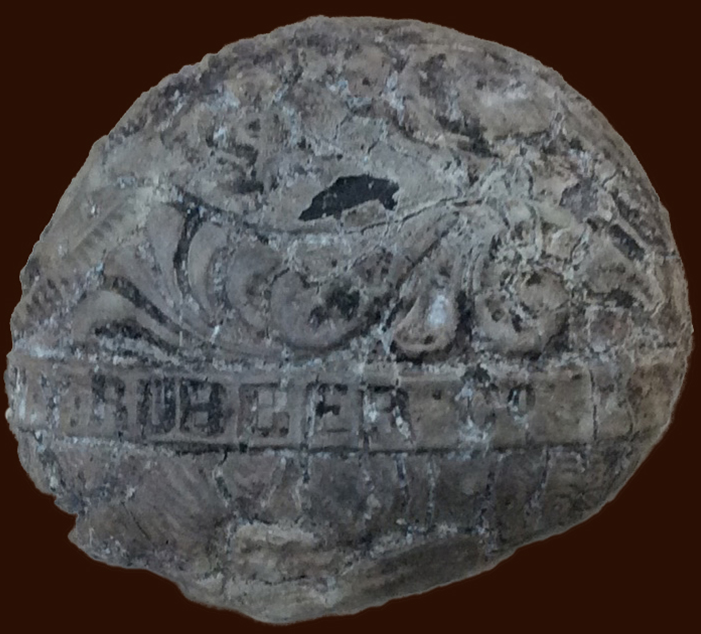 The rubber ball found in the c. 1850-1870 privy had been broken in half, but the manufacturer's name was still
visible on the center seam.
The rubber ball found in the c. 1850-1870 privy had been broken in half, but the manufacturer's name was still
visible on the center seam.
The New York Rubber Company was founded in 1851, but they changed their trade name to Wicapee Rubber in
1859. Because the rubber ball bears the stamp of the New York Rubber Company, that means it was manufactured
within that eight year period, putting it in the precise window of time the Otterbein site in Baltimore
(18BC27) where it was found, was active. The company created this ball by pouring liquid rubber into two
semi-circular molds and then fusing together the semicircles, leaving a seam around the hemisphere of the
ball. This and the need to mold a brand name onto the ball in the absence of appropriate printing technology
made this ball less bouncy than a perfectly round one. The ball was then likely transported from New York
to Baltimore via train or ship to be sold for pennies at a corner store.
Aside from their shape and uses, modern bouncy balls have little in common with this example. Whereas this
ball was produced with natural rubber, modern ones tend to use pressurized synthetic rubber which yields a
far more elastic ball. While this ball has succumbed to the elements, modern balls are far more resistant
to extreme cold and heat. Modern bouncy balls are also bouncier because of their lack of oddities and
smoothness achieved by avoiding the traditional technique that the New York Rubber Company used. Despite
this, the rubber ball of the 1850s was as much a source of amusement as its counterpart used over a
century later.
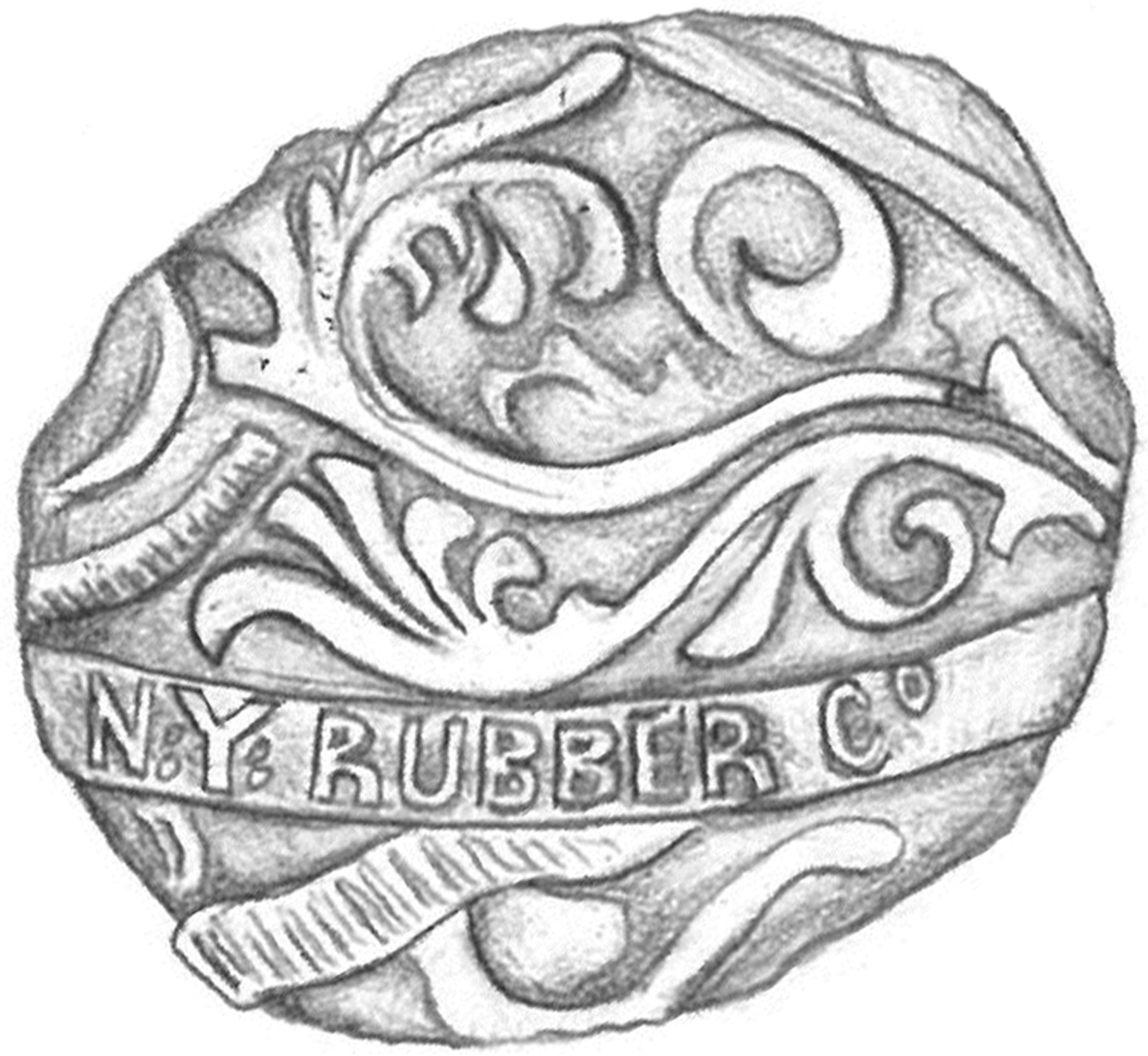 This drawing of the ball shows detail on the ball’s surface. Drawing by Alex Glass, Maryland
Archaeological Conservation Lab.
This drawing of the ball shows detail on the ball’s surface. Drawing by Alex Glass, Maryland
Archaeological Conservation Lab.
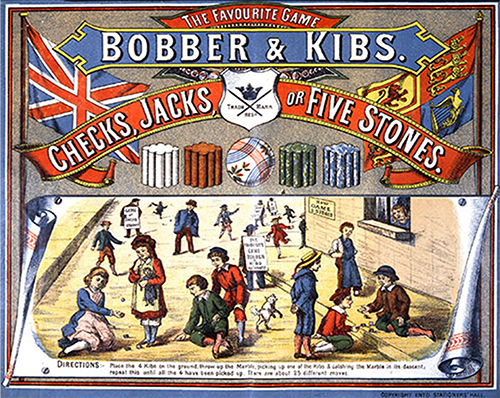 Children on this Victorian era 1894 game box can be seen playing jacks with rubber balls.
https://www.pinterest.com/pin/448108231645161670/.
Children on this Victorian era 1894 game box can be seen playing jacks with rubber balls.
https://www.pinterest.com/pin/448108231645161670/.
References Cited
Laws of the State of New York Passed at the Eighty-Second Session of the Legislature.
Banks and Brothers, Albany, New York, 1859, page 571.
The India Rubber World. Volumes 63-64. Bill Brothers Publishing Corporation, 1921,
page 444.
+
The India Rubber World. Volume 66. Bill Brothers Publishing Corporation, 1922,
page 759.