In the nineteenth century, pomade was a popular hair care item. This lid, made of refined
earthenware called white granite, was used for a jar containing ox marrow pomade. On the
lid was a printed underglaze depiction of an ox with the words "Moëlle de Boeuf," translating
to "bone marrow" in French, and the partial remains of the manufacturer, L. T. Piver, under
the ox.
Ox marrow pomade originally used bear's marrow. Due to the bear population diminishing,
manufacturers started using ox marrow instead, since oxen and other cattle were plentiful.
In nineteenth-century America and Europe, ox marrow pomade was made by simmering 10 ounces
of marrow and then straining over 10 ounces of castor oil. They would stir for hours, even
days, until it reached the right consistency. Along with being something applied to hair,
people would add essence to the mix and make it perfume.
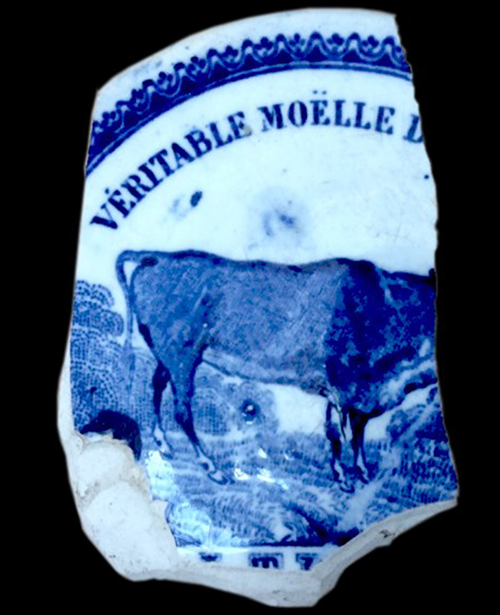 Fragmented lid of a pomade jar found in a circa 1850 to 1870 privy pit at the Federal
Reserve Site (18BC27).
Fragmented lid of a pomade jar found in a circa 1850 to 1870 privy pit at the Federal
Reserve Site (18BC27).
In the mid-nineteenth century, many French immigrants arrived in America and began selling
imported French goods. Two of the main sellers were Jules Hauel and Eugene Roussel. Hauel
and Roussel both owned perfumeries very close to Baltimore, where this artifact was found.
Roussel, being an immigrant from France, would have his stock imported from overseas like Hauel,
who was from Philadelphia. Both men owned perfumeries in Pennsylvania. Hauel owned three
shops, one on Chestnut St., one on Maiden Lane, and the last on Archer Street. Roussel
also owned a store on Chestnut Street. The manufacturer L. T. Piver was located in France.
After the success of its products, both in France and America, Piver opened up another
factory location not far from the first. Piver is now only known for its perfume; the
manufacturer no longer sells pomade today.
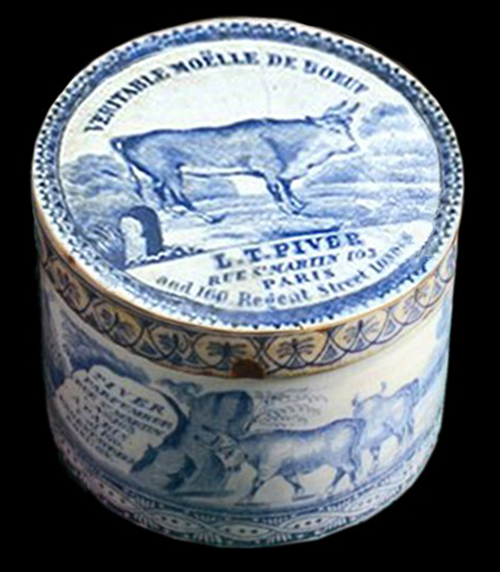 Complete example of a L.T. Piver ox marrow pomade jar that is very similar to
the example from the Federal Reserve Site. http://catalogue.drouot.com/ref-drouot/lot-ventes-aux-encheres-drouot.jsp?id=2323811
Complete example of a L.T. Piver ox marrow pomade jar that is very similar to
the example from the Federal Reserve Site. http://catalogue.drouot.com/ref-drouot/lot-ventes-aux-encheres-drouot.jsp?id=2323811
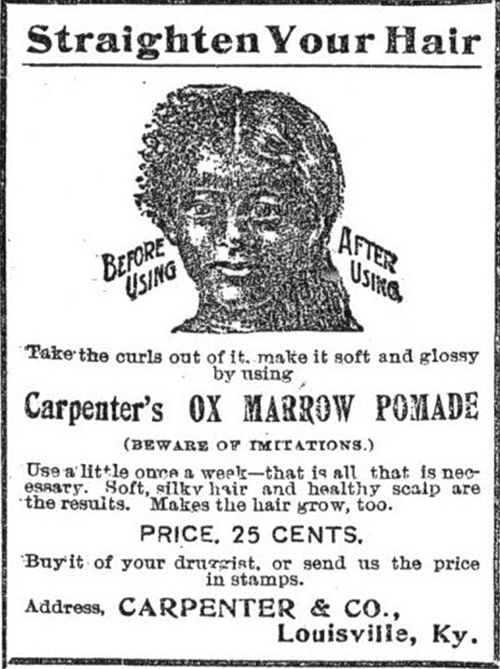 An 1800s advertisement for ox marrow pomade as a hair straightener.
http://newlynatural.com/blog/2009/05/ox-marrow-for-straight-hair/.
An 1800s advertisement for ox marrow pomade as a hair straightener.
http://newlynatural.com/blog/2009/05/ox-marrow-for-straight-hair/.
The pomade lid was found in a privy pit in the Otterbein neighborhood in Baltimore, in an area
formerly filled with row houses. In the time the artifact was dated to, Nathan Mansfield owned
the home. Mansfield was the occupant of the house with his wife, Mathilda, and his daughter,
Ida. Currently, the Federal Reserve Bank sits in this location.
Pharmacies in the 1800s sold pomade for its many purposes in aiding with beauty and physical
health. Pomade helped hair by keeping it manageable, moisturizing, conditioning, returning
grey to its natural color, and lengthening hair. Many believed that pomade helped to prevent
baldness as well. Its most popular use among African Americans was in straightening hair, and
making it soft and glossy. Adding essence to the batch would also turn the pomade into
perfume. Today, people still use pomade in the same ways.
References Cited
Webster, A.L.
1855 The Improved Housewife. Philips, Sampson, and Company. Published January 1st, 1855.
http://newlynatural.com/blog/2009/05/ox-marrow-for-straight-hair/ Article published: May 20th, 2009 by Kcurly.
http://www.hairraisingstories.com/Proprietors/HAUEL.html.
http://www.bottlepickers.com/bottle_articles272.htm.
http://www.collectorsweekly.com/assets/pdfs/bottles-and-extras/cows-onpot-lids.pdf.
http://www.mocavo.com/Nathan-Mansfield-Maryland-Census-Record-Indexes-1776-1778-1870-1880/06005273894947612486.