How has Maryland’s Environment Changed in the
Years since European Contact?
Contact and the colonization of North America
brought unprecedented change to the landscape and in the role
of human beings as agents of ecological change. The colonial encounter
marked the beginning of a tremendous acceleration in the rate
of 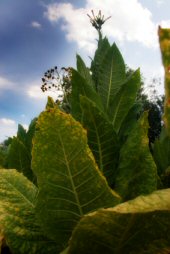 human-induced
environmental change.
human-induced
environmental change.
European colonists brought with them new attitudes
about land use, transforming the land in accord with their economic
needs and in response to the varying qualities of agricultural
terrain. In Tidewater
Maryland, tobacco varieties imported from the West Indies were
grown with great success, fueling an economy built on slave labor.
Native forests in these portions of the state were cleared faster
and more extensively than in northern and western areas.
 In
the early days of the colony, European settlers themselves slowly
cleared the land . Their pigs, cattle, horses, and fowl were fenced
out of houseyards and ranged free in the Maryland woods. The activities
of the livestock were very effective in clearing the understory
and preventing the regeneration of forests. Farming practices
-- especially tobacco agriculture, which was so widespread in
Tidewater Maryland -- included the frequent clearing of fields
and their later abandonment due to exhausted soils, which led
to the fragmentation of forests and the creation of patchwork
landscapes.
In
the early days of the colony, European settlers themselves slowly
cleared the land . Their pigs, cattle, horses, and fowl were fenced
out of houseyards and ranged free in the Maryland woods. The activities
of the livestock were very effective in clearing the understory
and preventing the regeneration of forests. Farming practices
-- especially tobacco agriculture, which was so widespread in
Tidewater Maryland -- included the frequent clearing of fields
and their later abandonment due to exhausted soils, which led
to the fragmentation of forests and the creation of patchwork
landscapes.
The late 1800s and early 1900s witnessed the most
extensive deforestation in Maryland, when approximately 80 percent
of the land was cleared of trees. The result was a heretofore unprecedented
homogeneity of the Maryland landscape.
The colonial transformation and the centuries which
followed have caused tremendous changes in Maryland’s plant
and animal communities. Habitat destruction, unregulated hunting,
and increased competition from introduced exotic species and diseases
resulted in the wholesale decline in wilderness-dependent species
and a corresponding rise in species that favored agricultural landscapes
and human habitation sites. This decline and loss has significantly
disturbed Maryland’s ecological balance.
Below were some of the effects caused
by the changing environment of Maryland:
- Overhunting was responsible for the collapse of the fur trade
by the middle 1600s
- The fossil pollen record reveals an explosion of ragweed pollen
about 350 years ago that coincides with massive forest clearing
and agricultural expansion following European colonization
- Colonial hunting and habitat destruction diminished the range
of bear, elk, big cats, and woodland bison
- The passenger pigeon – once the most common bird in
Eastern North America - was hunted to extinction (the last bird
died in captivity in 1914)
- Piedmont and mountain regions of Maryland once supported forests
of giant chestnut trees that were decimated by a blight introduced
in the 1920s.
- Dutch Elm disease (introduced in 1928) has significantly reduced
the elm tree.
- More recently, a small parasite has diminished the once-common
hemlock tree.
Study of sediment cores
offers a chronology of forest development and change. By examining
plant pollen types and rates of sediment accumulation, we
can learn about environmental change. |
Ecological transformation continued as Maryland’s
population burgeoned. Resources were harvested to fuel development
of towns and cities, industries took shape, and political boundaries
were shaped and defended. The early years of the republic saw a
huge expansion in canal and highway construction which improved
access to undeveloped areas and opened more land to farming, timber
harvesting, and mining. The resulting habitat destruction pushed
many species out of their native areas or into extinction, and invasive,
opportunistic species moved in to fill the void. Deforestation led
to extensive soil erosion – the effects of which were visible
from the mountains to the sea.
|
Early industries in Maryland
included charcoal and bog iron production. Their furnaces
consumed large quantities of wood, and it is estimated that
Maryland’s coastal plain forests were reduced by 30
percent by the year 1775. |
By the mid-19th century, the development of coal,
steam, and steel fueled greater industrial expansion. The period
witnessed urban development, civil war, and an influx of European
immigrants to Maryland’s shores. Changes in Maryland agriculture
characterize this period as well, as farming shifted toward the
western frontier.
| “The
real legacy of European Colonization has been the transformation
of
a highly variable, almost completely forested landscape into
a herbaceous-dominated system, interspersed with different-sized
fragments of secondary forest in different stages of succession.
. . It is difficult to predict what would happen to today’s
largely deforested landscape if it were subjected to the
kind of climate changes seen in the past.” Grace
Brush 2001: 57. |
Further Information:
Brush, Grace
2001 Forests Before and After the Colonial Encounter.
In Discovering the Chesapeake: The History of an Ecosystem.
Curtin,
Brush and Fisher, eds. Pp. 40 – 59. The Johns Hopkins University
Press, Baltimore.
Cronon, William
1993 Changes in the Land: Indians, Colonists, and
the Ecology of New England. Hill and Wang, New York.
Frick, George F., James L. Reveal, C. Rose Broome, and Melvin L.
Brown
1987 Botanical Explorations and Discoveries in Colonial
Maryland, 1688 to 1753. Huntia 7: 5-59. Hunt Institute
for
Botanical
Documentation, Carnegie Mellon University, Pittsburgh.
Brown, Melvin L., James L. Reveal, C. Rose Broome, and George F.
Frick
1987 Comments on the Vegetation of Colonial Maryland.
Huntia 7: 247-283. Hunt Institute for Botanical Documentation,
Carnegie
Mellon University, Pittsburgh.