What Was Maryland’s Landscape Like When
the English Colonists Arrived?
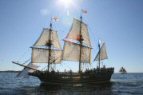 The
first written accounts of Maryland made by European explorers
describe rich and abundant landscapes of forest and water. The
Chesapeake Bay was the stage for the earliest direct contact with
Maryland and it was central to the initial experiences of European
visitors and the records that they made. The Bay supported a diverse
web of resources that provided food and which represented economic
potential for the colonial endeavor.
The
first written accounts of Maryland made by European explorers
describe rich and abundant landscapes of forest and water. The
Chesapeake Bay was the stage for the earliest direct contact with
Maryland and it was central to the initial experiences of European
visitors and the records that they made. The Bay supported a diverse
web of resources that provided food and which represented economic
potential for the colonial endeavor.
“… that aboundance of fish,
lying so thicke with their heads above the water, as for want
of nets (our barge driving amongst them) we attempted to catch
them with a frying pan”
Smith, John, Generall Historie of Virginia.
In P.L. Barbour, ed., The Complete Works of Captain John Smith
(1580-1631), Vol. II. (Chapel Hill: University of North Carolina
Press, 1986). |
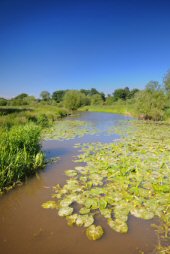 Early
historic accounts of Maryland include detailed descriptions of
both the physical and cultural landscapes: a rich estuary flanked
by marsh and swamplands, intertwining waterways, a gentle plain
of locally-diverse forests, and a network of human communities
concentrated in riverside villages where Native Americans plied
waterways and trails and managed hunting grounds, nut groves,
and gardens. The colonists observed that complex social and political
relationships linked the groups of Native Americans they encountered.
Early
historic accounts of Maryland include detailed descriptions of
both the physical and cultural landscapes: a rich estuary flanked
by marsh and swamplands, intertwining waterways, a gentle plain
of locally-diverse forests, and a network of human communities
concentrated in riverside villages where Native Americans plied
waterways and trails and managed hunting grounds, nut groves,
and gardens. The colonists observed that complex social and political
relationships linked the groups of Native Americans they encountered.
History speaks of the natural cycles of want and
plenty in the Chesapeake region. During the 
 early
summer the rivers, farm fields, and forest edges produced abundant
foods. This was followed by a plentiful autumn with a variety
of nuts, maize, and fall fruits. Dried and salted foods were stored
for winter use. But, according to most accounts, these stores
were exhausted long before springtime, and a “starving time”
followed when game was scarce and Indians lived almost exclusively
on bark, oysters, and plant tubers. The early chroniclers mention
the mobility of Native groups – which allowed for flexibility
in following food resources during these lean times, and in responding
to the weather. The colonists suffered from conventions of land
ownership, which offered less flexibility in terms of responding
to seasonal cycles. Being anchored to their farms, early settlers
suffered devastating privation and starvation.
early
summer the rivers, farm fields, and forest edges produced abundant
foods. This was followed by a plentiful autumn with a variety
of nuts, maize, and fall fruits. Dried and salted foods were stored
for winter use. But, according to most accounts, these stores
were exhausted long before springtime, and a “starving time”
followed when game was scarce and Indians lived almost exclusively
on bark, oysters, and plant tubers. The early chroniclers mention
the mobility of Native groups – which allowed for flexibility
in following food resources during these lean times, and in responding
to the weather. The colonists suffered from conventions of land
ownership, which offered less flexibility in terms of responding
to seasonal cycles. Being anchored to their farms, early settlers
suffered devastating privation and starvation.
Conflicts attendant to the colonial encounter had the
effect of disturbing Native American settlement patterns, moving
people from their traditional homes and changing the relationships
between Native groups.
At the time of contact, the forests of the Eastern Woodlands
were majestic. Variable
mixed hardwood forests formed a tall, dense canopy which dominated
the land. Maryland’s forest resources represented an economic
opportunity for the colonists. They used wood domestically for
building boats, homes, and farm structures. Timber was also exported
to England, where a crisis of deforestation made it a highly valuable
commodity.
|
European colonists settled in Maryland during
a cool time period in North America and Western Europe. This
time is referred to as the “Little Ice Age,” which
lasted from about AD1500 to AD1850.
|
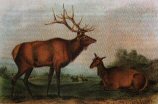
 At
the time of the colonial encounter, Maryland was home to numerous
animals now extinct or extirpated: Wapiti (Eastern elk), woodland
bison, passenger pigeon, and the Carolina parakeet were common,
and black bear, timber wolf, mountain lion, and bobcat ranged
throughout the state.
At
the time of the colonial encounter, Maryland was home to numerous
animals now extinct or extirpated: Wapiti (Eastern elk), woodland
bison, passenger pigeon, and the Carolina parakeet were common,
and black bear, timber wolf, mountain lion, and bobcat ranged
throughout the state.
European exploration and settlement of the New
World was primarily an economic venture: colonists sought resources
to finance the colonies, to compensate their financiers, and for
personal gain. Colonial ideas of land ownership and resource management
reflect a focus on industry and trade.
|
There is evidence that 17th-century farmers
on the Chesapeake colonial frontier made use of Indian fields which
were already cleared of forest cover and were located on the most
productive soils adjacent to waterways. |
|
Significant
Events Associated with Contact, Exploration, and Colonization |
1492-1607 -
1524 -
1571-1585 -
1607 -
1634 -
|
Early European contacts and exploration
of Eastern North America
Earliest written record by Giovanni da Verrazano describes the
Chesapeake Bay region
Attempted colonization of the region
First successful English colony established at Jamestown, Virginia
Saint Mary’s City was established and Maryland was founded |
Further Information:
Blanton, Dennis
Jamestown’s Environment at http://www.virtualjamestown.org/essays/blanton_essay.html
Brush, Grace
2001 Forests Before and After the Colonial Encounter.
In Discovering the Chesapeake: The History of an Ecosystem.
Curtin, Brush and Fisher, eds. Pp. 40 – 59. The Johns Hopkins
University Press, Baltimore.
Curtin, Philip D., Grace S. Brush, George W. Fisher
2001 Discovering the Chesapeake: The History of
an Ecosystem. The Johns Hopkins University Press, Baltimore.
Grumet, Robert S., writer
2000 Bay, Plain, and Piedmont: A Landscape History of
the Chesapeake Heartland from 1.3 Billion Years Ago to
2000.
The Chesapeake Bay Heritage Context Project. U.S. Department of
the Interior, National Park Service,
Annapolis,
Maryland.
Mann, Charles C.
2005 1491. New Revelations of the Americas Before
Columbus. Alfred A. Knopf, New York.
Roundtree, Helen C., Wayne E. Clark, and Kent Mountford
2007 John Smith’s Chesapeake Voyages.
University of Virginia Press, Charlottesville, Virginia.