Pig Point (18AN50)
Pig Point (also known as Leon) is a multi-component site occupied from the Early Archaic to the Late Woodland as well as containing late 17th- to early 20th-century occupations. Richard Stearns is the first known collector of the site, dating back at least to the 1940s. Howard McCord of Virginia is also known to have collected at the site. The site was initially recorded as being located along a low terrace along the Patuxent River at Pig Point. Robert Ogle, a local prolific collector in the region had also collected from this site.
The first time the site was visited by a professional archaeologist was in 1969 by Tyler Bastian, who had described the site as being located north of a modern house on this low terrace. In 1991 Al Luckenbach, archaeologist for Anne Arundel County, conducted a non-systematic surface collection of the low terrace at Pig Point, where he observed a shell midden and village site measuring approximately 100 × 50 feet.
Continued testing in 2009 and 2010 by Anne Arundel County’s Lost Towns Project expanded the known site boundary up onto a high terrace west of the initial recorded location. Excavations in the 2009 included 17 shovel test pits, and 30 excavation units. Of the 30 excavation units dug, 23 were located in a section of the site called the Upper Block, while 4 were located in the Lower Block – both of which were located within the upper terrace of the site. This work produced over 85,000 artifacts, including many ceramics dating throughout all part of the Middle Woodland period such as Popes Creek and Mockley, as well as Late Woodland Townsend wares – some of which were highly decorated.
Upper Block excavations uncovered over 1,000 overlapping post holes for house patterns dating from the Archaic and Woodland periods. Intact pit features within the Upper Block were tested for radiocarbon dates. Lower Block excavations consisted primarily of Woodland period materials in a stratified midden, though there was some evidence of earlier occupational horizons below the well-defined midden.
An additional 34 excavation units were excavated by the Lost Towns Project in 2010. Thirty of these units were excavated on the higher terrace of the site near the previous Upper and Lower Blocks, while 4 were dug in the lower terrace area of the site. Like the results from 2009, these units contained highly stratified layers dating to the Archaic and Woodland periods. Two intact Middle Archaic hearths adjacent to one another were radiocarbon dated within about a century of each other to about 8,000 years old. A large amount of lithic material points to heavy occupation during the Middle Archaic.
Perhaps most unique about this site is the presence of ritual pits containing Flint Ridge chalcedony Hopewell-like Adena points that were ritually "killed" and deposited in the pit, as well as copper beads. Radiocarbon dates from these pit features located in the Upper Block produced radiocarbon dates of 2160 to 1750 years before present (+/- 30 years).
References
2011a Two Dated Archaic Period Hearths from Pig Point (18AN50). Maryland Archeology 47(1):31-34.
2011b Hopewellian Isolates from Anne Arundel County, Maryland. Maryland Archeology 47(2):15-21.
2013 A 'Delmarva Adena' Mortuary Complex at Pig Point on the Patuxent River, Maryland. Journal of Middle Atlantic Archaeology, Volume 29.
Associated Artifacts
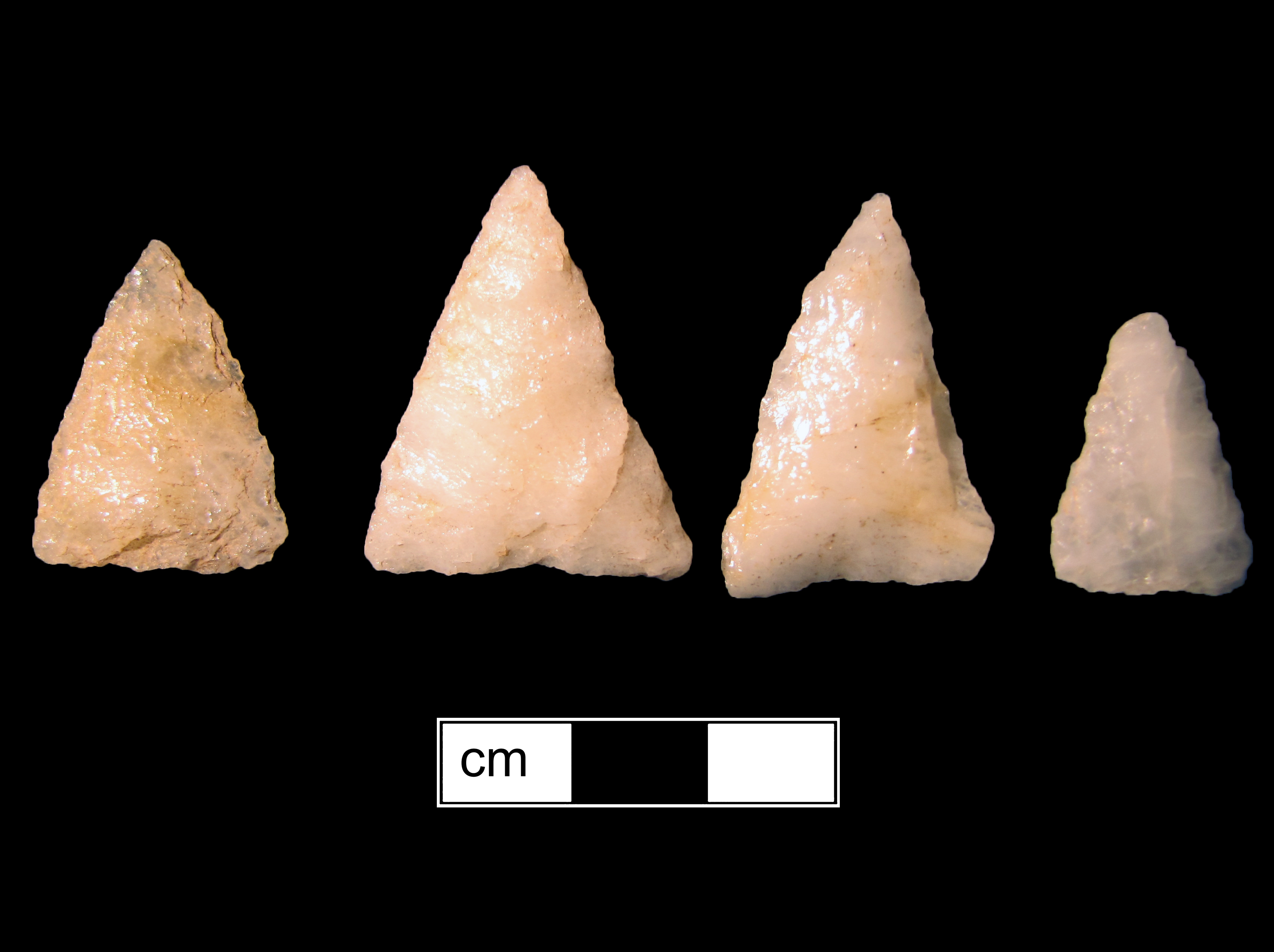
Archaic Triangular Points