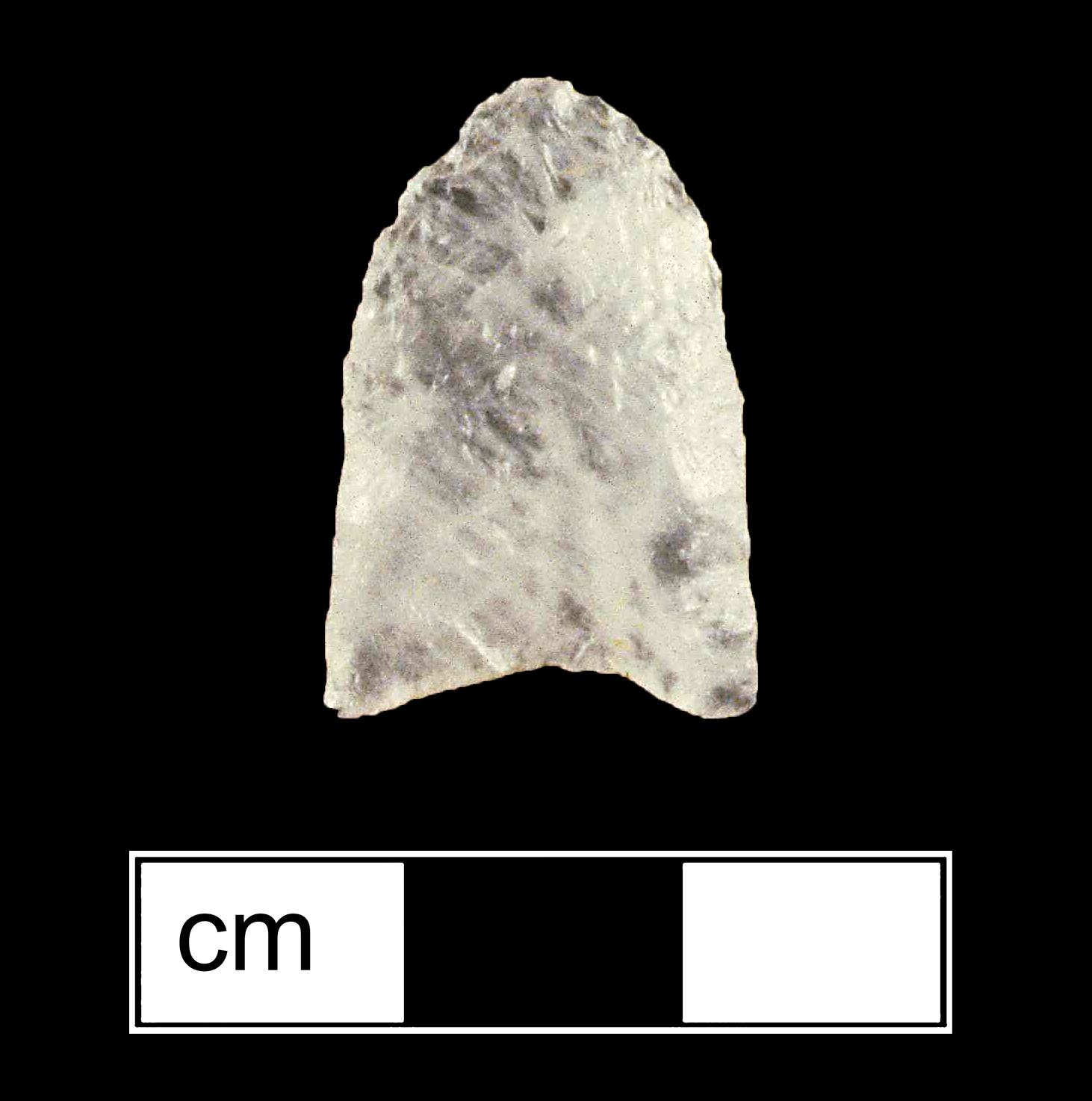
Katcef (18AN57)
Site History
The Katcef (18AN57) site represents stratified Late Archaic overlapping camp sites, Paleoindian and Early, Middle, & Late Woodland base camps located in the Patuxent Preserve in Anne Arundel County, Maryland.
Archaeological Investigations
This site was first identified by avocational archaeologist Robert Ogle, who collected from the site. Ogle’s collection from the Katcef site was cataloged by archaeologist Laurie Steponaitis in the 1980s and in 2020 by Anne Arundel County archaeologists at Lost Towns. The collection included a range of projectile points from the Archaic and Woodland periods, as well as Woodland period pottery.
A Phase I and II survey done by American University in 1989 consisted of 337 shovel test pits spaced at intervals of 50 or 100 feet, plus 22 three by three-foot units. A Phase III excavation in 1990 placed grids of three by three-foot units in five areas of artifact concentrations.
The Katcef site was originally designated as two separate sites: 18AN57 - the J. Beck site, was located at the northern edge of the site; and 18AN58 - the Pigeon House or Katcef site was located on the southern edge of the site. During a survey of sites along the Patuxent River in 1980, Laurie Steponaitis determined that the area in between the two sites was in reality a continuous site connecting 18AN57 and 18AN58; hence both sites are felt to be part of a larger site which is designated as the Katcef site.
The site appears to have been largely destroyed by housing construction in the early 1900s.
References
1990 Intensive Archaeological Reconnaissance in the area of the Proposed Patuxent River Estates. MHT# AN 164.
1991 Phase III Archaeological Investigations of (18AN57), Anne Arundel County, Maryland. MHT# AN 177.
2013 Comparative Study of Prehistoric Settlements on the Patuxent River (Lost Towns Project). MHT # AN 642.