Bayly (18DO536)
Site History
The Caile-Bayly Site (18DO536) is a multi-component site comprised of an Early Archaic lithic scatter; a late 17th-20th-century domestic site; and a standing 18th-century house. The Bayly house is probably the oldest dwelling in Cambridge, having been moved from Annapolis in the 1750s or early 1760s by John Caile and reassembled on the present site with the front originally facing the river. The oldest portion of the house is the larger frame section. The brick addition to the north was built by Dr. Alexander A. Bayly sometime around 1837. Dr. Bayly also added the porches to what is now the front, as well as a new kitchen. In the rear of the house are boxwood gardens and several early outbuildings, including an 18th-century smokehouse.
Archaeological Investigations
In September 2018 and May of 2019, MDOT/SHA archaeologists investigated the Bayly site as part of an archaeological public outreach project. The investigation included a geophysical survey to locate subsurface anomalies, excavations of a systematic shovel test pits, five 5 × 5 foot units and ten 5 × 2.5 foot units. Excavations within yards and within outbuilding footprints revealed historic fill episodes, intact yard surfaces/sheet middens, a masonry privy foundation, and post and planting holes.
Much of the archaeological testing focused on the Bayly Cabin, a 11.6 × 20.8 foot 18th-century frame structure standing west of the Caile-Bayly House and smokehouse. Archaeological and architectural analysis suggest it was moved to its current location in the mid-19th century. Dendrochronology suggested a circa 1737 date for the structure's framing timbers, and it was hypothesized that the structure may have served as the original kitchen on the property during the Caile ownership. The absence of a hearth in the structure in its new locations suggested that it was used as a store or storeroom, rather than as housing for enslaved laborers, as oral tradition had suggested. Prior to the move of the structure, the yard area appeared to have been used as a garden. Archaeological testing under the floor of the Bayly Cabin revealed this area had been used for primary refuse disposal in the second half of the 19th century, evident in a number of reconstructed ceramic vessels found there.
The work revealed how the landscape at the Caile-Bayly site evolved over the last two hundred years. A sheet midden revealed through testing dated to the 18th century, as did artifacts from the privy structure.
References
2022 Archaeological Investigations on the Caile-Bayly Historic Site, Cambridge, Dorchester County, Maryland. Dovetail Cultural Resource Group. Prepared for the Maryland Department of Transportation. DO83.
Associated Artifacts
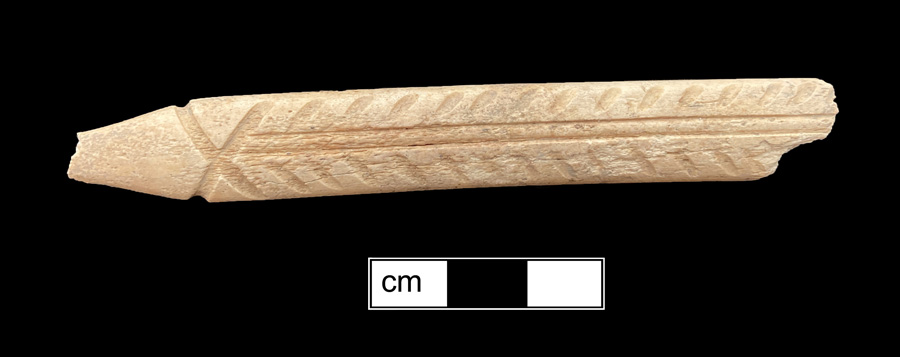
Toys and Games