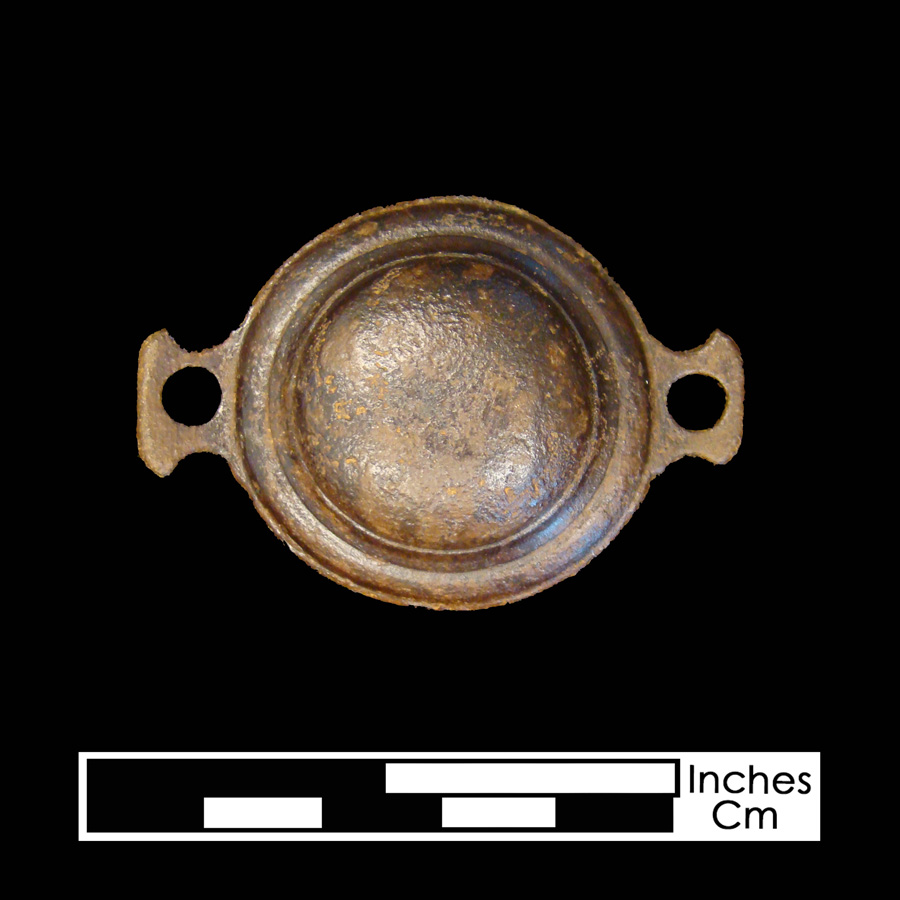
Raven (18HO252)
Site History
The Raven archaeological site (18HO252) is a multi-component site consisting of Late Archaic & Late Woodland camps and a late 17th- or early 18th-century to late 18th-century plantation site. This site is located on the eastern bank of the Patuxent River near Brighton Dam in Howard County. The site is normally submerged but was recorded when reservoir levels were below normal levels. The boundaries of this site also overlap with 18HO88, the Panda site.
Planter Thomas Hutchcraft inhabited this site between 1732-1768. The 1756 land deed indicates that he owned a few slaves, presumably to farm his tobacco fields. He was one of the earliest settlers and planters now known to have inhabited early Howard County.
Archaeological Investigations
Field investigations at this site consisted of several non-systematic surface searches by professional archaeologists during periods of low water levels in the early to mid-2000s. The 2006 survey by the Lost Towns Project included a metal detector survey as well.
This site was originally recorded by Wayne Clark, Paul Inashima, Al Luckenbach, and Susan Langley in 2002 during a survey for the Washington Suburban Sanitary Commission. It was recorded as a late 17th century site revealed during extreme low water level of Triadelphia Reservoir. Bellarmine jar fragments with face, Rhenish blue & gray salt-glazed stoneware, small North Devon sgraffito sherd, horseshoe and chain fragments, some bone, and lots of green bottle glass including kick; Jack's Reef Corner-Notched point. Artifacts were observed but not collected.
In June and July of 2006, repairs to the dam again lowered the water level, and Al Luckenbach and the crew of the Lost Towns Project, along with Wayne Clark and Jim Benton conducted a controlled surface collection and non-ferrous metal detector survey. The distribution patterns of the 17th- and 18th-century domestic artifacts, personal items, agricultural artifacts, architectural artifacts, and tools suggest that these artifact groups are temporally related. Diagnostic artifacts in these categories date primarily to the 18th century, and therefore support the archival evidence that Thomas Hutchcraft inhabited this site during the period 1732-1768. There is no clear documentary evidence that there was any historic habitation prior to Hutchcraft although the presence (noted in earlier surveys) of both Rhenish "bellarmine" jugs and North Devon sgraffito-decorated earthenware might suggest some human occupation during the earlier, late 17th century Anne Arundel County "ranger" period.
A variety of chert, quartz, quartzite, and rhyolite lithics are evidence of prehistoric habitation. One point was identified as a Brewerton side-notched point, which dates to the Late Archaic period (3000-2000 B.C.E.). Another projectile point documented during an earlier survey of the site proved to be a Jack's Reef corner-notched - a type which is associated with the Late Woodland period, dating to around A.D. 800-1250. This wide date range is indicative of intermittent occupations over thousands of years.
References
2003 Archeological Investigations Within the Duckett and Triadelphia Reservoirs - Washington Suburban Sanitary Commission, Howard, Montgomery, and Prince Georges Counties, Maryland. MHT # HO 99.
2006 A Controlled Surface Collection and Metal Detector Survey of the Raven Site (18HO252) at Triadelphia Reservoir, Howard County, Maryland. (Anne Arundel County Trust for Preservation.) MHT # HO 252.