White Swan Tavern (18KE232)
Site History
The White Swan Tavern site (18KE232) is a possible late 17th-century tannery site and early 18th-century standing brick tavern Chestertown in Kent County, Maryland. The earliest documented occupation of the site dated to the purchase of the lot by Colonel Joseph Nicholson in 1733. Nicholson constructed the earliest portion of the structure that was to later become a tavern. Nicholson’s widow, Mary Hopper Nicholson, sold the property in 1793 to John Bordley, who held it for less than a decade. Although it may have functioned as a tavern earlier, newspaper advertisements as early as 1825 and an 1832 deed showed the use of the building as a tavern. In 1854, the property was converted to a store and remained in the Eliason family until its purchase in 1977 by Horace Havemeyer Jr.
Archaeological Investigations
Excavations at the White Swan Tavern were undertaken by Karl de Rochefort-Reynolds of the Chesapeake Community College and Talbot County Historical Society between 1978 and 1981. These excavations were done at the expense of the property owner to facilitate the comprehensive restoration of the site and grounds. More than 50,000 fragments of ceramics, glassware, metal, worked stone, worked wood, leather, and bone – dating from circa 1650 to 1850 – were discovered.
No catalog or site report was completed, but University of Delaware archaeologist Jay F. Custer described finding and re-boxing the 50,000-odd artifacts in 1992, which had been stored in the property owner's barn for a decade. The artifacts were to be studied by the University of Delaware Center for Archaeological Research and eventually given to the Maryland Historical Trust.
The excavations appear to have taken place in three areas (1) the tavern yard, west of the main block and south of the kitchen wing; (2) the tavern and associated well feature, in the southwest corner of the main block; and (3) the kitchen, which includes a frame kitchen, a hyphen addition joining the kitchen and the tavern, and a privy/well feature. Units of 3 × 3 feet were excavated in three-inch levels.
In the tavern yard, a brick and flagstone paving was found buried at depths of 1.5 to 2 feet, extending nearly 25 feet from the rear of the tavern. In most instances, the bricks and flagstone sat upon undisturbed, intact soils. Few artifacts were found beneath the pavement. Diagnostic artifacts from the tavern yard spanned a lengthy time frame, from the early 18th to the early 20th centuries. Diagnostic ceramics of varied dates from the tavern yard are distributed among the arbitrary excavation levels in a mixed fashion and this mixing suggests that the yard deposits were badly disturbed, making it difficult to date the laying of the pavement itself.
A series of 21 units were excavated in the crawlspace and basement area of the tavern itself. The excavation units under the tavern produced a range of artifacts similar to that seen in the tavern yard. Ceramics from the 18th to 20th centuries were present in mixed associations in almost all of the units. The most common diagnostic artifacts (ceramics, coins, and bale seals) dated to the first half of the 19th century, although domestic artifacts from the 18th and 19th centuries were found throughout.
Excavations within the crawlspace and basement did reveal some information about the architectural elements of the structure. The remains of a foundation of a back porch and a rear bulkhead stair entrance to the basement were encountered along with the remains of an earlier wooden front porch. These features likely date to the middle and late 18th century. The well located at the southwest corner of the building was excavated to a depth of 13 feet. Diagnostic artifacts indicate the well was constructed in the early 18th century and related to the occupation of the original core of the tavern structure. It was probably filled in the late 18th century, prior to the major renovations of 1793. All of the well sediments contained abundant floral and faunal remains, including cow, pig, bird, deer, and oyster. Floral remains were well preserved, and numerous samples were taken for analysis.
Units excavated in the vicinity of the kitchen revealed portions of the brick foundations of a hyphen that connected the kitchen and the tavern. The units under the brick hyphen and kitchen contained a series of relatively intact 18th-century, and possibly late 17th-century, deposits. De Rochefort-Reynolds felt that this stratum, more than 2.5 feet in depth and underlain by hard-packed sand, might have been a tanning pit present on the property prior to the construction of the structure that became the tavern. However, the documentary data and the identification of the sediments in this stratum as related to a tanning pit are somewhat speculative.
References
1995 "A Summary of Archeological Investigations at the White Swan Tavern (18KE232), Chestertown, Kent County, Maryland." Maryland Archeology, Vol. 31, Numbers 1 & 2, March-Sept. 1995, pp. 25-38.
Associated Artifacts
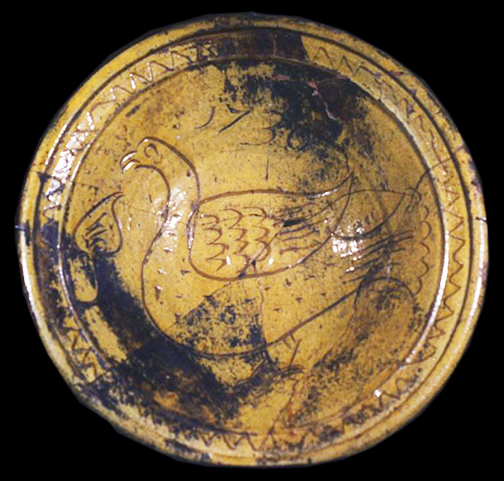
North Devon Sgraffito