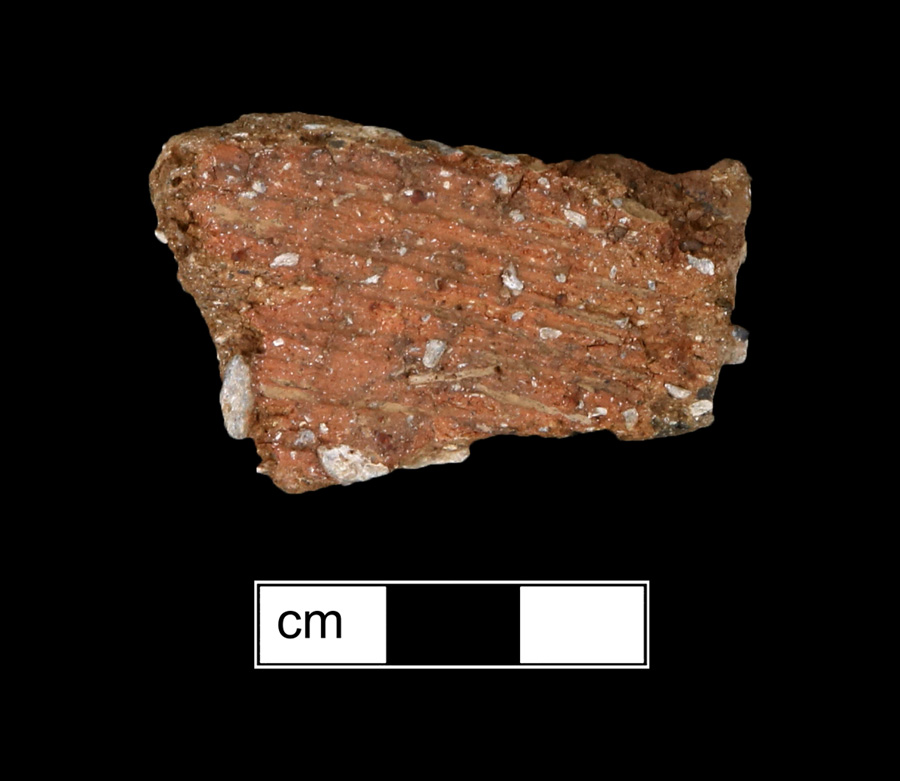
Selden Island III (18MO2)
Site History
The Selden Island III site (18MO2) is an Early Woodland base camp located on Selden Island in the Potomac River in Montgomery County, Maryland.
Archaeological Investigations
This site was initially excavated in 1945 by avocational archaeologists Richard Gates Slattery and Hugh V. Stabler. The excavations consisted of numerous test trenches dug at intervals in a 30 by 35 foot area on several visits into the spring of 1946. The precontact period features discovered consisted of a series of 12 separate circular rubbish-filled pits. The walls of all but three pits were generally vertical with little variation from top to bottom; the other three had sloping basin-like walls. The diameters, measured at the base of plowzone, ranged from 34 to 57 inches, but generally held to near 3 feet and the depths varied from 24 to 41 inches. One pit was floored with 60 broken and unbroken rocks completely covering the bottom of the pit. Intermingled with these rocks were many fragments of a single large pottery vessel.
There was no evidence in any of the pits of fire-baked walls, layers of ash, or concentrations of charcoal that might indicate use in cooking, pottery firing, etc. The layer of rocks found in the bottom of Pit No. 4 might indicate its use as a storage pit, the rocks placed so as to protect the contents from excessive moisture which would tend to be greatest on the bottom. Whatever their original purpose, the pits were finally used as refuse depositories.
Ceramics were less abundant than on other sites excavated in the area at the time; however, 431 sherds and one partially restorable vessel were recovered from the 12 pits and test trenches. Of this total, 93+ percent were tempered with coarsely ground steatite. The remaining sherds were tempered with very finely divided crystalline rock. Both, apparently, were cord-marked, although some of the steatite-tempered sherds were net-impressed. Some steatite-tempered vessels had lug handles that appear to have been modeled closely from those found on large steatite bowls of this area. This ware type was named Selden Island Ware.
Thirty complete and broken projectile points were recovered, of which 16 were classifiable as to shape. A plate accompanying Slattery's 1946 article depicts at least one Calvert and at least one possible Vernon point. The "rounded bases" reference may be Piscataway points. In addition, two grooved axe fragments, several pieces of worked steatite, and two rounded marble-sized stones were found.
The site was partially destroyed in 1977 by the construction of an irrigation pond. Later that year, Russ Henry and R.E. McDaniel completed some work at the site. McDaniel returned to the site in 1979 to conduct a surface collection after the pond destroyed part of the site. The property owner granted permission for some additional work to be done and in 1980, archaeologists with the Virginia Research Center for Archaeology conducted a surface survey. Artifacts recovered included 150 ceramic sherds corresponding with Early Woodland types, steatite bowl fragments, and 345 lithics. All of the points are stemmed (both large-bladed stemmed and small, expanding stem fishtail type) or ovoid base. There is an extremely high incidence of quartzite flakes and unifaces.
Artifacts from this site are curated at the Smithsonian and the Maryland Archaeological Conservation Lab.
References
1962 A Survey of Historic and Prehistoric Archeological Sites along the Chesapeake & Ohio Canal National Monument 1961-1962. MHT# MO 41.
1946 "A Prehistoric Indian site on Selden Island, Montgomery County, Md." Reprinted from Journal of the Washington Academy of Sciences, Vol. 36, No. 8, August 15, 1946, pp. 262-266.