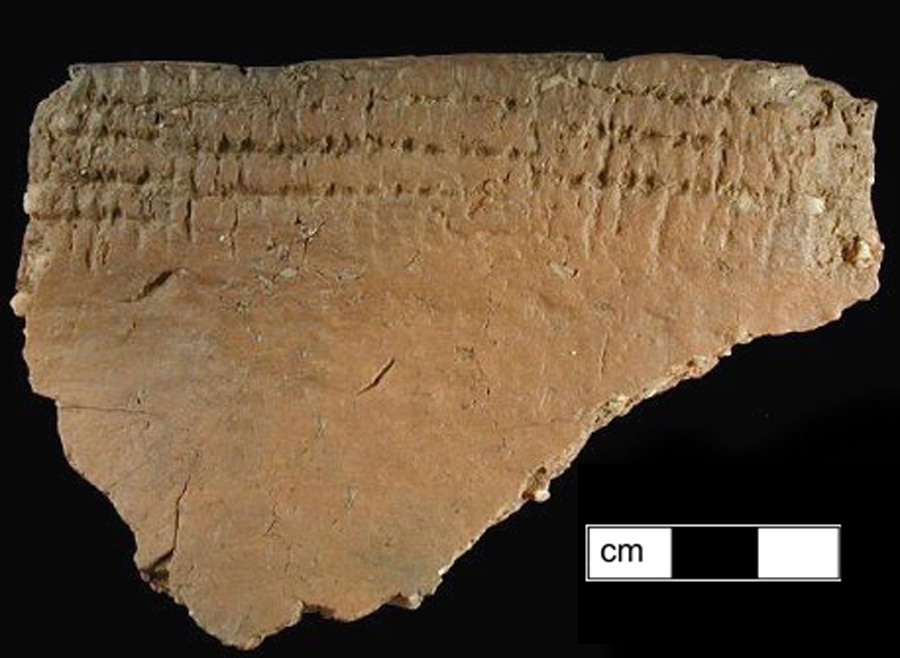
Farmington Landing (18PR4)
Farmington Landing is located on the south shore of Piscataway Creek within Piscataway Park. The site contains evidence of a series of Early, Middle, and (predominantly) Late Woodland occupations. A number of subsurface pits and other archaeological features indicate a probably Late Woodland village at this location. The site may be associated with the Accokeek Creek site, approximately 2 miles to the west.
Archaeological Investigations
Elmer Reynolds of the Archeological Society of Washington, D.C. was the first to examine the Farming Landing site in 1881. The site was subject to frequent flooding and erosion and had been collected by locals for many decades (McGarry 1982). A notable collector from the site was Major George Leach, who amassed a large collection that was later donated to the National Park Service (Cissna and McNett 2001).
More thorough documentation of the site did not come until 1967 as part of a field session of the Archeological Society of Maryland (ASM) led by Douglas Woodward. At the time, it was believed that the site was at risk for gravel mining, so it was approached as a salvage project. Shovel testing, as part of the first phases of the project, indicated a roughly 10-inch thick midden over most of the site, which had been disturbed by plowing. In areas of artifact concentrations, 16 trenches, measuring 3 feet by 10 feet, were excavated. Two trenches were expanded to expose a large pit feature (Cissna and McNett 2001).
Three large pits were identified as part of this work (Pits C, K, and L). Pits C and K date to the Late Woodland period, with a predominance of Townsend ceramics. Pit C contained 120 Townsend and 18 Potomac Creek sherds, in addition to earlier ceramics such as Mockley, Popes Creek, and Accokeek. Other artifacts recovered were projectile points, a stone tobacco pipe, a bone awl, deer antler, and faunal remains. Pit K consisted nearly entirely of Townsend sherds, a large triangular point, and faunal remains that included deer, turtle, beaver, and oyster shells. Pit L dates to the Early Woodland period, with 52% of sherds being Popes Creek and 36% being Accokeek ware. Faunal material included deer, bird, fish, turtle, unidentified small mammal, and clam shells. Two human phalanges were also recovered from Pit L.
A second ASM field session returned to the site in 1968. This work consisted of excavating 27 5-by-5 foot test units in areas north of the 1967 excavations. Most of the 27 test units were excavated as larger excavation blocks. Three features uncovered during the 1968 investigations included a possible human burial, a hearth, and a dog burial. Remains from the human burial were excavated and donated to the Smithsonian (Woodward 1967; Thurman 1972).
In 1974, Betty Veatch used the data from the ASM investigations and examined the Leach Collection at the Smithsonian for her master's thesis at American University. Veatch did not examine lithic material within the Leach collection (Veatch 1974). Other less intensive surveys followed after the National Park Service acquired the Farmington Landing property. This included mitigation related to shoreline improvements in 1976 and a surface survey of the beach, which turned up mostly debitage and a single Late Woodland Madison projectile point.
References
2001 Archeological Survey of Piscataway Park. Unfinished draft report on file, National Park Service, Museum Resources Service Center, Lanham, Md.
1982 Piscataway Archeological Survey-1981, Piscataway Park, National Capital Parks-East, National ark Service, Denver Service Center. Ms. on file, National Park Service, MRCE, Lanham, Md.
1972 Re-Excavation of the Accokeek Creek Site: A Preliminary Report. Paper presented at the 37th annual meeting of the Society of American Archaeology, Bal Harbour, Florida.
1967 The Piscataway Site: A Progress Report. Archaeological Society of Maryland Miscellaneous Papers 6:1-11.