Thomas Point (18ST570)
Site History
The Thomas Point site (18ST570) is a Late Archaic to Early Woodland shell midden located on the Patuxent River in Myrtle Point Park in St. Mary's County, Maryland.
Archaeological Investigations
The Thomas Point Site was discovered in 1986 during a Phase I archaeological survey of the 211-acre Patuxent River Farms property. This survey identified 37 sites, including 9 which were determined National Register eligible. Two of these eligible sites could not be avoided during construction – the Myrtle Point site (18ST569) and the Thomas Point site (18ST570) – and they were further investigated from 1987 through 1989.
The Phase I shovel testing, at 10m intervals along transects spaced 30m apart, identified the site as a large shell midden and campsite extending for approximately 220m along the edge of a bank overlooking a tidal marsh, and for a maximum of 160m west of the marsh bank. Site boundaries were most clearly defined by the nearly continuous distribution of oyster shell fragments, and less commonly recovered lithic knapping debris, fire-cracked rock, and shell-tempered ceramics. The highest shell concentrations occurred close to the marsh bank. Nearby all the shell was broken, rounded, and recovered in the plowzone. One shovel test encountered an area of complete layered shell interpreted as an area of preserved midden directly south of the ravine bisecting the site. This stratum yielded four fragments of Late Woodland shell-tempered pottery. This area of buried midden was intensively excavated in 1988 during the subsequent Phase III investigations. In total, one projectile point (a Late Archaic Holmes point) and 29 ceramics were found. These included 1 Accokeek cord-marked, 1 Popes Creek cord-marked, 3 unidentified quartz-tempered sherds, and 1 unidentifiable sand and grit tempered sherd. The remaining 23 were Late Woodland Townsend-Rappahannock series ceramics.
Phase II and III investigations were conducted in 1987 and 1988 by Julia King and Joe Herbert. The 1987-88 Phase II testing consisted 48 1 × 1 m units placed at 20m intervals across the area identified by the Phase I survey. Phase III efforts focused on the investigation of the shell midden through the excavation of 77 1 × 1 m units transecting the midden and surrounding area.
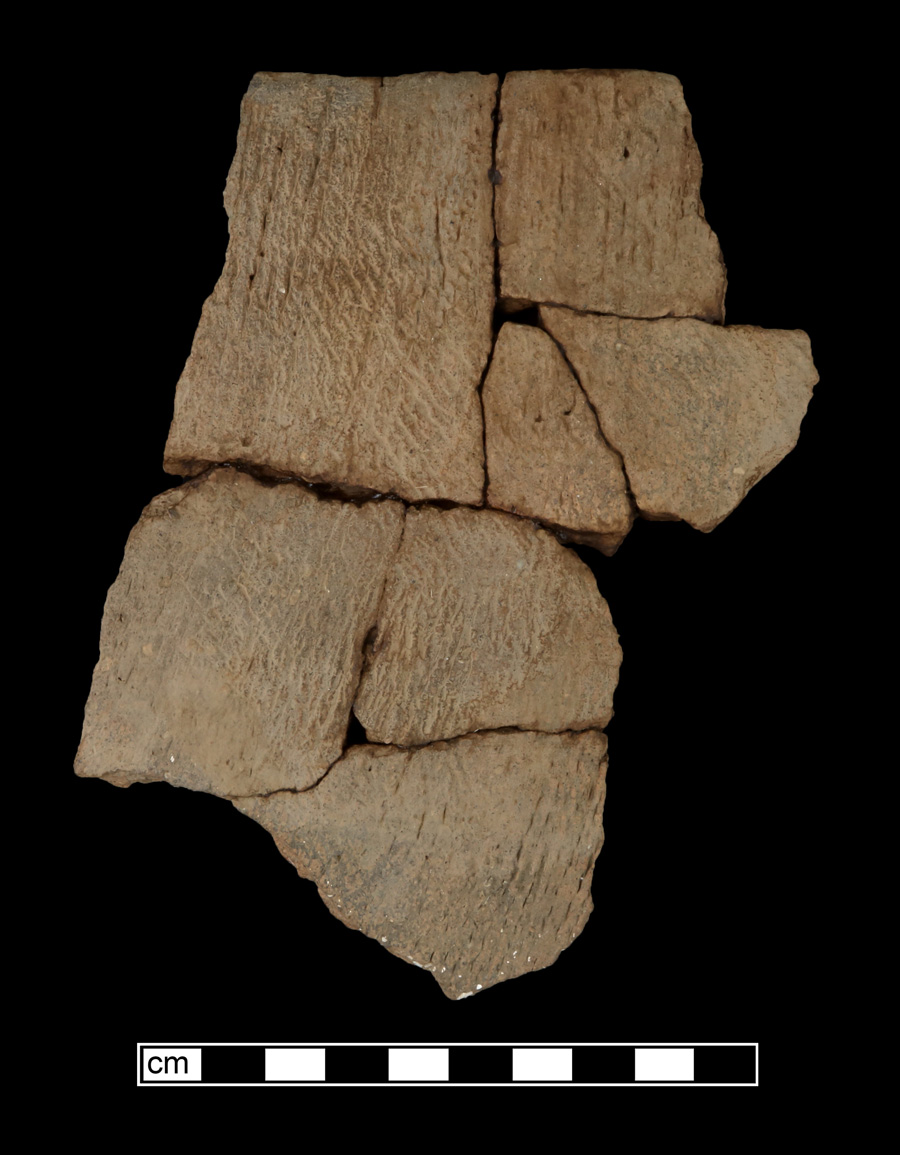
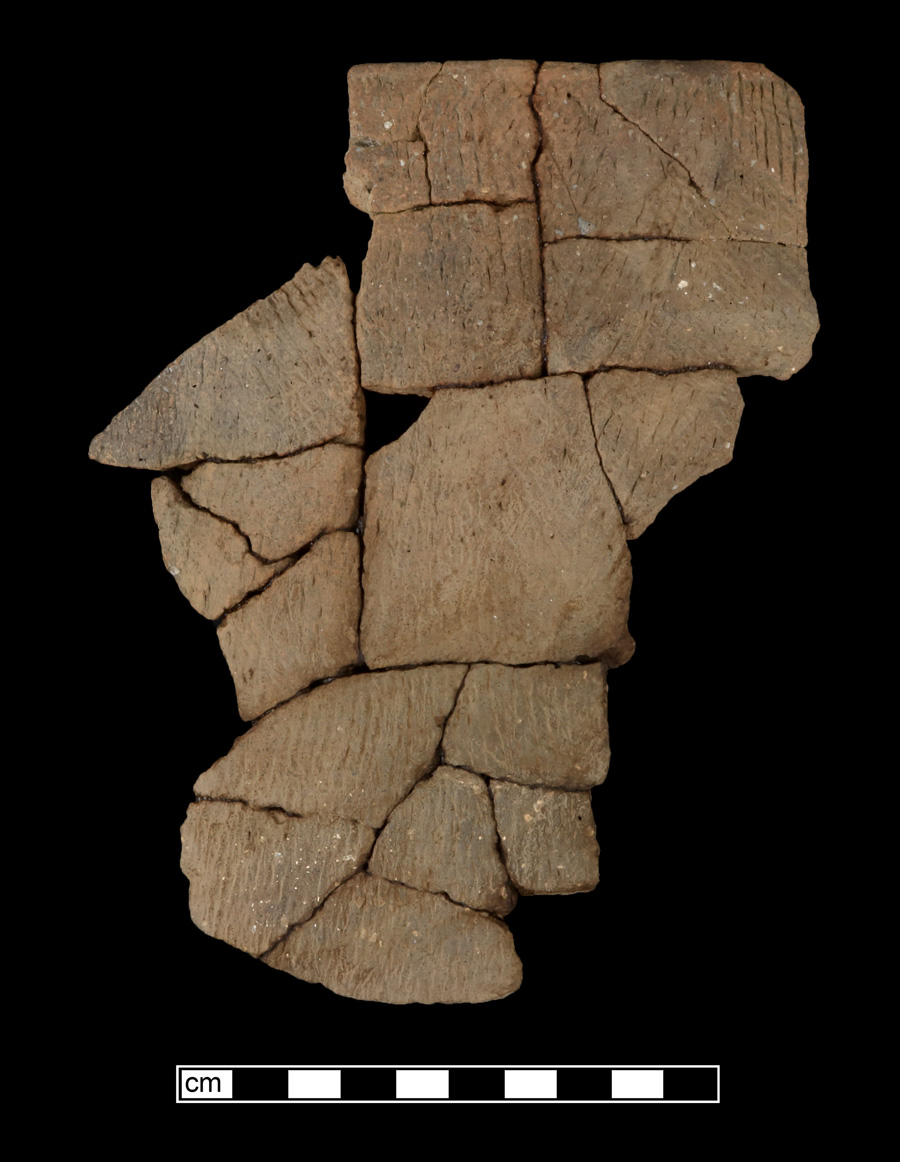
The data indicated that the site was first occupied in the Late Archaic period. Traces of activities from this period are limited to a few stone tools and flaking debris which shows little spatial clustering. More frequent reoccupation during the Middle Woodland is evidenced by the presence of Mockley ceramics found in the shell midden. Residential occupation intensified during the Late Woodland when isolated shell heaps merged to form a continuous midden. Cultural remains from this period include ceramics of the Townsend series (Rappahannock Plain and Fabric-impressed, and Townsend incised) and Sullivan Cove ware (cord marked), small, triangular projectile points, bone and carbonized plant remains. Evidence of historic occupation at the site is limited to a few, widely scattered 19th- and 20th-century ceramics, kaolin pipe fragments, glass, and nails. The sparsity and random spatial distribution of these materials provide little evidence for the presence of architectural structures.
Data from the shell midden provides evidence that the transition from Middle Woodland, Selby Bay Phase to the Late Woodland, Little Round Bay and Sullivan Cove Phases occurred in this region between A.D. 800 +/- 70 and A.D. 1070 +/- 50. Increased sedentism associated with the Late Woodland period is reflected by food remains from the midden which indicate that maize agriculture was an integral part of the economy. The Middle Woodland reliance on nonlocal rhyolite for making stemmed points was replaced about A.D. 900 with the use of local quartz and chert for the manufacture of small, triangular arrow points. The production of ceramics also shifted at this time from those stamped with cordage to wares impressed with fabric or incised with geometric designs.
References
1995 Thomas Point (18ST570) Emerging Late Traditions in Southern Maryland. (JPPM Occasional Papers No. 5) MHT # ST 145.
1989 An Archaeological and Historical Survey of Myrtle Point, St. Mary's County, Maryland. MHT# ST 74.
1991 Myrtle Point: the Changing Land and People of a Lower Patuxent River Community. JPPM Occasional Paper No. 3. MHT# ST 99.
Associated Artifacts
Sullivan Cove