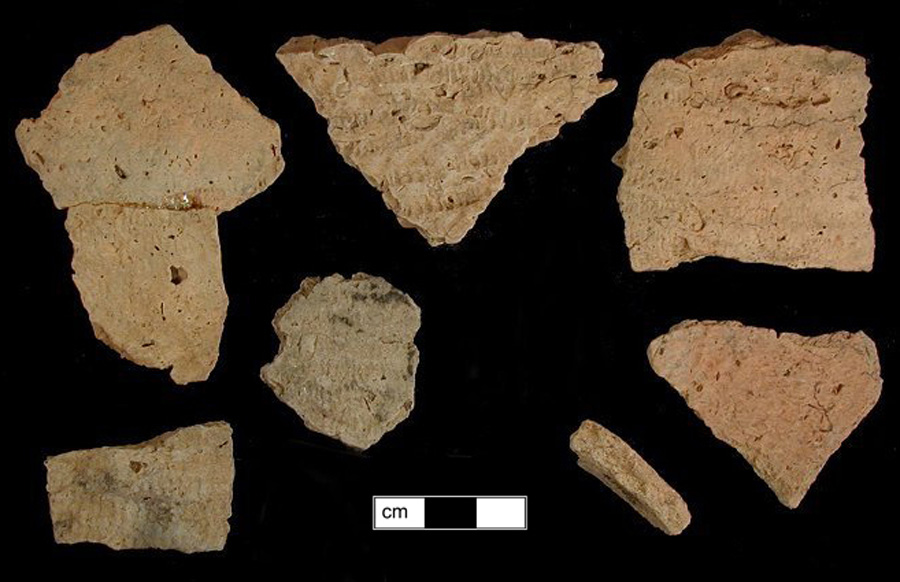
Miller (18WC68)
Site History
The Miller site (18WC68) is an Early and Late Woodland shell midden and 18th-century artifact scatter along the Nanticoke River in Wicomico County, Maryland.
Archaeological Investigations
The site was first recorded by geologist J.T. Ducatel in 1836. The site was visited by Tom Davidson of Salisbury State College in 1983 and subsequently examined by the U.S. Army Corps of Engineers to determine whether riprap and grading construction would adversely impact significant cultural resources, and to comply with the Department of the Army regulations for the protection of cultural resources permit actions in waters of the United States.
This site was evident as the intermittent remains of a shallow Late Woodland shell midden that stretched 150m along the eastern bank of the Nanticoke River. What is left of the site lies adjacent to the shoreline within 5 meters; shore erosion has been extensive. Artifacts recovered from the site included Townsend corded and fabric impressed pottery, as well as lithics and faunal bone. There were no intact features noted during the investigation.
In addition to precontact materials, the presence of brick, coal, cinder, and a scattering of square nails, a glass vial, and a yellow-green glazed earthenware ceramic sherd is indicative of 18th-century cultural residue. The wooden structure where a brick chimney now stands was donated and moved to the Pemberton Hall Plantation Site, a National Register property (see 18WC29), by the previous owner, Dr. John M. Bloxom of Salisbury.
References
1986 Archeological Investigation of the Miller Site, 18WC68, Nanticoke River, Wicomico County, Maryland. Maryland Archaeology Vol. 22, No. 1 (March 1986).