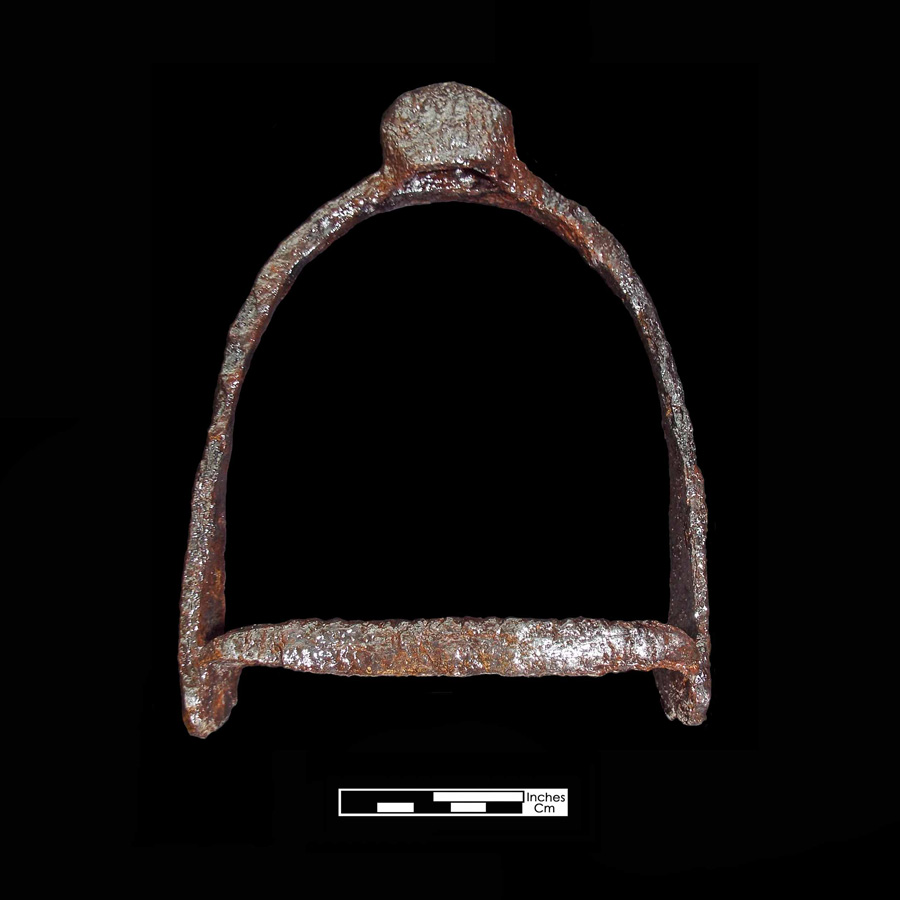
Wolstenholme Towne, Carter's Grove Site C (44JC115)
Period of significance is ca. 1620-1622.
Site History
In 1618 over 200 settlers boarded the ship Gift of God and set off from England as part of the Martin’s Hundred enterprise, a subsidiary to the Virginia Company of merchant adventurers who had established a colonial foothold at Jamestown the previous decade. The shareholders were promised 20,000 acres in Virginia, and by 1620 they established their settlement, Wolstenholme Towne, about nine miles downstream from Jamestown on a desirable waterfront property along the James River that would later become Carter’s Grove plantation.
While Martin's Hundred’s investors supposedly sent 280 recruits, by the winter of 1621/22 they apparently numbered only 140. In March 1622, they lost an additional 70 settlers to an attack by the Powhatan, who tried to expel the colonists under the leadership of Chief Opechancanough. The Powhatan burned dwellings and outbuildings and killed or captured about half of the occupants.
Despite the losses, the English later returned to Martin's Hundred to rebuild, albeit with a much lower population and few surviving buildings. Further complicating the fate of the Hundred, in 1624 James I withdrew the Virginia Company charter, declared Virginia a royal colony, and left subsidiary investors such as the individuals that had funded Martin’s Hundred in a somewhat ambiguous position. Archaeologists found sites occupied into the 1640s. While the early years of settlement were likely marked by a desire to stick together and remain within fleeing distance of a fortified dwelling, by the 1640s the population of Martin's Hundred seems to have dispersed, presumably to spread out more and take advantage of the thousands of arable acres the Hundred offered.
Archaeological Investigations
Between 1976 and 1981 excavations undertaken at Carter's Grove plantation under the direction of Ivor Noël Hume targeted 17th-century sites that had been identified by an earlier survey. Piecing together historical and archaeological evidence, researchers identified the sites as belonging to Martin's Hundred. The sites were named in the order in which they were found (Site A, Site B, etc.), and then later analysis and research led to a better chronological understanding of each site and the inhabitants who may have lived here. Subsequent excavations, such as those on the Locust Grove Tract of Carter's Grove, revealed additional sites believed to be affiliated with Martin's Hundred (Moodey 1992).
Martin's Hundred’s Site C is interpreted as Wolstenholme Towne, the original center of the settlement. Site C yielded a 93 × 130 foot fort with a watchtower at the southeast corner and a flanker or bastion at the southwest corner. Bracketing the fort on the river side were a “Company Barn” presumably used to store the produce of the venture, and a "Company Compound" containing a long house, outbuildings, a clay borrow/trash pit dubbed "Potter’s Pond," enclosure palisades, and one grave of a man likely killed in the 1622 attack.
On the river side of this compound was another dwelling the excavators called the "Domestic Unit," which presumably represented a standard home for Company laborers, though erosion has presumably claimed most of these. Ivor Noël Hume and the other excavators and researchers interpret the Site C area as having been established after the arrival of Governor William Harwood in 1620 and destroyed in March 1622 by the Powhatan. Although some deposits may represent post March 1622 clean-up by survivors or new immigrants to Martin’s Hundred, this complex was abandoned after the attack in favor of the new center of the settlement ' represented by Site A.
References
1992 Phase II Archaeological Investigation of the Locust Grove Tract, Carter's Grove Plantation. Colonial Williamsburg Archaeological Reports. Accessed online.
1983 Discoveries in Martin’s Hundred. Colonial Williamsburg Archaeological Series No. 10. The Colonial Williamsburg Foundation, Williamsburg, Virginia.
1988 Martin's Hundred. Alfred A. Knopf, New York.
2001 The Archaeology of Martin's Hundred: Part I, Interpretive Studies; Part II, Artifact Catalog. University of Pennsylvania Museum of Archaeology and Anthropology, Philadelphia, PA, and The Colonial Williamsburg Foundation, Williamsburg, Virginia.