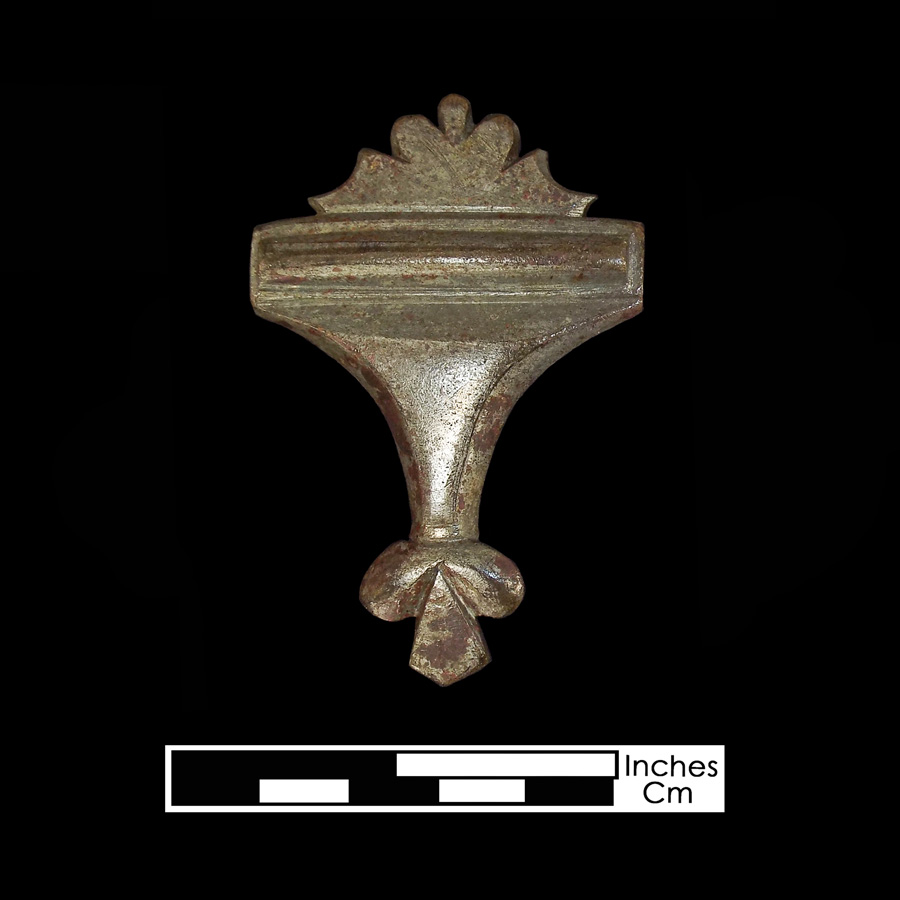
North Quarter (44JC52)
Site History
The North Quarter site (44JC52) is the site of an enslaved quarter dated to the second half of the 18th century and located on the Kingsmill Plantation tract east of Williamsburg on the James River. The quarter is depicted on the Desandrouins Map of 1781 as containing three structures.
Archaeological Investigations
The site was discovered during a Phase I testing survey of the Kingsmill tract by the Virginia Historic Landmarks Commission Research Center for Archaeology in 1973. This work documented the site as an area of heavy brick and a possible cellar. Planned development of the property led to an archaeological investigation in 1977 and 1978. This work was directed by Dave Hazzard and Nick Luccketti of the Virginia Department of Historic Resources.
The archaeological work focused on one structure believed to have been part of a quarter for enslaved individuals. Removal of the plowzone in the area of the brick concentration revealed a backfilled cellar, but no evidence of structural foundations, suggesting that the building had been supported on either ground-laid wooden sills or brick piers. The placement of the half cellar and two subfloor pits within the footprint of the building suggested that structural dimensions of 25 × 16 feet. Other features included postholes and drainage ditches. A brick concentration and several scaffold postholes suggested that the hearth and chimney for the building were along its north façade.
Artifacts recovered from the excavation indicate that the site was abandoned around the turn of the 19th century. The presence of a cannonball, regimental buttons, gun parts and French wine bottles suggest that this building may have been used by French troops during the Revolutionary War.
Artifacts from this site are curated at the Virginia Department of Historic Resources in Richmond.
References
1984 Kingsmill Plantations, 1619-1800; Archaeology of Country Life in Colonial Virginia. Academic Press, New York.
1979 North Quarter Salvage Excavation Interim Report. Virginia Research Center for Archaeology, Williamsburg.