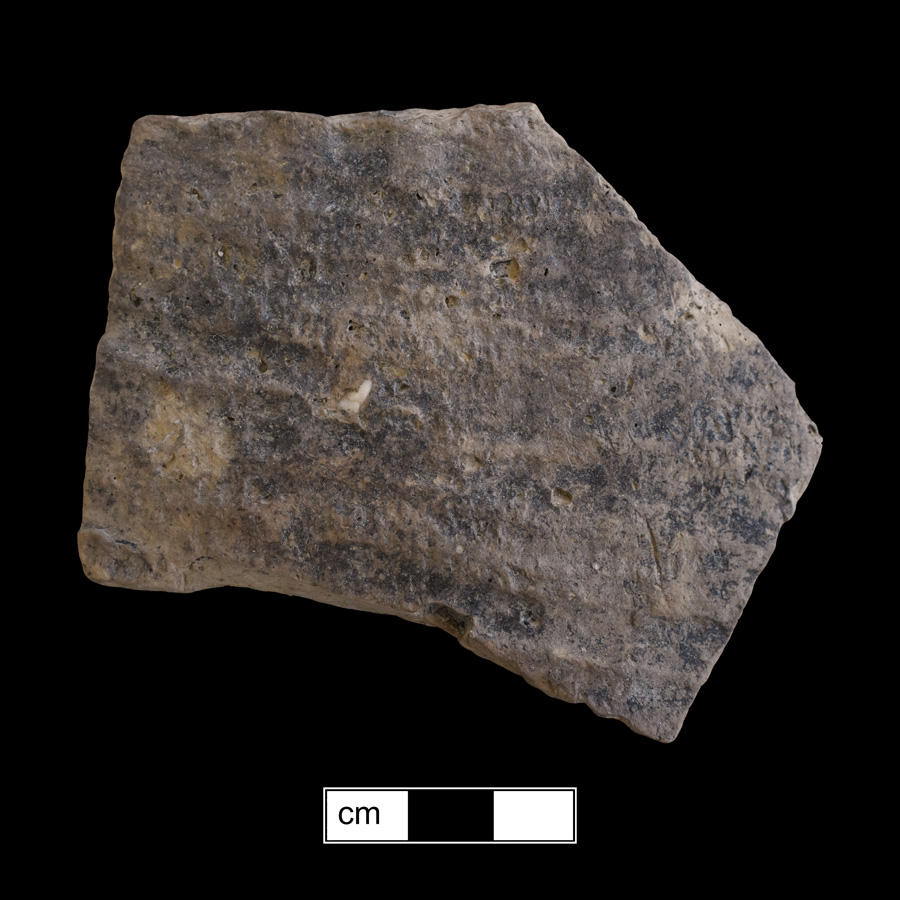
Sharps (44RD238)
Site History
Sharps (44RD238) is a multicomponent site consisting of an Early and Late Woodland artifact scatter, as well as a scatter of 17th- and 18th-century European and English artifacts. The site is located on the Rappahannock River near Warsaw in Richmond County, Virginia.
Archaeological Investigations
Archaeologists from St. Mary's College of Maryland monitored the site during the July 2019 replacement of a bulkhead after receiving a call that human remains had been found. Examinations of the remains concluded they were not human.
The archaeological work included cleaning up a portion of the exposed stratigraphic profile (20 feet wide × 5 feet deep) to observe a feature that had been disturbed by the work being done. A thin strip of undisturbed feature was observed just above subsoil. The feature had darker colored soil (grayish brown 10YR5/2 sand) and a higher concentration of oyster shells that also appear more intact/whole. The shoreline had been entirely excavated.
Prior to the monitoring work conducted in July 2019, archaeologists from St. Mary's College of Maryland examined a collection of hundreds of artifacts recovered by the son of the property owner from this site and several others nearby. His collection from Sharps includes stone tools, projectile points, and ceramics dating from the Early Archaic through the Late Woodland. Historic artifacts within his and other local collections included 18th and 19th-century ceramics, glass, and tobacco pipes.
Artifacts observed from the site included the following types of Native American ceramic: Accokeek, Yeocomico/colonoware, Potomac Creek, Moyaone, colonoware/Camden, and colonoware/Townsend. Historic period artifacts included White clay tobacco pipes-bowl and stem fragments, red clay tobacco pipes, tin-glazed earthenware, Staffordshire slipware, unidentified coarse red earthenware, olive green glass fragments, hoe blades, copper scrap, wrought and cut nails, brick, mortar, plaster, oyster shell, and faunal bones.
Historic period artifacts are likely associated with the nearby historic home known as Milden Hall, which stands approximately 650 feet west of the site. Archaeologists from St. Mary's College conducted a site visit to Milden Hall after the installation of a utility line from the house to the pier and observed 19th-century artifacts.