Leedstown (44WM22)
Site History
Leedstown is notable in history as the location of a colonial town and river crossing which adopted the Leedstown Resolves in the lead up to the American Revolutionary War. The Leedstown Resolves were published in 1766 as a response to the British Stamp Act of 1765. Located at a horseshoe bend of the Rappahannock River, the town, established in 1742, was also the site of a colonial ferry crossing that was often frequented by George Washington in his travels from Mount Vernon to the Virginia colonial capital of Williamsburg.
Nothing survives of the town today except for partial foundation remnants of the c. 1730 Bray’s Church and evidence of brick-lined floors eroding from the banks of the river. In addition to the colonial town, Leedstown is notable to artifact collectors as a site where 17th century glass trade beads can be found. Believed to be the location of a bead cache, the indigenous occupation of the site is believed to be part of the Rappahannock town known as Pissaseck.
Archaeological Investigations
Archaeologists were first interested in Leedstown because of the glass beads collected and recorded there that have been found in numerous collections throughout the United States. One of the first archaeologists to document the site and the potential bead cache was David Bushnell of the Smithsonian Institute's Bureau of Ethnology in the 1920s/30s. Bushnell described 13 varieties of glass beads at the site in addition to numerous points and pottery dating from the Early Archaic through the Late Woodland.
Beads were concentrated in one area of the site in a low area near the ruins of Bray's Church. Bushnell surmised that the beads were likely buried in a box or other container that has been eroding ever since. The most notable style of bead is a compound drawn bead with a translucent green core covered in opaque red glass with blue and white stripes (Kidd and Kidd Type IVbb7). These types of beads are rarely found on sites occupied by Europeans and have been found almost exclusively on indigenous sites from Pennsylvania to Florida. The only known examples within the Chesapeake region have been found on indigenous sites at Port Tobacco (18CH94) and Heater’s Island (18FR72) in Maryland and Conoy Town (36LA57) along the Susquehanna River in Pennsylvania.
Ceramics that Bushnell collected from Leedstown and surrounding fields were lated examined by Clifford Evans of the University of Virginia in the early 1950s. Other Virginia archaeologists such as Ben McCary and Howard MacCord also visited the site at different times between the 1950s and 1970s.
While collectors have visited Leedstown for many decades after Bushnell and others, it wasn’t until 2018 that archaeologists from St. Mary's College of Maryland conducted a systematic survey of 7.5 acres of the Leedstown site, which collected evidence of both the indigenous and colonial occupation. A total of over 17,500 artifacts were recovered. Three test units were excavated where shovel tests encountered high counts of Late Woodland ceramics. One of the three test units was placed in the conjectured location of the bead cache described by Bushnell. A total of 198 beads from the site housed at the Smithsonian were also re-examined in addition to 27 found during the 2018 excavations.
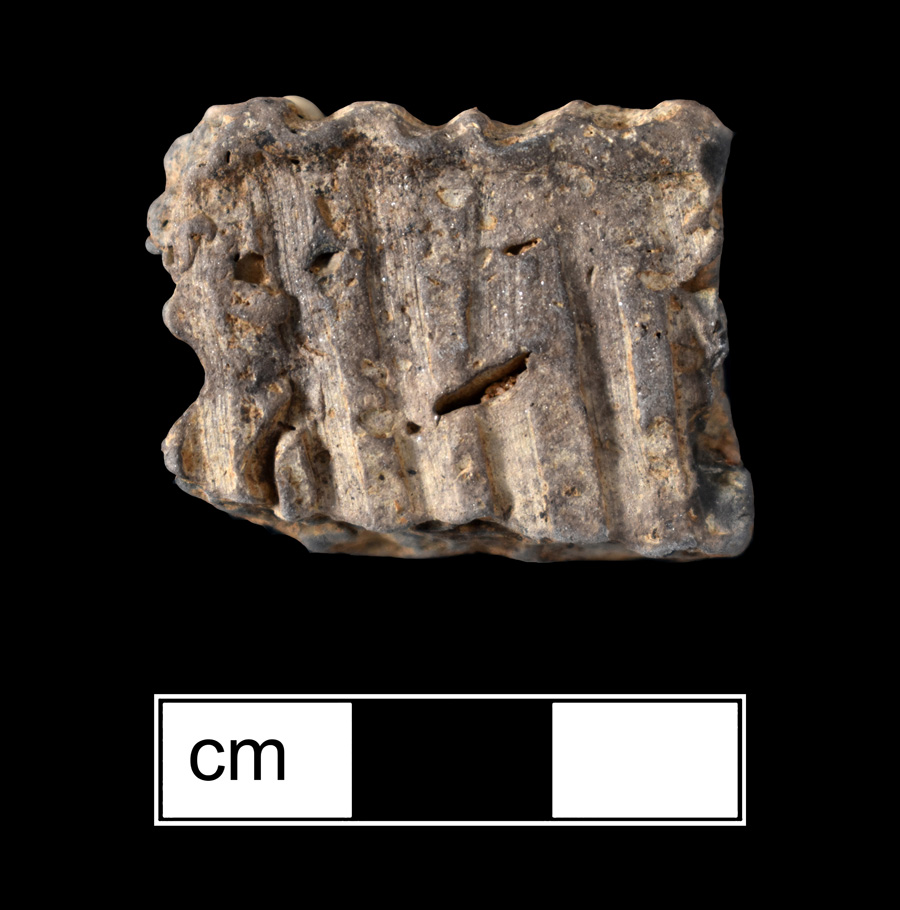
While Bushnell recorded a number of ceramics dating from the Early through Late Woodland, the 2018 excavations recovered primarily Late Woodland types – most notably Townsend series ceramics. One rim sherd recovered was uniquely decorated with incised vertical lines on the exterior, lip nicked rim, and peculiar impressions on the vessel interior. The interior decoration appears to have been made with the edge of a fabric or cord wrapped paddle. Other sites with such an interior decoration include another Rappahannock River site known as Sharps (44RD238) and Longview Beach/Secowocomoco/Lower Brambly (18ST51) in St. Mary's County, Maryland.
References
1937 Indian Sites Below the Falls of the Rappahannock, Virginia. Smithsonian Miscellaneous Collections, Vol. 96, No. 4. Washington, D.C., Government Printing Office.
1955 A Ceramic Study of Virginia Archeology. Smithsonian Institution Bureau of American Ethnology Bulletin 160. Washington, D.C., Government Printing Office.
2022 The Leedstown Bead Cache and Anglo-Native Trade in the Rappahannock River Valley. Journal of Middle Atlantic Archaeology, Vol. 38, 2022.
2023 Ceremonial Landscapes in the Chesapeake. In Our Hidden Landscapes: Indigenous Stone Ceremonial Sites in Eastern North America. University of Arizona Press.
2016 Defining the Rappahannock Indigenous Cultural Landscape. Report prepared for NPS Chesapeake Bay, the Chesapeake Conservancy, and the Rappahannock Tribe of Virginia.