Silicified Stone
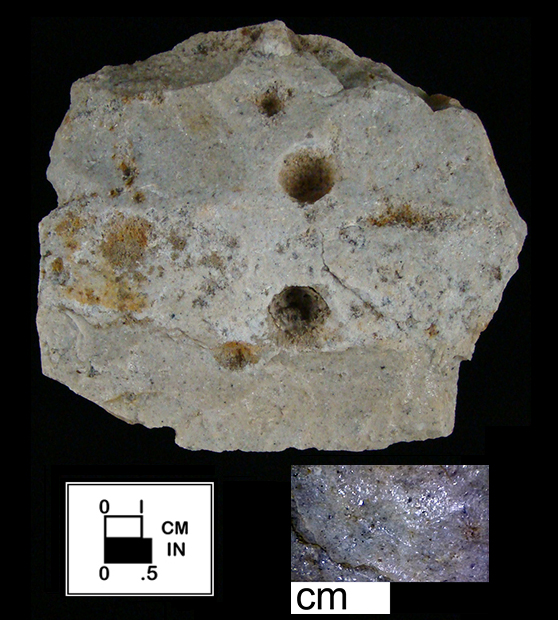
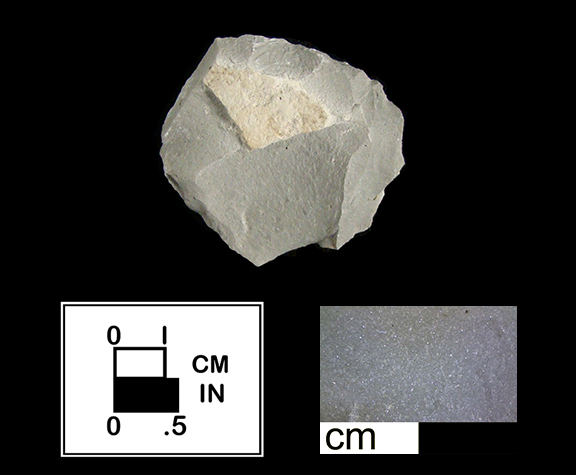
Occurs when silica is introduced into a rock via groundwater or fluids of volcanic origin. The introduced silica either fills spaces in the rock or replaces preexisting minerals. Petrified wood is a silicified material, and was occasionally used for tools on the Eastern Shore (Lowery 2002). Silicified sandstone is found at various locations in Maryland, especially on the Coastal Plain. It can be difficult to distinguish this material from quartzite with the naked eye (Andrefsky 1998), but the individual grain boundaries in silicified sandstone are distinct from the surrounding cement. On the Eastern Shore, it often has a gray/blue translucent appearance when freshly exposed, with inclusions of microfossils and dark lignite particles (Lowery 2002). It weathers severely, and can fall apart with age. Indians utilized silicified sandstone from along the Choptank and Wye rivers on the Eastern Shore, as well as on the Potomac River in Southern Maryland. Silicified sandstone was used during the Late Archaic period in far Western Maryland (Wall 1992). A finer-grained material, silicified siltstone, was also used in that region (Ebright n.d.), and silicified mudstone tools have been found on the Eastern Shore. High quality silicified mudstone is fine grained and fractures conchoidally (Lowery 2002).