Adhesive Decoration
Adhesive decorative methods involve adding a decorative element to the surface of glass through painting or spraying. Four types of adhesive decorative techniques include staining, enameling, gilding, and iridescent glass.
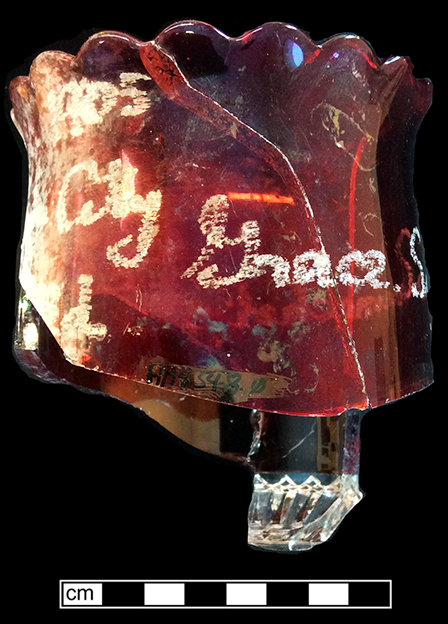
Staining – In this adhesive technique, staining material is painted on colorless glass. The decorated glass is then refired to fuse the staining material with the glass and attain the desired color. Staining glass was an inexpensive method to add a layer of surface color to colorless glass. Stained glass is different from fused glass, which is colorless glass dipped into a molten colored glass.
Produced using silver chloride, amber staining on glass dates as early as 1820 and red/ruby staining by 1840 (Jones 2000:150). This technique was popular between the late 1880s to the early 20th century. Stained glass is common on inexpensive tourist glassware that often displayed acid etched place names, dates and personal names. The colors will often wear off of the vessel surface, showing the colorless glass beneath.
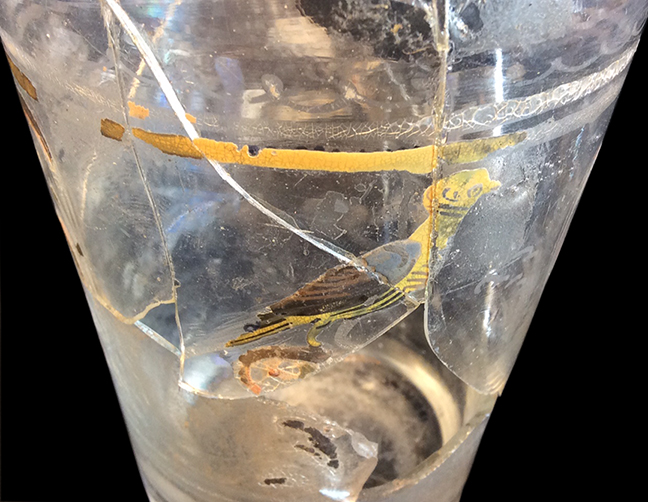
Enameling – Enameling is an adhesive technique that involves colors mixed with adhesives applied to the glass surface. The glass is then fired to fuse the colors to the surface. This is an ancient technique practiced since the medieval period but began to be used on English drinking glasses in the second half of the 18th century (Bickerton 1986:28). This technique was popular from the 1880s into the early 20th century (Jones 2000:150). It became popular again in the late 1920s and soon became a mechanized process.
Gilding – Gilding is an adhesive technique introduced in the second half of the 18th century (Bickerton 1986:28, 32). The earliest gilding was done with oils and since it was not fixed by firing, will be less likely to survive archaeologically.
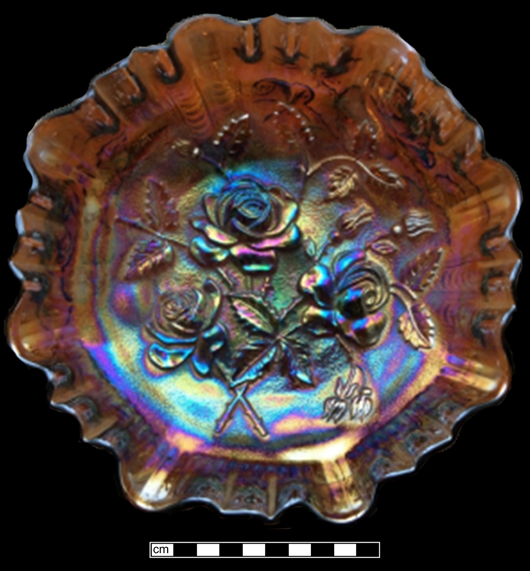
Iridescent – Iridescent glass was created by exposing hot glass to metallic chlorides, creating a range of colors like purple, blue, and amber. This technique was developed in the 1870s but was not used on pressed “carnival” glass until 1905. Carnival glass, made in the United States between about 1895 and the late 1930s, was so named because it was frequently offered as a fairground prize (All About Glass/Corning Museum of Glass; Jones 2000:151).
References
n.d. https://allaboutglass.cmog.org/. (This website has an extensive glass dictionary and thousands of photographs).
1986 Eighteenth Century English Drinking Glasses; An Illustrated Guide. Antique Collector’s Club, Woodbridge Suffolk.
2000 A Guide to Dating Glass Tableware, 1800 to 1940. Studies in Material Culture Research. Edited by Karlis Karklins. Society for Historical Archaeology.