Hot Glass Decoration
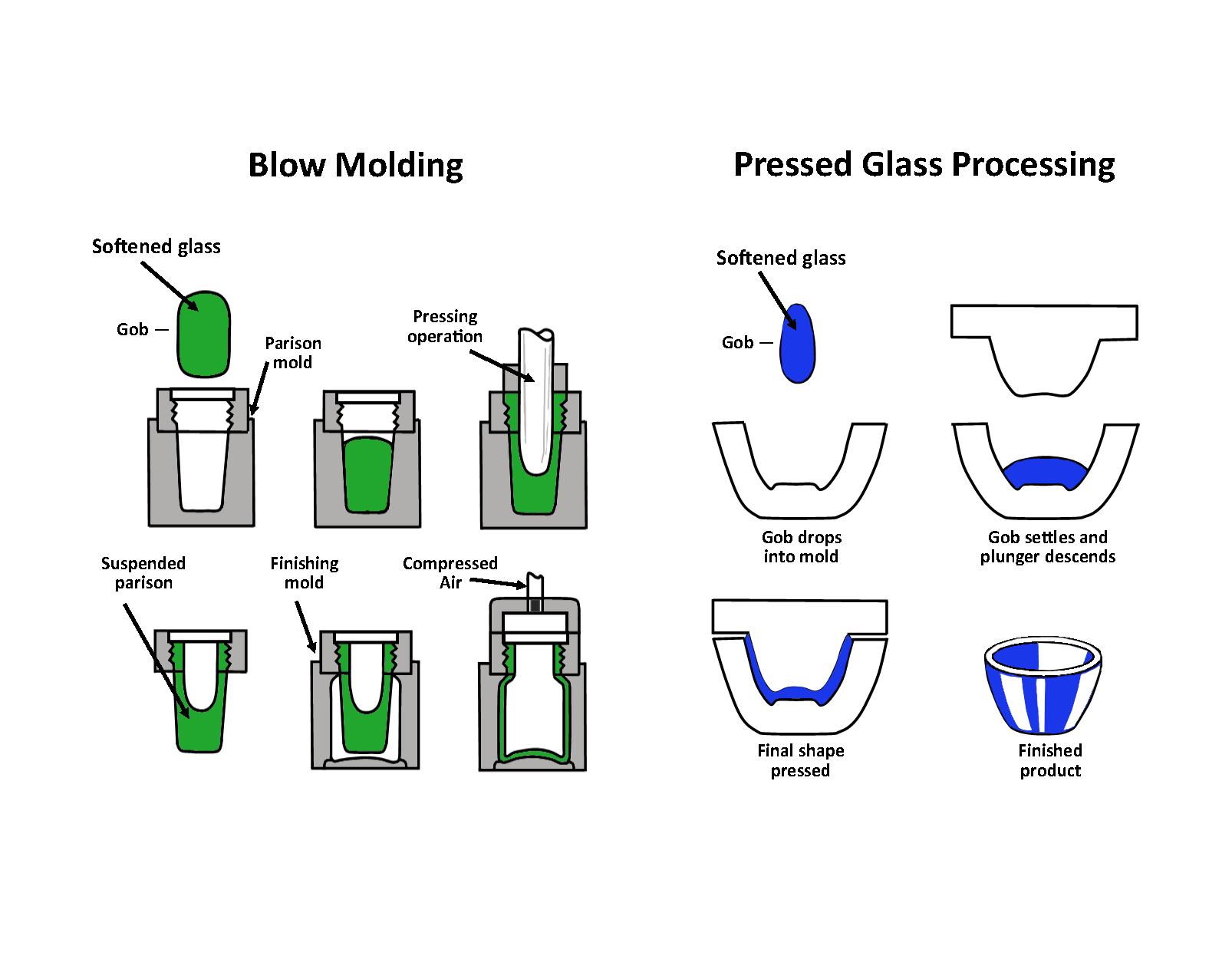
Molded Glass – Molding glass is one of the primary hot glass decorative methods. Molding can be accomplished with a number of methods, primarily by blowing, or pressing molten glass into a mold. Semi-automatic machine blown table glass production began in 1897 for stemware and tumblers, while fully automated production began in the 1920s (Jones 2000:155).
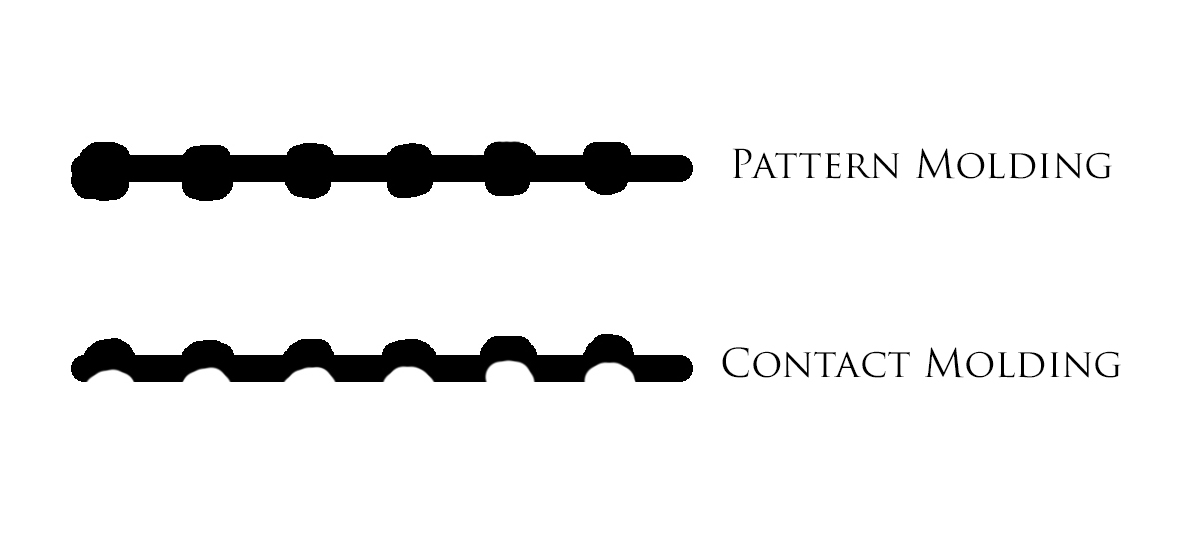
Pattern Molding – In this technique, the molten glass is blown into a patterned mold, removed and blown to full size, resulting in a diffused pattern that can be felt on both the interior and the exterior of the vessel. Diamond shaped patterns were more characteristic of 18th-century vessels, while ribs, panels and flutes, or combinations of these motifs, were more typical of the 19th century (Jones 2000:155).
Contact Molding – Glass blown in a full-size mold that shaped and decorated in one step. The glass can be mouth blown or machine blown. A rib or convex element on the outside of a contact molded piece corresponds to a concave element on the vessel interior. Contact molding dates as early as Roman times but was re-introduced in Europe in the 17th century. It became an increasingly common technique in the 18th century (Jones and Sullivan 1985:24). The use of contact molding mostly ended by the 1870s (Jones 2000:157). Produced in colorless, as well as aqua, amber, purple, blue, and olive-green glass and was used for tumblers, decanters, cruets, and salts.
| Dating Contact Molded Motifs |
|---|
| 1790s to ca. 1820 – ribbed and fluted bases, with rays on the base. |
| 1820s to 1840s – vertical ribs with flowing lines (scrolls, arches, fans, etc.). Overall molded patterns are more common in this period. |
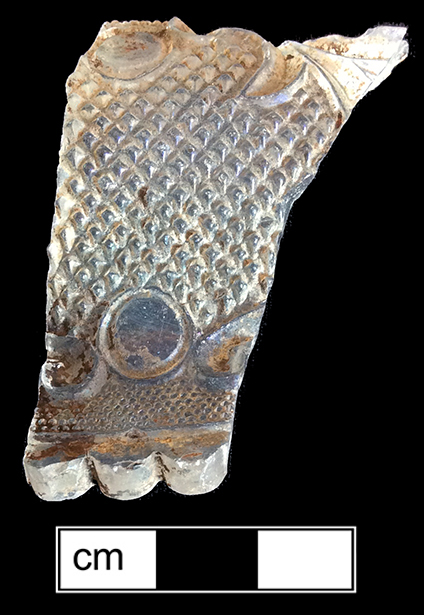
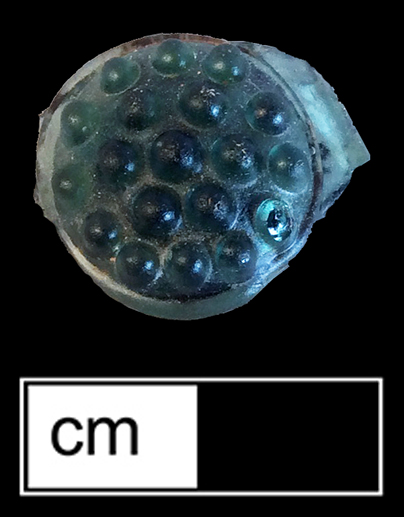
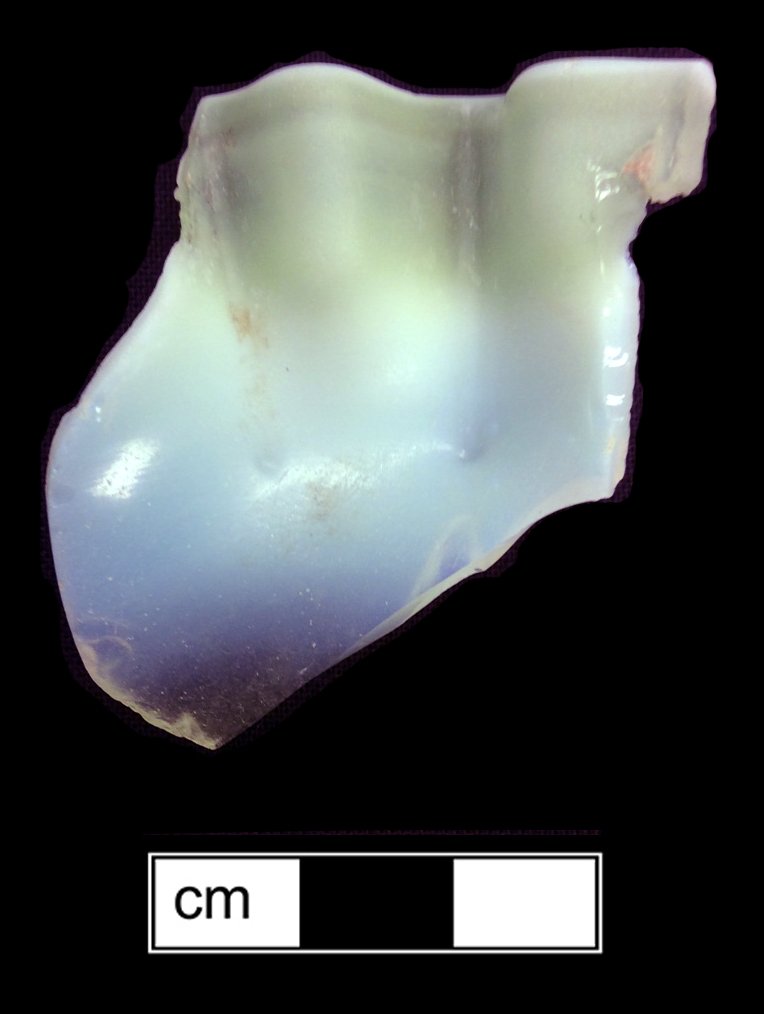
Press Molding – Press molded glass is made in a multiple part mold by using a plunger to push and form molten glass within the mold. The vessel’s inner surface takes the shape of the plunger, and the outer surface, the shape of the mold. The inside shape of the vessel does not have to correspond to the outside surface of the vessel.
The use of press molding for table glass began by the late 1820s (Jones 2000:161). Exceptions were press molded decanter stoppers and some feet for stemmed vessels (c. 1780s). Press molded vessels were usually open-mouthed, since the plunger needed to be removed from the vessel. Press molding was particularly useful for creating open forms like plates, open salts, and rectangular vessels. Tumblers, stemmed glasses, and decanters were not produced by press molding until the late 1830s (Jones 2000:161). Early pressed glass tends to be made from colorless leaded glass, until the c. 1864 improvements in soda lime glass production.
| Dating Early Pressed Glass |
|---|
| 1827-c. 1850 – The entire surface of the vessel was usually covered with pressed decoration in crisp detail. Motifs included strawberry diamonds, crosscut waffle squares, and fans. Small dots, diamonds, or lines in the background are the reason these early pieces are known as "lacy." Pieces from this period are usually made from colorless leaded glass. |
| c. 1840-1870s – Decorative motifs were geometric and imitated cut glass patterns. Facets, ribs, and panels were common. |
| c. 1865-1880s – Pieces of pressed glass from this period are likely to be soda lime glass, which was less expensive to manufacture. Patterns tended to circle the vessel horizontally, rather than extending from the base to the rim. Nature motifs like plants and animals were common, as were plain vessels. |
Determining if Glass Decoration is Cut or Pressed
| Detail | Cut Glass | Pressed Glass |
|---|---|---|
| Mold seams | No mold marks; any mold seams have been removed by the cutting or polishing process | Mold seams are almost always visible |
| Feel of the pattern | Sharper detail with more defined pattern and sharper edges | Pattern will be smoother and more rounded to the touch |
| Overall appearance | Fine striations from the cutting are often visible (not on modern cut glass, which is chemically smoothed); often variations in shape and the spacing of the cut pattern are evident, since the work was done by hand | The design does not show variation in shape or spacing, since the mold was generally perfected prior to use |
| Motifs | Motifs tend to be geometric—panels, flutes, ribs, and mitres (angled cut) | Great variety of patterns, including stippled "lacy" areas |
| Pontils | Pontils may be finished or unfinished | Pontils are usually polished smooth |
Glass-on-Glass – In this hot glass technique, decorative glass elements like trails, threads, loops, buttons, prunts, or pinchers are attached to the vessel surface. A prunt is a blob of glass that is applied to a glass object primarily as decoration (All About Glass/Corning Museum of Glass).
Flashed and Cased Glass – Flashing and casing are hot glass techniques that use multiple layers of glass. The cased glass technique fuses successive layers of different glass colors. Cased glass vessels are sometimes decorated with cutting to expose the different color layers. In cased glass, the two layers of glass are of equal thickness (Jones 2000:149). Flashed glass involves the application of a thin layer of glass of one color over a contrasting color by the process of dipping a gather of hot glass into a crucible of hot glass of the second color. The vessel is then blown to its final form (All About Glass/Corning Museum of Glass). The thinner layer tends to be the deeper color glass (Jones 2000:149).
Mottled Glass – In this hot glass technique, small pieces of colored glass are rolled onto the molten glass surface on a marver table, creating a mottled or splotchy appearance.
Marbled Glass – This hot glass technique typically consists of an opaque white glass swirled with glass in a contrasting color, like purple, brown, green, blue, or pink.
References
n.d. https://allaboutglass.cmog.org/. (This website has an extensive glass dictionary and thousands of photographs).
2000 A Guide to Dating Glass Tableware, 1800 to 1940. Studies in Material Culture Research. Edited by Karlis Karklins. Society for Historical Archaeology.
1985 The Parks Canada Glass Glossary for the Description of Containers, Tableware, Flat Glass, and Closures. With contributions by George L. Miller, E. Ann Smith, Jane E. Harris and Kevin Lunn. Parks Canada, Quebec.