Tumblers
A tumbler is a cylindrical open-mouthed vessel for consuming beverages. Tumblers are flat bottomed and do not have handles. They are the most commonly found table glass vessel on archaeological sites and are generally difficult to date. Tumblers can have straight, tapering, barrel, or waisted side walls.
Leaded tumblers were most common in the first half of the 19th century (Jones 2000:225). Tumblers could be left plain or decorated by engraving, cutting, contact molding, or after 1830, by press molding.
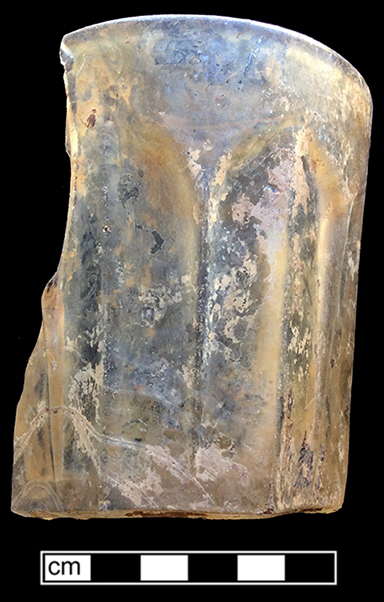
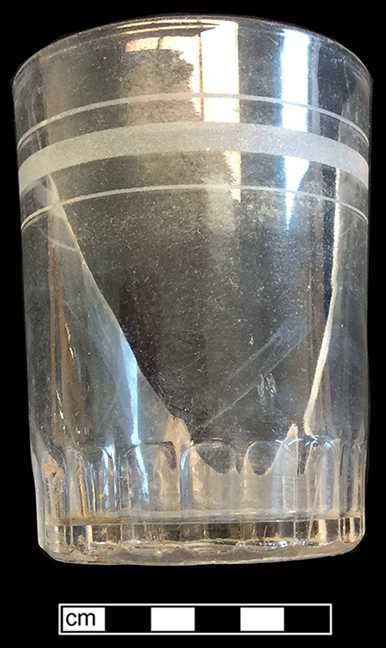
Paneled Tumblers – Pressed panel tumblers were first introduced in the mid to late 1830s (Jones 2000:225). Mold lines are often difficult to detect, since they will be hidden along the paneled edges and are not usually visible on the base. Paneled tumblers are a common find in 19th-century archaeological contexts.
Packer's Tumblers – Commercial glass vessels that were produced to hold mustard, jelly, and other food. Once emptied of their original contents, they were used as tumblers. They display a number of different closures/finishes, including Anchor Cap closures, lugged closures or slip tops (Jones 2000). Rows (1 to 3 rows is typical) of fine vertical ridges near the finish indicate an Anchor Cap closure. The Anchor Cap was introduced in 1908 and made into 1960s (Jones 2000:119).
References
2000 A Guide to Dating Glass Tableware, 1800 to 1940. Studies in Material Culture Research. Edited by Karlis Karklins. Society for Historical Archaeology.