Glass Composition
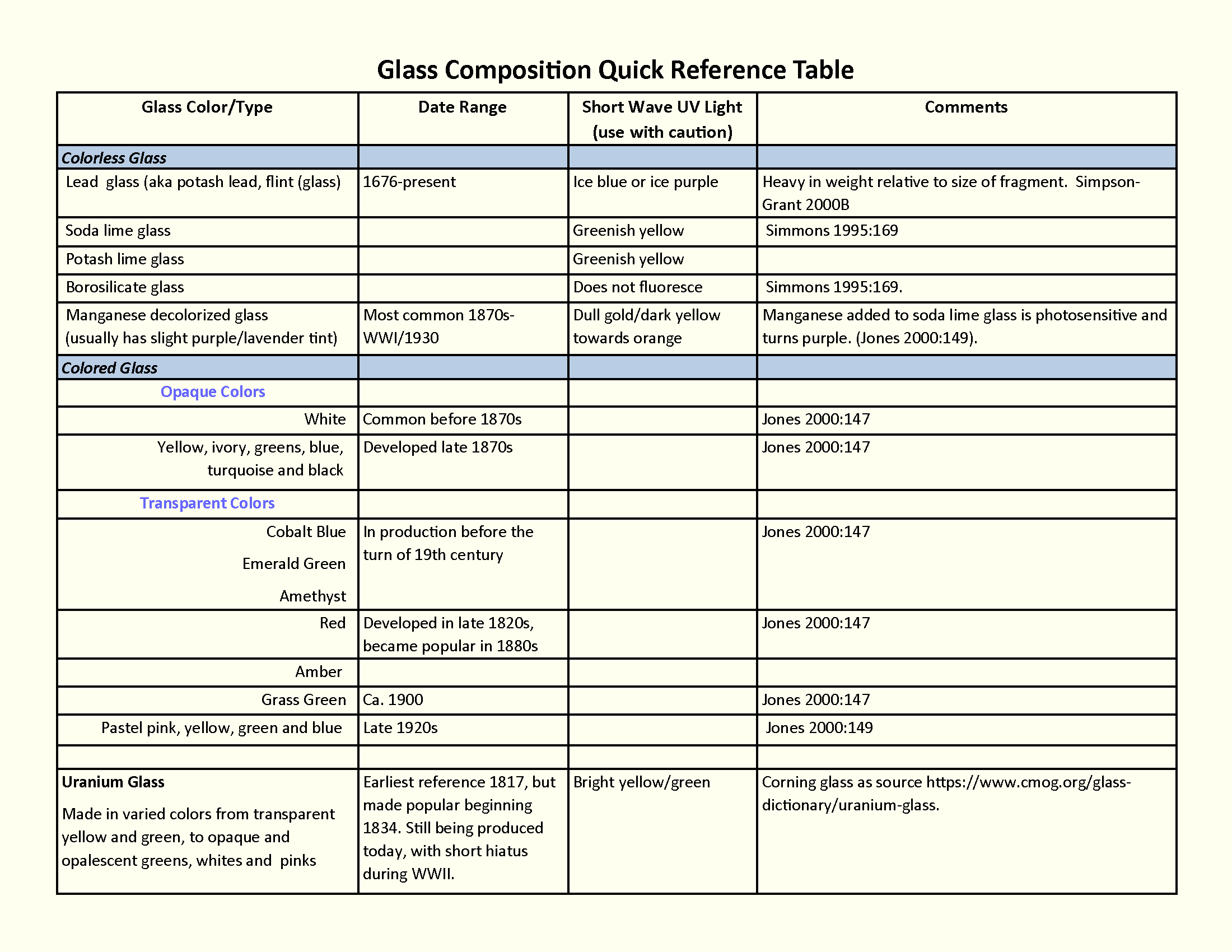
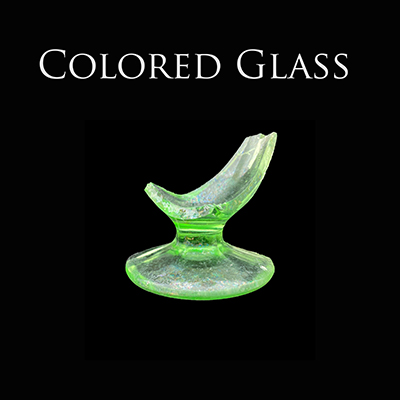
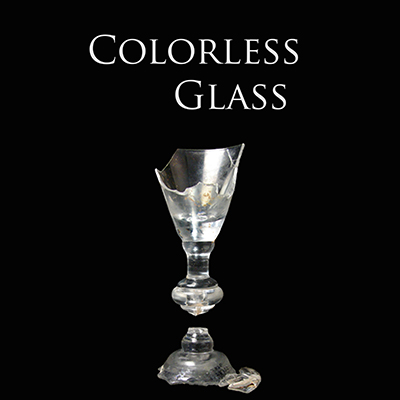
The glass that archaeologists can expect to find on colonial and post-colonial archaeological sites is composed of three primary components: silica (normally in the form of sand), soda or potash as a flux, and either lime or lead as a stabilizer (Jones and Sulllivan 1985:10). This section is divided into colorless and colored glass and provides basic information on determining the composition of your fragments. While a visual examination of glass can be used with a limited degree of accuracy, the only way to really determine the composition of glass is through chemical analysis.
Using ultraviolet light to determine glass composition is complex and should be used carefully (Jones et al. 1985:12). Fluorescence is not so much characteristic of the type of glass, but is indicative of refining agents, furnace atmosphere and melting temperature (Newton and Davidson 1989). That being said, a UV light can be very useful in sorting large quantities of glass. A general guide that can be used with caution is shown on the chart.
References
1985 The Parks Canada Glass Glossary for the Description of Containers, Tableware, Flat Glass, and Closures. With contributions by George L. Miller, E. Ann Smith, Jane E. Harris and Kevin Lunn. Parks Canada, Quebec.
1989 Conservation of Glass. Butterworth-Heinemann Ltd, Oxford, p. 192.