Bridle Bits
Introduction
The bridle bit is the metal hardware that sits in the horse’s mouth and attaches to the reins, creating a conduit of communication between the horse's mouth and the rider's hands. There are many different styles of bits ranging from very simple to extremely complex, not all of which can feasibly be covered here. The focus of this section of Diagnostic Artifacts is to help people identify bits found archaeologically, particularly from colonial sites throughout Maryland and Virginia.
People who ride today typically have preferences about the right bit for the right kind of riding (saddle horse) or driving (horses harnessed to pull a vehicle, plow, etc.), as did people in the past. Unfortunately for archaeological interpretation different bits cannot necessarily be attributed to specific activities. Much has to do with the personality of the horse or mule, the skill of the rider or driver, and the kind of equipment available. Although bits have been designed and marketed for specialized uses such as hunting, racing, dressage, driving, etc., it cannot be assumed that the original intended function correlates with how bits were actually used.
Users should think of this section of the Diagnostic Artifacts website as a basic guide introducing archaeologists to the most common types of bits found by archaeologists in the Mid-Atlantic. These are the snaffle (Figure 1), curb (Figure 2), bridoon (Figure 4), and Pelham (Figure 5).
Snaffle Bits
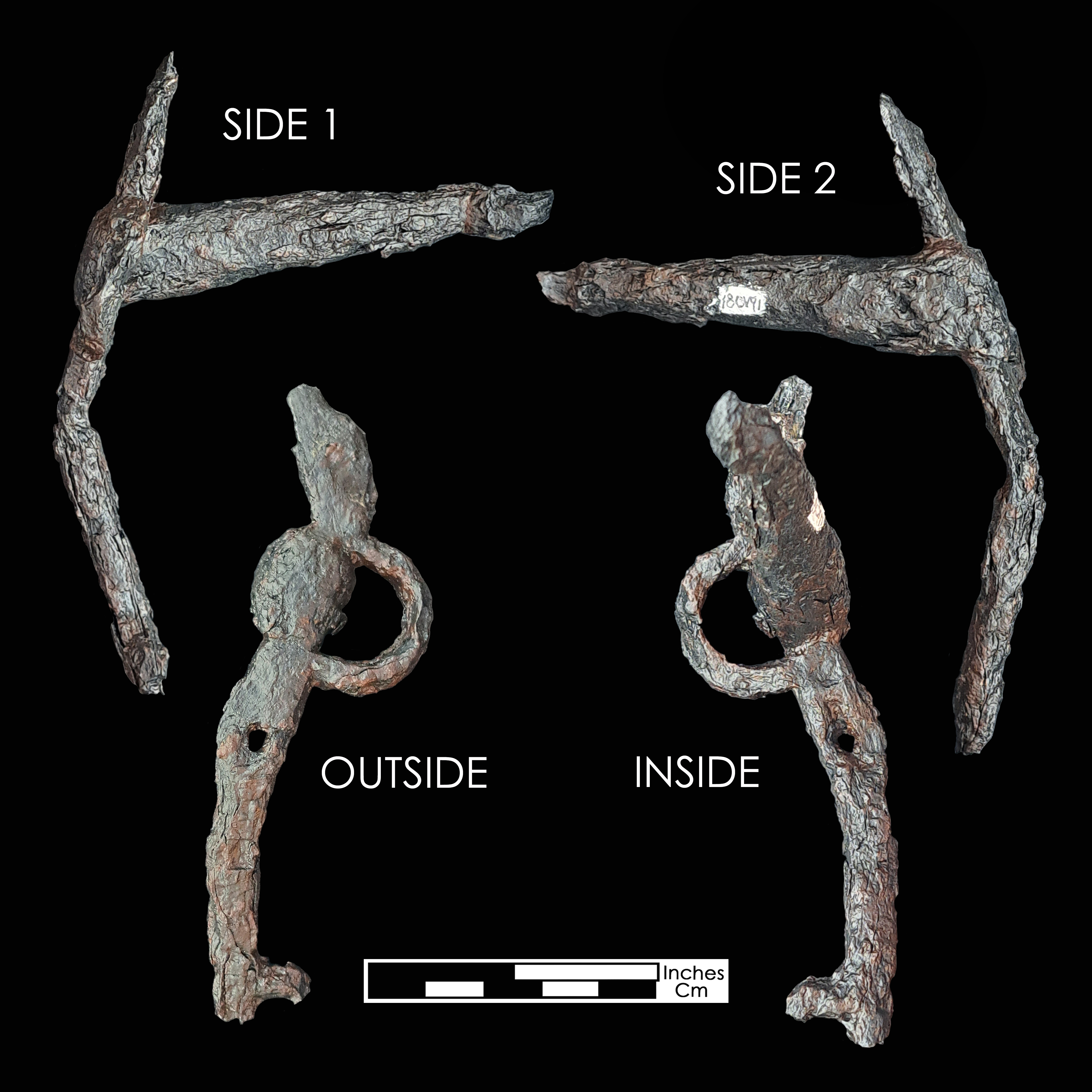
Snaffle bits, also known as “watering” bits, are characterized by a mouthpiece that is typically jointed in the middle and held in the horse’s mouth by the cheek straps of the bridle on a ring that also bears the reins (Figure 1). This ring is positioned at the corner of the horse's lips. In the 17th and 18th centuries, the bit ring was usually small, and cheek pieces flanked the ring to prevent the snaffle from being pulled to one side through the mouth (Chenevix-Trench 1970:22). Today snaffles with these cheek pieces is called a “full cheek” snaffle to differentiate the style from those that simply have bit rings large enough to prevent pulling through the mouth; a form that overlaps with the bridoon (see below).
With the position of the reins at the corner of the horse’s lips, pulling up on a snaffle causes the horse to raise its head. When the mouthpiece is jointed, this action also squeezes the horse's face a bit (Chenevix-Trench 1970:22). The snaffle is considered a mild bit, though it can cause injury to a horse's mouth (Edwards 2007:51).



Curb Bits
The curb bit has many forms and can be incredibly complex in its execution. Curbs often have a mouthpiece just like that of the snaffle, but rather than bit rings at the intersection of the horse's lips, the curb has a chain passing under the horse’s chin and the reins attach to branches that hang below the mouth. When pulled, the reins activate the curb as a lever pushing the chain up on the chin of the horse and squeezing the chin between the chain and the mouthpiece. This pressure causes the horse to bring its head down.
Curb bits can have straight or curved cheek pieces, they can be incredibly elaborate and decorative, and they are the only bit type to have decorative cheek bosses. Curb bits can vary greatly and in the 16th century it was trendy to create whole books of different curb styles, especially in Germany. However, when horse populations boomed in the English tobacco colonies in the second half of the 17th century, English bit makers, known as loriners, adopted a few relatively simple versions of the curved cheek curb bit and churned these out by the thousands for the export market. A typical example is depicted in Figure 2, though variation should be expected. For example, not all curbs have a "partridge eye" on the branch, instead relying on a single chain or bar attached to the lower eye to keep the branches from spreading too far apart, and curb bits often had a “simple canon” mouthpiece rather than the plain jointed mouthpiece shown in Figure 2 (Figure 3).
Bridoons
The bridoon, also spelled "bradoon," is similar to a snaffle, but without cheek pieces. The bridoon was used in conjunction with a curb bit to make a double bridle with two sets of reins; one operating the lever of the curb, and the other operating upon the horse’s mouth. Aside from offering the rider more options for communication with the mount, the bridoon could act as a back-up in cases where the curb broke or otherwise failed at a critical time, such as during a hunt or battle (Berenger 1771:218-223: Garsault 1774:133-134).
Bridoons found archaeologically often have two rings flanking a jointed mouthpiece or a bar mouthpiece that is often curved (Figure 4). In the 17th and 18th centuries, the bit rings on a bridoon could be relatively small and comparable to the diameter of a snaffle bit ring. In later contexts, a mouthpiece flanked by two bit rings large enough to touch the cheeks and prevent slippage through the horse's mouth could be called a snaffle rather than a bridoon; the forms overlap and terms have changed over time.

Pelham Bits
The Pelham bit is a combination curb and snaffle with reins attaching to branches below the mouth and at a ring at the mouth (Figure 5). Instead of placing both a bridoon and curb bit in the horse's mouth, the Pelham allows both types of rein attachments to operate on one mouthpiece. The Pelham is often disparaged in period documents as inferior to a double bridle. Berenger (1771:214) considered the Pelham and other combination bits to be "of no account," and Anderson (1894:82-83) explained that, "The Pelham bit, which has for many years been widely employed, does not give either of the two principal effects for which it was designed." Nevertheless, the Pelham was "widely employed" and does appear in archaeological assemblages, albeit less often than other bit types.
Historical Background
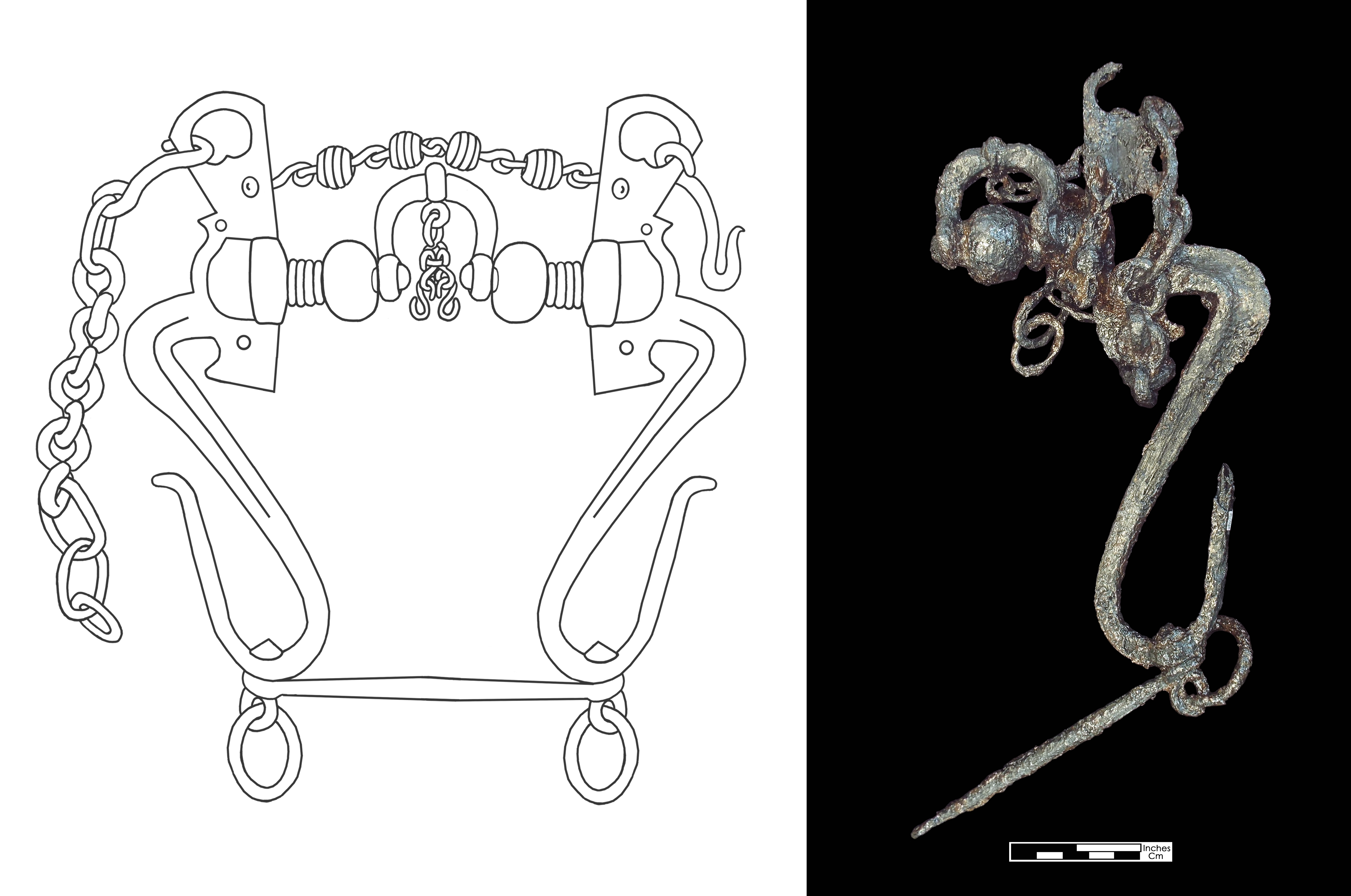
At the beginning of the 17th century, European riders favored elaborate curb bits for maximizing control of the horse. For example, one of the bits from the c. 1607-1624 occupation of James Fort is extremely complex, with balls and rings bookending the port (U-shaped center) of the mouthpiece, dangling chain links hanging from the port to give the horse something to play with, and a beaded chain to promote salivation (Figure 6). Such bits might only be found in Jamestown, however, as the horses there were eaten during the "Starving Time" in 1609. Horse populations were negligible in the tobacco colonies for decades, with only enough horses for 1% of the population as late as 1650.
By the time horse populations did rise in the second half of the 17th century, a shift had occurred in horsemanship philosophies away from cruel “corrections.” Instead, new publications on scientific equitation favored working with each horse’s personality and using irresistible mechanical techniques to teach desirable maneuvers rather than painful punishments (Chenevix-Trench 1970). Bridle bits of bewildering complexity fell out of favor.
Additionally, post-Restoration England saw the introduction of, "a slapdash, unscientific, but highly effective form of cross-country riding, based on free forward movement, extension instead of control, the snaffle instead of the curb" (Chenevix-Trench 1970:152). This shift correlated with the rise in popularity of fox hunting over landscapes where hedge jumping became a necessity. By the 18th century, Francois Garsault (1774:133-134) noted that, contrary to French practice, the English rode and ran their horses with a snaffle to "give them more breath" so they could run faster for longer.
Despite this trend, the curb bit and double bridle remained a staple for saddle horses throughout the 17th and 18th centuries.
Acknowledgments
The Bridle Bit section of Diagnostic Artifacts was funded in part by a grant from the Conservation Fund. Partners contributing collections access for this grant include Colonial Williamsburg, Historic St. Mary’s City, Preservation Virginia’s Jamestown Rediscovery, and the Viginia Department of Historic Resources.
References
2000 Living and Working in Seventeenth Century England: Descriptions and drawings from Randle Holme's Academy of Armory. CD-Rom. London: The British Library Board.
1894 Curb, Snaffle, and Spur: A Method of Training Young Horses for the Cavalry Service, and for General Use Under the Saddle. Little, Brown, and Company: Boston.
1771 The History and Art of Horsemanship, Vol. I. T. Davies, Russel Street, London.
1970 A History of Horsemanship. Doubleday & Company, Inc., New York.
2007 Horse and Man in Early Modern England. Hambledon Continuum: London.
1774 L'Art du Bourrelier et du Sellier. Bibliothèque Nationale de France, https://gallica.bnf.fr/ark:/12148/bpt6k10671826/f7.item.r=garsault%20sellier#, accessed November 11, 2020.
1751 Ecole de Cavalerie, Contenant la Connoissance L'Instruction, et la Conservation du Cheval. Huart et Moreau Fils: Paris. Accessed in the Charles Lawrence Ferguson Collection, the library of the Society of the Cincinnati, Washington, DC.