Horse Care
This section of Diagnostic Artifacts is about the tools of the stable used to groom horses and administer to their health, particularly in the 17th and 18th centuries. For the most part, this section is dominated by the metal curry comb, though even these were rare in colonial Maryland and Viginia. Many other artifacts of the stable were either organic and unlikely to survive in the archaeological record, or metal but ambiguous in form and function (Figure 1).
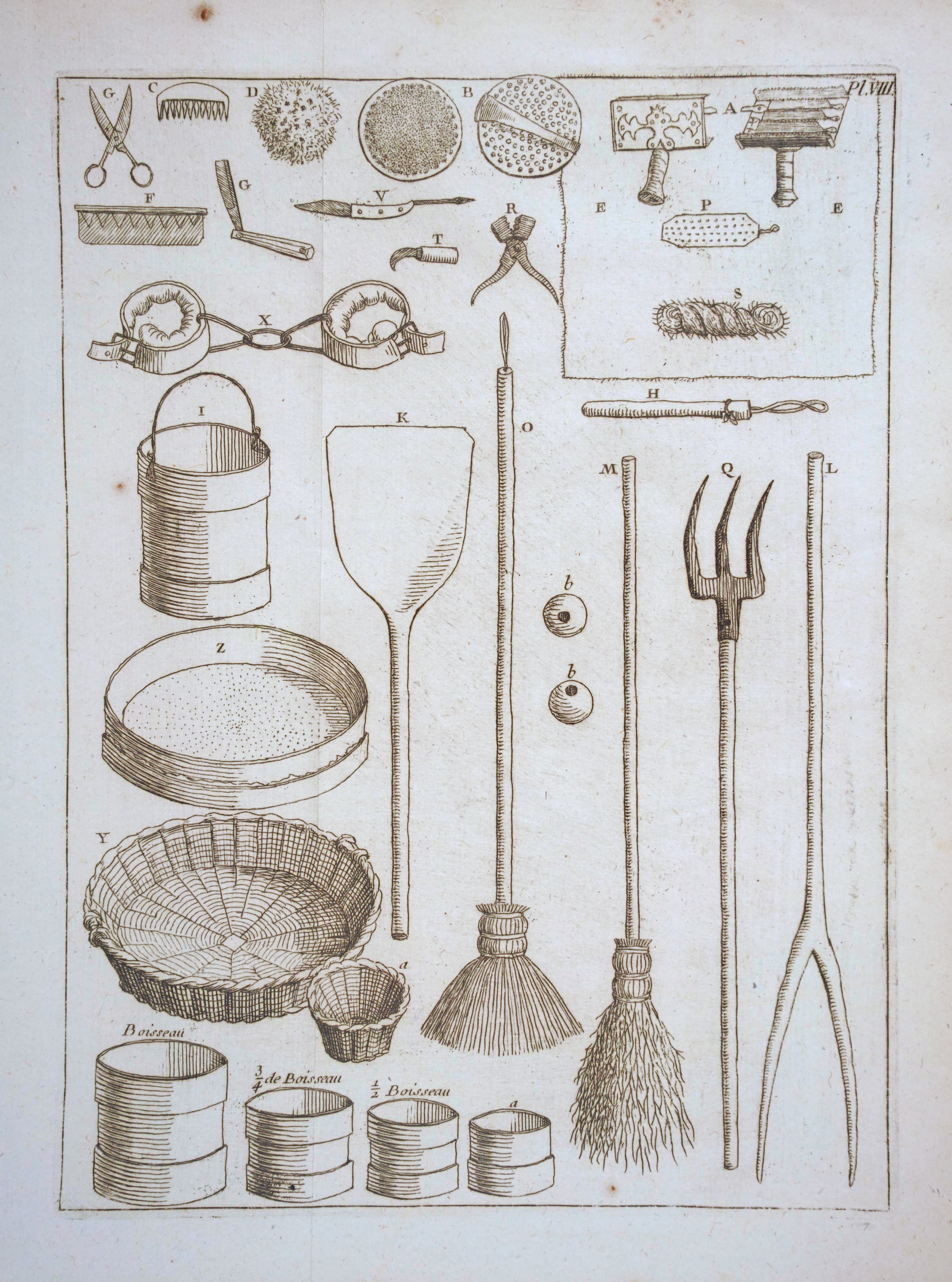
Figure 1. Plate VIII from Garsault (1741: 99-100). The items shown are those that are essential to
a groom as follows (translated from the French):
A) The tin-plated iron brush [curry comb] is used to remove the first dirt.
B) The round brush is then used to remove the finest dirt and unite the hair.
C) The horn comb for combing the tail and the manes.
D) The sponge to wash the hair and clean the legs.
E) The cloth or serge duster to wipe the hair and make the coat shiny.
F) The knife to knock down the horse’s sweat.
G) The scissors or the razor to trim the hair.
H) The nose torch [twitch] to prevent the horse from torment when trimming the hair.
I) Bucket to provide the water for dressing and drinking.
K) The shovel to clean the stable of manure.
L) The wooden fork for making and stirring the litter.
M) The birch bale to sweep away horse urine.
O) The rush brush should only be used to wash the wheels and undercarriage of vehicles, because to wash
the legs you should use the small, long brush (P) with the sponge.
Q) The iron fork is used to stir the manure.
R) The hair clip is used to remove the dewlap hair from a horse that has too much hair.
S) The cap of hay goes out into the field to rub a horse that is hot, etc.
T) The hoof pick is used to clean the underside of the foot. A groom must carry it in the countryside to
remove the rubble and stones that would get under the foot.
V) He must also always have a punch knife in his pocket, both for cutting leather when necessary and for
making holes in belts as appropriate.
The stable furniture is the fetters (X), which are placed at the feet of horses accustomed to putting their feet in the manger. The balls (bb) to lower the halter lead ropes. The rack (Y) or screen (Z) to remove dust from the oats when they are fed. The measure (aa) in which we measure the oats we give to the horses; it is of solid wood.
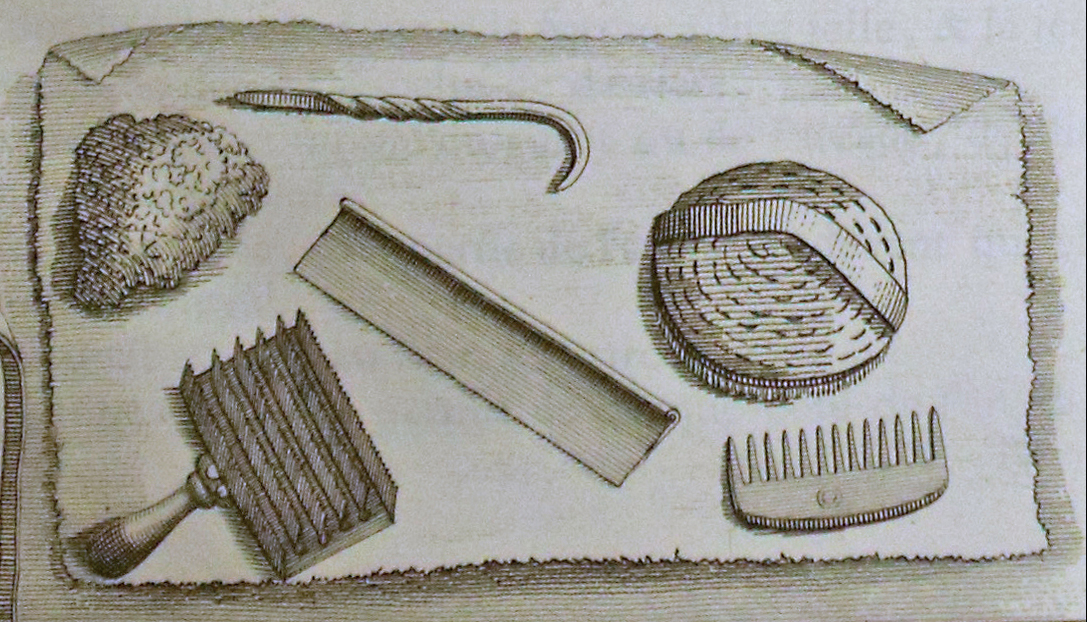
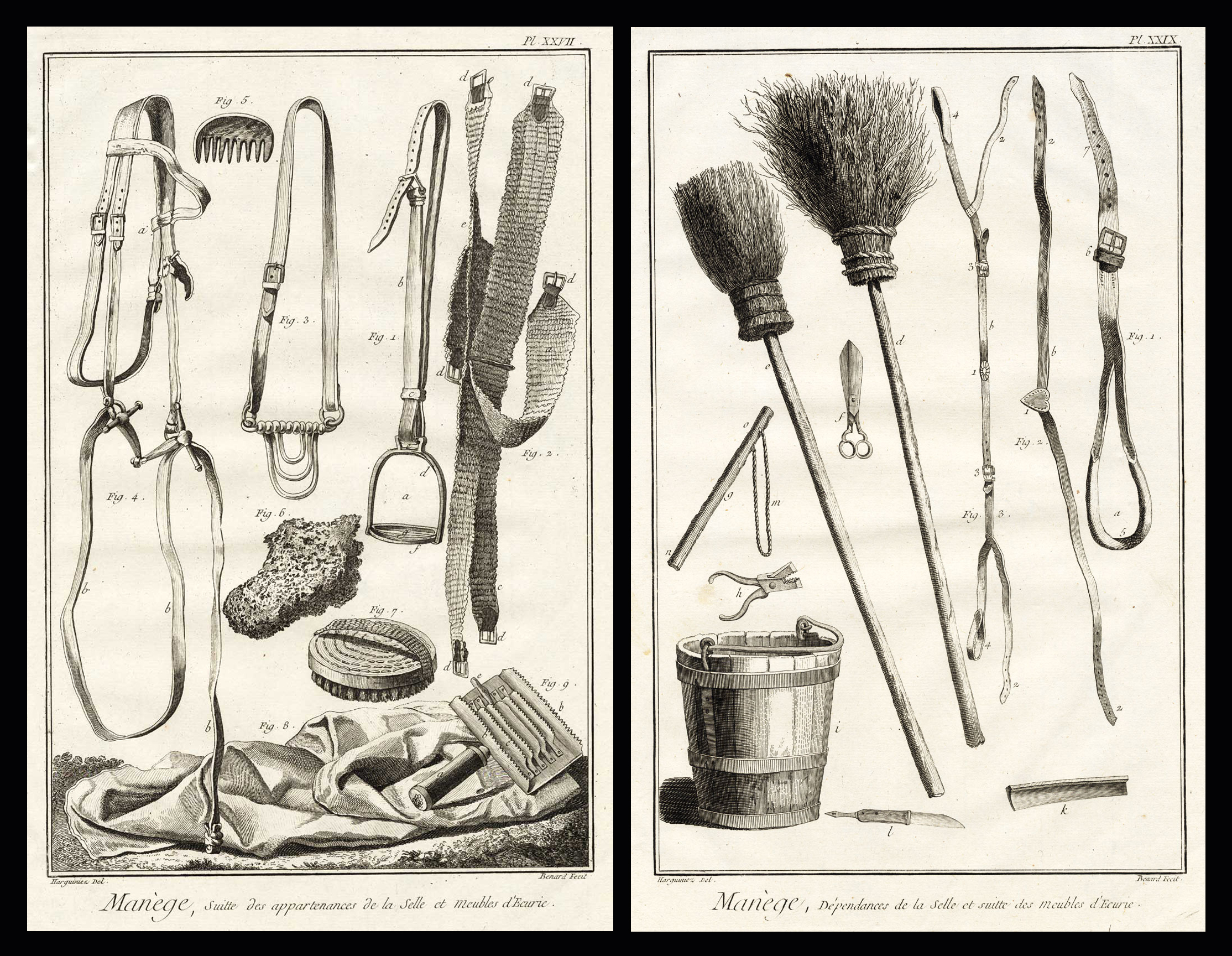
Metal curry combs are usually recognizable in the archaeological record thanks to their parallel iron serrated blades and angled handles that often end in decorative attachment plates (Figure 1:A). The curry comb was used as a first step in cleaning the horse’s coat. Garsault (1741: Plate VIII) illustrates a curry comb similar to those recovered in the Chesapeake (Figure 1). Many other essentials for the groom are also illustrated, so this plate and translations of its description are included in full in Figure 1. The same tools are also depicted by Gueriniere (1751:40) and Diderot and Alembert (1751-1765), suggesting that the established necessities of horse care should be relatively consistent (Figures 2-3).
Apart from the curry comb, it can be difficult to definitively attribute artifacts to the horse care category without a strong contextual argument. For example, large scissors could have many potential uses, but a pair of large scissors found in an 18th century stable are more likely to be associated with mane and tail maintenance than tailoring. Similarly, blade tools and files or rasps used for hoof maintenance might not stand out from other tools unless they are affiliated with a stable context or part of an artifact assemblage rich in other equestrian artifacts. Figures 1-3 are all provided despite their redundancy so that archaeologists can familiarize themselves with tool groupings that might end up as archaeological assemblages in areas where horses were groomed. Not every folding blade tool is likely to relate to horses, but a blade or punch tool found in context with a curry comb and a large pair of scissors warrants mention as a possible groom’s punch knife (Figure 1:V). Both context and artifact associations are key.
The rarity of colonial artifacts in this category has to do with the blasé approach to horse care adopted in the 17th- and 18th-century Chesapeake. Although saddles and bridles were imported by the thousands each year and nearly everyone owned a horse by the 1680s, little was done to care for them beyond offering some corn feed after a hard ride and setting them out to forage in the woods. Stables and horseshoeing were rare prior to the 1750s. This makes it even more important to recognize artifacts of horse care when they do appear, as that may indicate special attention to equestrian pursuits beyond the norm for the region.
Acknowledgments
The Horse Care section of Diagnostic Artifacts was funded in part by a grant from the Conservation Fund. Partners contributing collections access for this grant include Colonial Williamsburg, Historic St. Mary’s City, Preservation Virginia’s Jamestown Rediscovery, and the Viginia Department of Historic Resources.
References
1751-1765 Encyclopédie, ou Dictionnaire Raisonné des Sciences: Des Arts et des Métiers. Paris: Chez Braisson, David, Le Breton, Durand. The Robert Charles Lawrence Fergusson Collection, Society of the Cincinnati, Washington, D.C.
1774 L'Art du Bourrelier et du Sellier. Bibliothèque Nationale de France, https://gallica.bnf.fr/ark:/12148/bpt6k10671826/f7.item.r=garsault%20sellier#, accessed November 11, 2020.
1751 Ecole de Cavalerie, Contenant la Connoissance L'Instruction, et la Conservation du Cheval. Huart et Moreau Fils: Paris. Accessed in the Charles Lawrence Ferguson Collection, the library of the Society of the Cincinnati, Washington, DC.