Leather Ornaments
Defining Attributes
This page documents decorative copper alloy or white metal alloy ornaments used primarily on leather. These artifacts generally have a cast molded face and at least two tines on the back. Copper alloy tacks used for attaching furniture upholstery, decorating trunks and coffins, etc. are not discussed in this section, though these may have been used on leather, and the items listed as leather ornaments may have occasionally been used to decorate furniture. Click here for more information.
Archaeologists have not yet developed a dated typology for leather ornaments because sample sizes have generally been too small. This section of the website therefore offers comparative chronological data in the form of images, measurements, context, and site information for every leather ornament available at the MAC Lab and cooperating regional repositories. While the sample size is still too small to assign date ranges to particular leather ornament styles, preliminary studies indicate that significant trends are emerging. For a detailed article about this analysis, click here.
Terminology
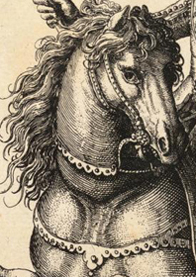
Different terms have been used to describe the leather ornaments discussed in this section. Archaeological catalogs have used terms such as: Leather escutcheon, Clasp, Rivet, Attachment Plate, Adornment, Stud, Tack, and Mount. Those experts who still make leather goods by hand, however, will generally refer to the metal ornaments in terms of what they were used on. For example, "winker bosses" are metal ornaments on the winkers, or blinders, that shielded a horse's eyes, and "keepers" are metal ornaments that act much like a belt loop to secure long strap ends. More often than not, however, the metal ornaments were purely decorative and might have been placed on just about any leather strap, bag, saddle pad, sword hanger, etc. The term "leather ornament" has been adopted for this section because it is broad enough to include all types of metal leather attachments.