Saddles
Introduction
There are many varieties of saddles and many elements of saddles that make them a complex topic to summarize in a simple reference guide. The easiest analogy is to think about saddles and their accompanying tack (girths, bridles, reins, cruppers, etc.) like one would think about a car today. Both saddles and cars can reveal much about transportation and human mobility; both are complex pieces of furniture for people to sit on; both have many hidden elements that are not seen when they are whole; both vary over time, but sometimes in only subtle ways; both can have specialized forms to maximize a particular characteristic such as speed, comfort, weight-bearing, durability, safety, and military utility; both can have many "options" or extra elements that appear on some forms but not others; and some were made at great expense to signal wealth while others were made for affordability. In theory, archaeologists can find much juicy interpretive material in artifacts with so many specialized variations. However, archaeologists are dealing with very small fragments of these complex pieces of furniture, so understanding specialized saddle functions through artifacts will be the exception, not the rule.
Users should think of this section of the Diagnostic Artifacts website as a basic guide introducing archaeologists to durable saddle elements, most of which are hidden when the saddle is whole. It is on the car-equivalency level of, "it has four wheels, axles, and an internal combustion engine, so it's probably some kind of car." Such knowledge of the norm helps exceptions stand out, such as sidesaddles for women. More intensive analysis of saddles and associated assemblages is then easier to achieve within the context of specific time periods and sites.
Several elements of saddles and horse tack may not be readily recognizable as such when out of context. Just as a car will have many nuts and bolts that could be used as fasteners on other things, a generic upholstery tack will not be recognizable as a saddle part when found alone. This site therefore focuses on saddle elements that are likely to only appear on a saddle, rather than the upholstery nails, tacks, staples, and iron plates that could also be used on other things. Archaeologists should always be mindful of context however, as a handful of brass tacks found in close association with other saddle elements are rather more likely to have adorned a saddle than those found with alone or with other furniture elements such as trunk parts.
The following figures and text provide basic information about saddle anatomy and types of historic saddles that likely existed in the 17th- and 18th-century English tobacco colonies of Maryland and Virginia. All saddle parts that have been identified in the MAC Lab’s collections – including postcolonial examples – are available here with images and context information. Select artifacts from partner institutions are also included with attribution.

Saddle Anatomy
The recognition of archaeological saddles requires an understanding of their anatomy with a specific focus on the metal hardware that is most likely to survive underground (Figure 1; Table 1). There are many kinds of saddles employed for riding and driving (Table 2), but in general all consist of a wooden base known as the saddletree, metal hardware for reinforcement and attaching horse tack, and padding or upholstery designed for aesthetics and the comfort of both horse and rider. Most of the metal hardware was concealed by the upholstery and tends to go unrecognized by archaeologists.
Table 1. Summary of common metal hardware found on saddles of the 17th and 18th centuries
| Saddle Part | Defining Characteristics | Function | |
|---|---|---|---|
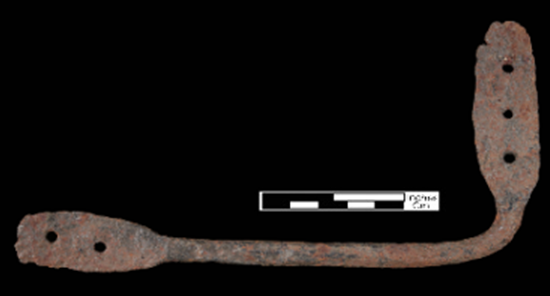
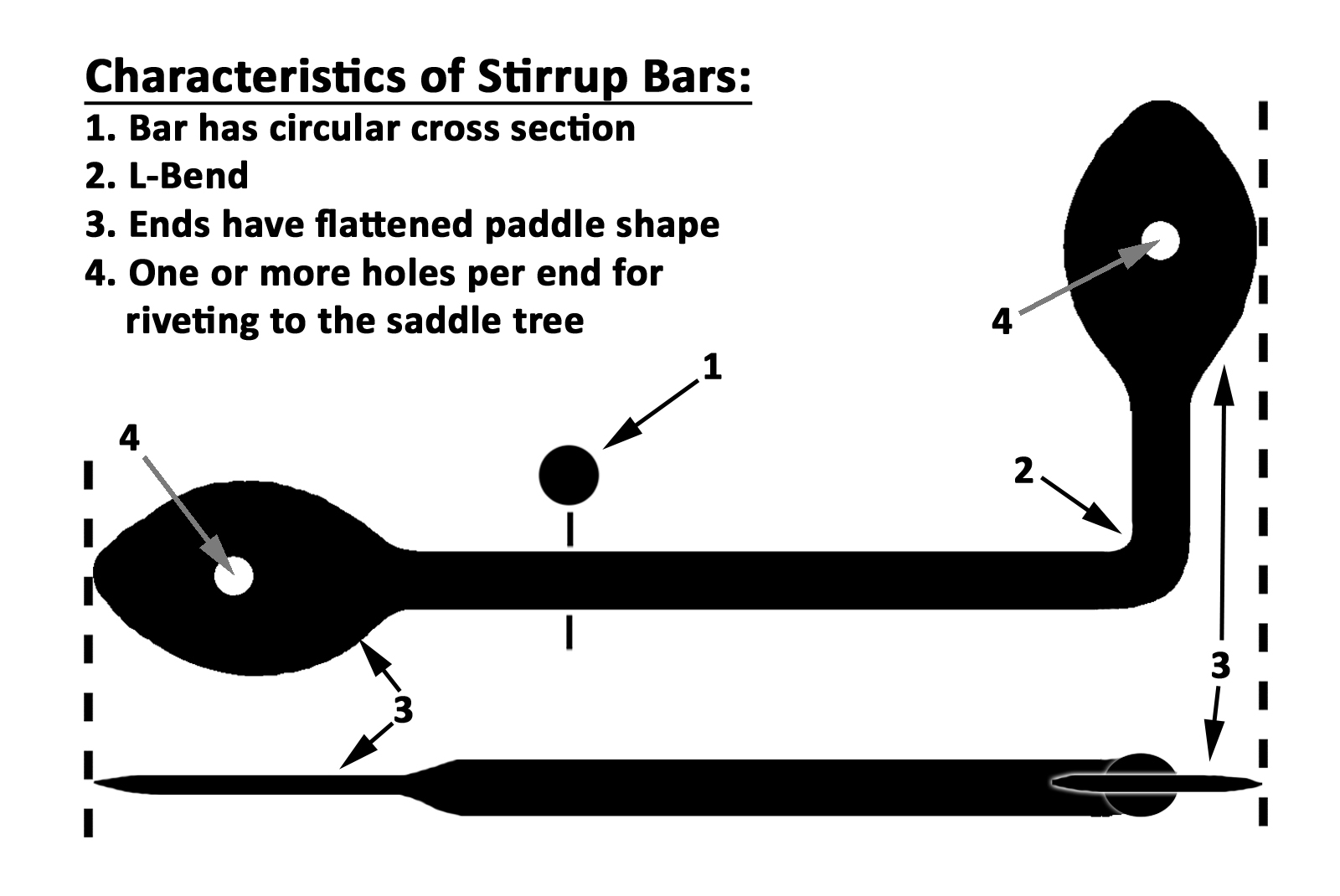
| Stirrup Bar |
|
• See Figure 2 • L-shaped overall • Bar is circular in cross section • Ends are flattened and have one or more rivet holes |
• Riveted to the saddle tree to hold stirrup leathers |
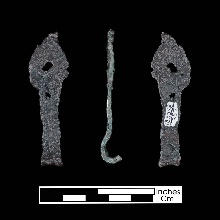
| Stirrup Bar Support |
|
• Iron strap that is folded in half and rounded at the fold to fit a stirrup bar • Terminals are typically wider than the portion of the strap at the fold • Both terminals have rivet holes |
• Supports the stirrup bar around the halfway point • keeps the stirrup leathers from sliding out of position |
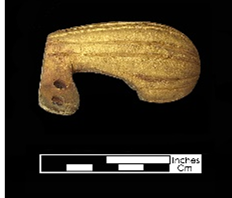
| Metal Pommel |
|
• Cast copper alloy • Distinctive hollow codpiece shape • Often has linear decoration • Tabs or "ears" with holes for attachment |
• Primarily decorative • Introduced mid-17th century • Fell out of favor for most saddles by the 1730s • Later examples may indicate the use of training saddles |
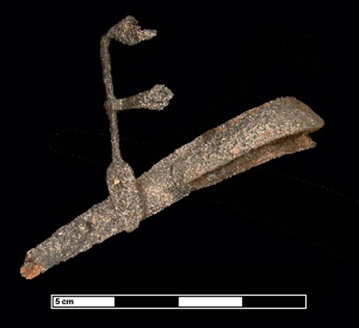
| Gullet Plate* |
|
• Thin iron strap with rivets at frequent intervals that is curved in a U-shape or V-shape at the center • When rivets are oriented vertically, the arms point down • Generally widest at center with tapered arms • Rivet length may vary from longer at the center to shorter at the ends, reflecting saddletree thickness; most rivets are <1" long • Contoured to sit against curved wooden arms (not flat like architectural hinges) • Often filed so that edges appear beveled • Often sandwiched, with gullets from both sides of the saddletree connected by rivets • Rivets are circular in cross-section |
• Strengthen the wooden saddletree over the horse’s withers while still allowing flexibility • May support additional hardware such as the stirrup bar |
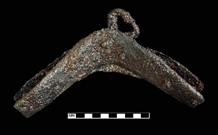
| Hind Plate* |
|
• Thin iron strap with rivets at frequent intervals that has a boomerang or V-shape with tapering arms • Widest at the center point • When rivets are oriented vertically, the arms spread out horizontally • Contoured to sit against curved wooden arms (not flat like architectural hinges) • Often filed so that edges appear beveled • Often sandwiched, with gullets from both sides of the saddletree connected by rivets • Rivet length may vary from longer at the center to shorter at the ends, reflecting saddletree thickness; most rivets are <1" long |
• Rivets are circular in cross-section • Strengthen the cantle or rear of the saddletree • May support additional hardware such as a crupper loop (also known as a crupper buckle or crupper sivet) |
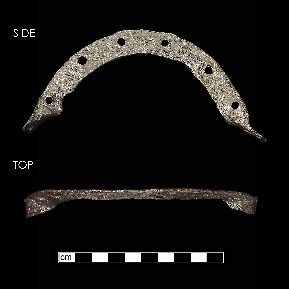
| Crown Plate* |
|
• U-shaped or V-shaped iron strap with rivet holes at intervals • Sometimes contoured in cross section to be thicker along the inside of the bend • Sometimes twisted at the end to attach to saddletree side arms • Generally thicker than gullet and hind plates; not intended to be flexible |
• Strengthen the center join of the saddletree over the horse's withers |
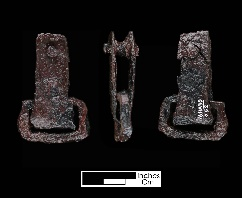
| Sivet |
|
• Looks like an iron buckle frame
• Typically has no tongue • Attaches by means of a folded iron strap that rivets to the side arm of the saddletree • Rectangular or trapezoidal frame shape |
• Hardware to hold saddle straps that buckle to the girth strap |
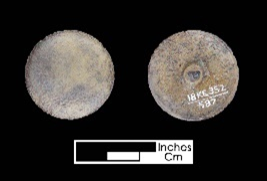
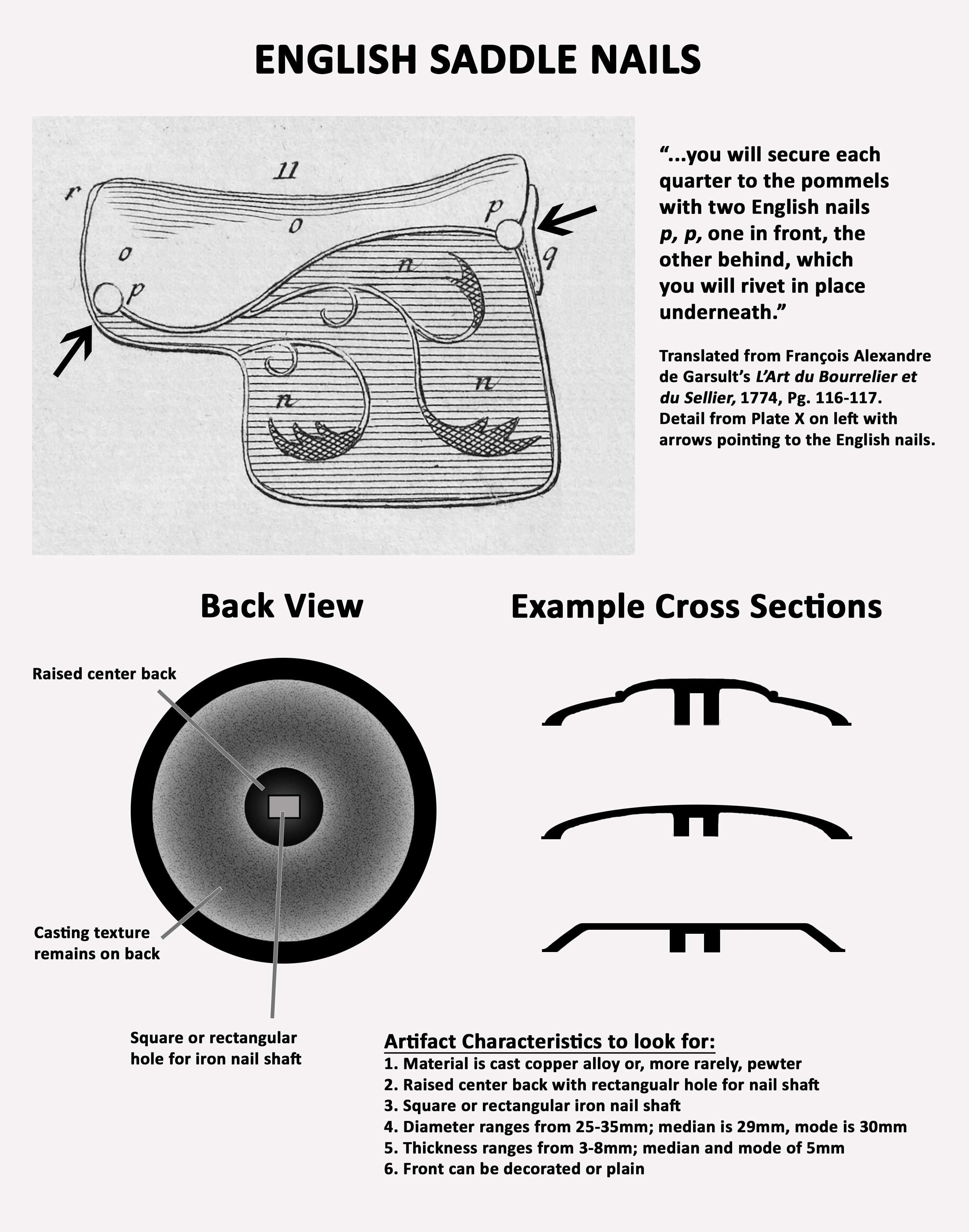
| “English nail”** |
|
• See Figure 3 • Button-like hardware, usually copper alloy, that is used at the four quarters of English saddles • Back has an attachment for a square iron nail shaft |
• Decorative • Offers some reinforcement for saddle upholstery • Diagnostic of English saddles |
| * Terms based on Randle Holme’s 1688 Academy of Armory (Alcock and Cox 2000). ** Term derived from Garsault (1774:115-116, Plate X-11p). |
|||
Historical Background
The saddles first introduced in the English colonies at the turn of the 17th century were large and heavy with high bolsters to practically enclose the pelvis and thigh of the rider. This type of saddle, often referred to as a "great saddle" in period literature, was popular for keeping riders seated in combat or popular sports such as jousting, but by the time horse populations increased in Maryland and Virginia in the mid-17th century, saddles were undergoing a transition away from the high bolsters that dominated the Medieval period towards saddles that offered more freedom of movement (Chenevix-Trench 1970; Edwards 2007).
Several factors fed into the evolution of English saddles in the 17th century. First, the adoption of firearms changed the nature of warfare, rendering pole arms largely obsolete for soldiers on horseback. Saddles hugging the lower body to enable use of these awkwardly long weapons ceased to be of benefit in battle, though bolstered saddles lingered stylistically. Second, deforestation for ship building and declining populations of stags redirected the attention of those who hunted to the pursuit of the fox. At the same time, the rise of enclosure acts in England and the adoption of stock-proof hedges to mark property boundaries necessitated that hunters be able to jump these obstacles (Chenevix-Trench 1970; Edwards 2007).
Unheard of prior to the Restoration, jumping was difficult and risky in traditional great saddles with prominent pommels. Landing wrong on the pommel risked castration, and high sides trapped riders when horses fell (Chenevix-Trench 1970:148-150; Edwards 2007:124). By the beginning of the 18th century, relatively high bolsters and metal pommels only remained in use on training saddles, and according to la Guerinière (1736:92-93), the "selle a piquer" for training was the only one to continue using the metal pommel.
To facilitate jumping, the 17th century gave rise to the "English saddle" which is often referred to as a "hunting" or "running" saddle in period documents (Alcock and Cox 2000; Sheffield v. Stark 1695-1705). The relatively simple design of the English saddle’s seat, with its gradual curve to a raised pommel at front and cantle at rear, allowed more freedom of movement and abandoned much of the weight of the great saddle. Saddle skirts shrank to only cover the area below the rider's thighs rather than falling straight from the full length of the saddle.
Both great saddles and English saddles were in use in the second half of the 17th century as horse populations in Maryland and Virginia skyrocketed. By the 1680s saddle horses were considered a necessity in the tobacco colonies of the Chesapeake, and English saddlers stepped up the production of saddles and bridles for export (Breen 1977). Customs records show that Maryland and Virginia imported more English-made bridles and saddles annually than all other colonies throughout the colonial period (Great Britain Board of Customs and Excise 1697-1773). This included not only great saddles and English saddles, but also side saddles for women and pillions to allow a passenger to sit on the horse’s rump behind the saddle. As roads improved and more urban centers developed, especially in the second half of the 18th century, there was a rise in the use of vehicles and the harness and postillion saddles that came with them (Breen 1985:37; Sweeny 1994:38).
Maryland and Virginia relied heavily on imported saddlery throughout the colonial period. Although other colonies such as Pennsylvania had local saddlers in abundance, these tradespeople specialized in assembly and they, too, relied on imports. The metal components of saddles and bridles came from English loriners and saddler's ironmongers who specialized in creating equestrian hardware. In 1783, John Adams (1970[1783]:11) noted that despite America’s hard-won independence, they would continue to rely on goods that "must be imported from Great Britain," including materials for coach-makers and saddlers. It was not until America’s industrial revolution was well underway in the 19th century that the dependence on imports waned.
It was also in the 19th century that Western saddles became widely available along the east coast. The divide between English and Western riding styles had evolved over centuries of different colonial influences in North America (Chenevix-Trench 1970:216-217). Horse furniture of the Spanish colonies had stylistic differences from the English that are indicative of the cultural ties between North Africa and the Iberian Peninsula. Once introduced to the Spanish colonies of North America, the blending of North African, Iberian, and Mexican artistry and horsemanship emerged as the Western riding tradition. As US boundaries moved westward and industries sought to make goods for larger regions, manufacturers such as C. M. Moseman and Brother (1987[ca. 1893]) offered a variety of both English and Western saddles and domestic and imported saddles to consumers. By the end of the 19th century, both Western and English saddles were available nationwide.
Interpretation
Interpreting saddle parts beyond basic identification is best achieved by looking for diagnostic elements. For example, English nails are only found on English saddles, sidesaddles have distinctive gullet forms, metal pommels are either indicative of 17th-century saddles or saddles for training, and saddles with specialized hooks and terrets can be identified as driving-related. Identifying these characteristics in the context of specific sites allows for richer interpretations.
Decoration of visible saddle hardware such as pommels and English nails is less informative from an interpretive standpoint. Some decoration can indicate time period, since there was a general trend from more decoration to plainer styles over the course of the English colonial period, but decoration does not seem to be associated with the expense of the saddle and furniture. From the 17th century to the early 19th century, it was the cost of the upholstery that set expensive saddles apart, not the metal components. Some saddles were covered in plush velvets and metallic thread fringe or embroidery, and while the latter can survive archaeologically, a very strong association with saddle hardware would be needed to suggest the metallic thread was not from clothing or accessories.
Saddles are best understood as one component of a full suite of horse furniture along with bridles, breast straps, cruppers, girths, stirrup leathers, and other tack. To identify these in the archaeological record, see sections of Diagnostic Artifacts on Leather Ornaments, Stirrups, Bits, and Cheek Bosses.
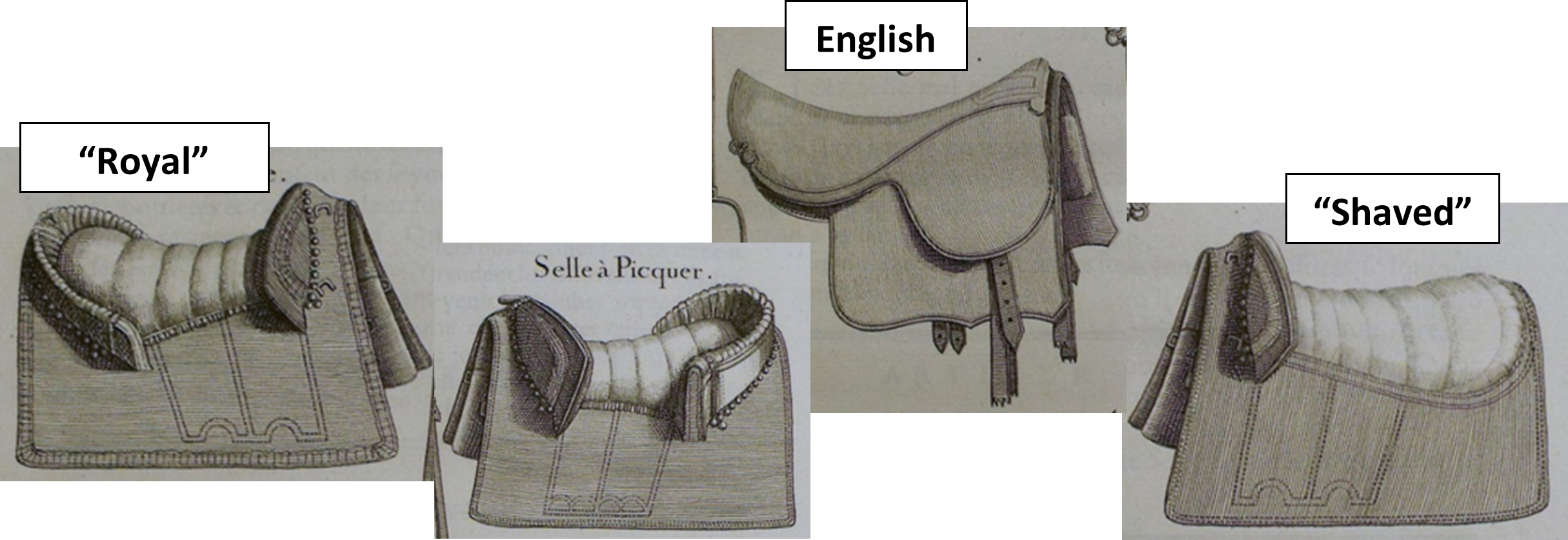
Table 2. Summary of saddle types used in the English colonies since the 17th century
| Saddle Type | Characteristics | Uses | Temporal Notes |
|---|---|---|---|
| Royal saddle | Bolsters on front and back, relatively low (about 2.5" tall) | Military, countryside riding | Metal pommel falls out of favor by 1730 for safety reasons |
| "Piquer" Saddle | Bolsters front and back, relatively high (about 4” tall) | Riding and training young horses; high bolsters to help keep the rider seated, hold thighs more firmly | |
| English saddle | No bolsters, lightest option | Hunting at first, then general riding for everyday use and dressage. | In use by the late 17th century; dominant by ca. 1730 |
| "Shaved" saddle | Hybrid of royal saddle and English saddle; Low bolster (about 2") in front only | Hunting | No longer in use by the turn of the 19th century |
| Pack saddle | Forms vary, but largely wood with iron fittings and hooks | Cargo | |
| Chair side saddle | Exactly as it sounds, the saddle is shaped like a chair and faces the side, with a footrest like a step hanging down on one side | Primarily for women but could also be for inexperienced riders or anyone who just wants to be a passenger. The rider in this saddle is not controlling the horse. | Predates settlement of the English tobacco colonies, but continued in use |
| Side saddle | Saddle where the rider faces front, with one knee pulled up but both feet on the same side | Ladies' riding | Form with second pommel 'hook' introduced in the 19th century |
| Pillion | Not a saddle itself, but a pad attached behind a saddle to make a seat | Seat for a passenger to ride behind the person in the saddle proper | In use throughout the 17th and 18th centuries and beyond |
| Postillion saddle | Variation of the English saddle | Driving; the postillion driver rides one of the horses pulling the vehicle, unlike a coachman who drives horses while seated on the vehicle | Atypical in the tobacco colonies prior to c. 1750, except in high-class households near urban centers such as Williamsburg, VA |
| Harness saddle | A narrow saddle to support the weight of vehicle shafts or poles; often with rein guides or terrets; no seat | Driving | Atypical in the tobacco colonies prior to c. 1750, except in high-class households near urban centers such as Williamsburg, VA |
| Images from Guerinière (1751). | |||
Acknowledgments
The Saddle section of Diagnostic Artifacts was funded in part by a grant from the Conservation Fund. Partners contributing collections access for this grant include Colonial Williamsburg, Historic St. Mary’s City, Preservation Virginia’s Jamestown Rediscovery, and the Viginia Department of Historic Resources.
References
1970[1783] Observations on the Commerce of the American States with Europe and the West Indies; Including the several Articles of Import and Export. Research Reprints Inc.: New York.
2000 Living and Working in Seventeenth Century England: Descriptions and drawings from Randle Holme's Academy of Armory. CD-Rom. London: The British Library Board.
1977 Horses and Gentlemen: The Cultural Significance of Gambling among the Gentry of Virginia. The William and Mary Quarterly 34(2):239-257.
1985 Tobacco Culture: The Mentality of the Great Tidewater Planters on the Eve of Revolution. Princeton University Press: Princeton, NJ.
1987 [ca. 1893] Mosemans' Illustrated Catalog of Horse Furnishing Goods: An Unabridged Republication of the Fifth Edition. Dover Publications, Inc., New York.
1970 A History of Horsemanship. Doubleday & Company, Inc., New York.
2007 Horse and Man in Early Modern England. Hambledon Continuum: London.
1741 Le nouveau parfait maréchal : ou, la connaissance génerale et universelle du cheval; divisé en sept traits. Chez Despilly: Paris, France. Bibliothèque Nationale de France, https://gallica.bnf.fr/ark:/12148/bpt6k108877x.image, accessed November 11, 2020.
1774 L'Art du Bourrelier et du Sellier. Bibliothèque Nationale de France, https://gallica.bnf.fr/ark:/12148/bpt6k10671826/f7.item.r=garsault%20sellier#, accessed November 11, 2020.
1697-1773 Ledgers of Imports and Exports. Accessed in the Joseph Downs Collection and the Winterthur Archives. Originals located in the London Public Record Office.
1751 Ecole de Cavalerie, Contenant la Connoissance L'Instruction, et la Conservation du Cheval. Huart et Moreau Fils: Paris. Accessed in the Charles Lawrence Ferguson Collection, the library of the Society of the Cincinnati, Washington, DC.
1701 The Academy of Armory, or a Display of Heraldry. Book IV. London: Printed and sold by the booksellers of London and Westminster. Winterthur Library Rare Books.
1695-1705 Sheffield v Stark & ors, exhibits concerning Maryland trade (tobacco and slaves). The National Archives, Kew. Reference E 219/446.
1994 High-Style Vernacular: Lifestyles of the Colonial Elite. In Of Consuming Interest: The Style of Life in the Eighteenth Century, edited by Cary Carson, Ronald Hoffman, and Peter J. Albert. p. 1-58. U. Press of Virginia, Charlottesville, Virginia.