Horseshoes
Introduction
Horseshoes are usually recognized by archaeologists, though little has been written to help people date and understand these artifacts. This section of Diagnostic Artifacts in Maryland is intended as a starting point for helping archaeologists describe the attributes of horseshoes and identify some characteristics that offer interpretive potential. The most important thing to note about archaeological horseshoes is their context because that can suggest whether the horseshoe’s last function had to do with protecting a hoof or a household. For centuries horseshoes have been used to ward off witches, curses, and other evil forces. Despite changes in belief systems over time, horseshoes remain a staple of household magic as protective lucky talismans, and this function should be considered in archaeological interpretations depending on the context as outlined below.

Anatomy and Shape
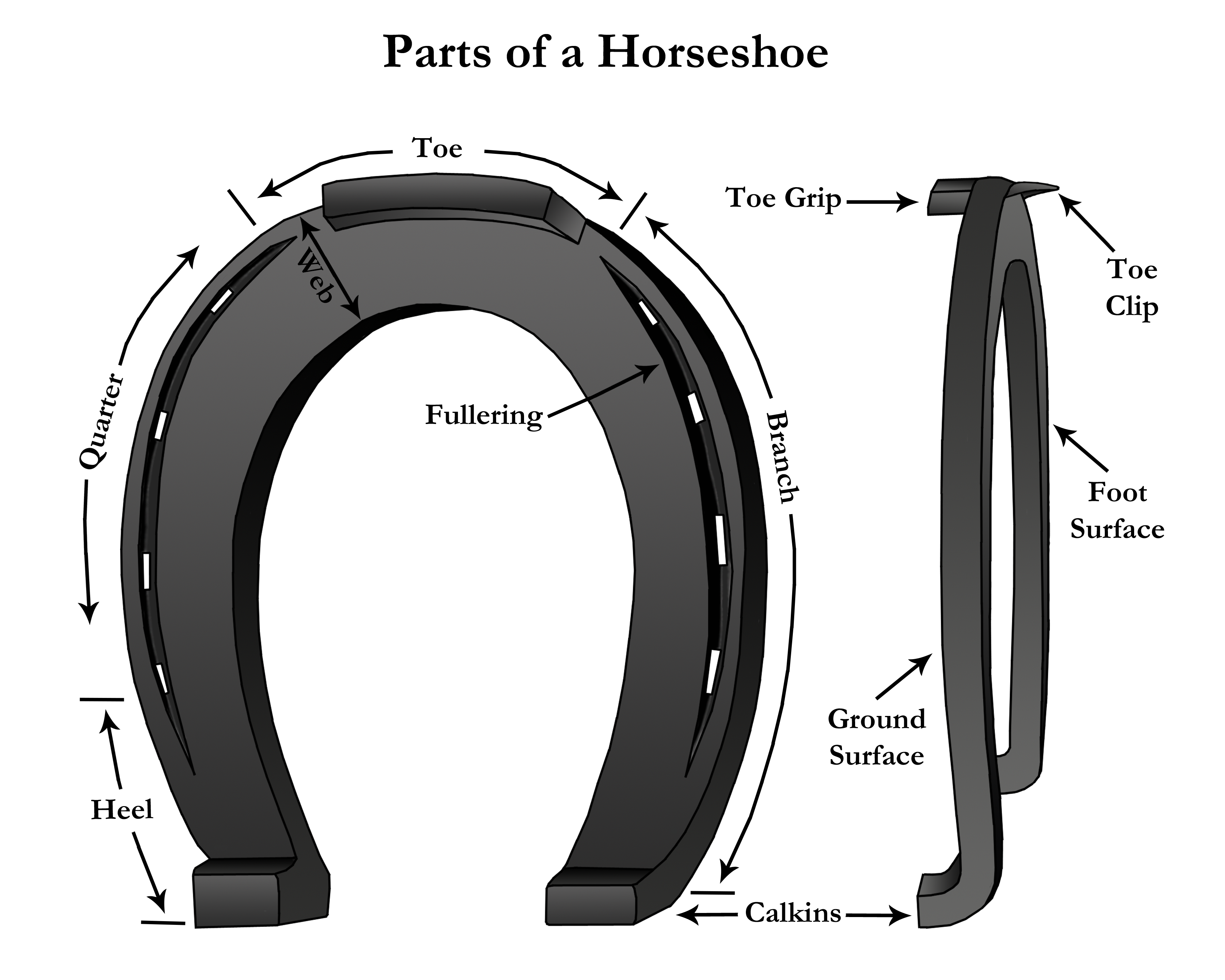
Figure 1 offers terminology to use when describing horseshoe elements in artifact catalogs. Not all elements will be found on every horseshoe. For example, toe grips and calkins pointing toward the ground to help with traction are not always present.
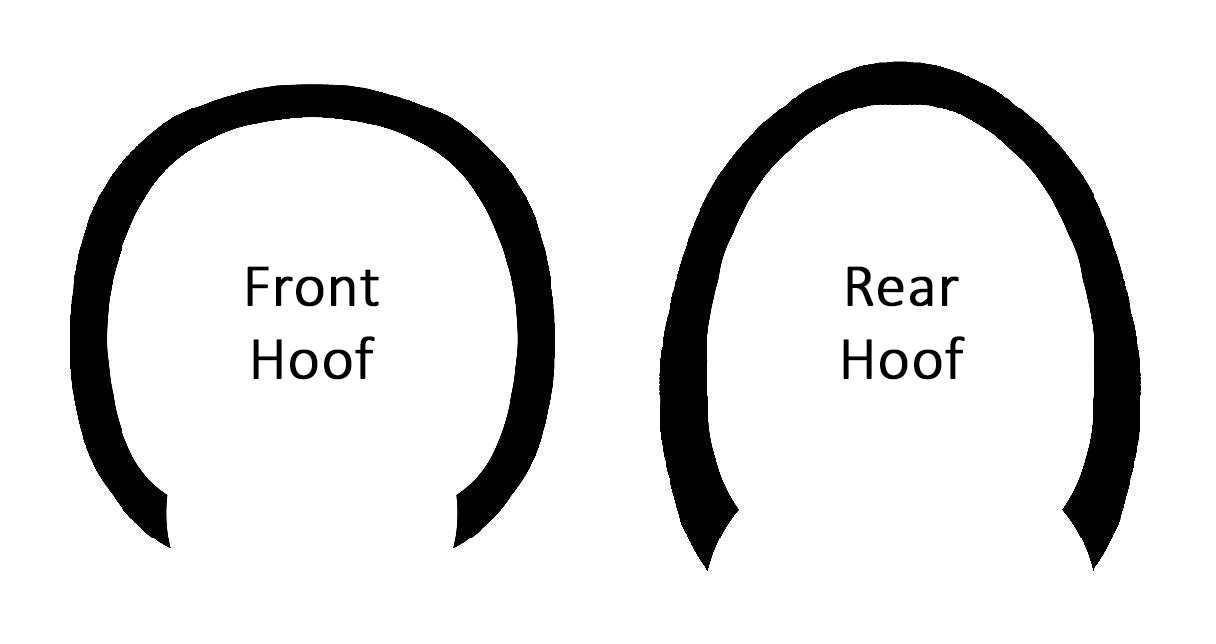
The overall shape of the horseshoe can sometimes indicate whether it was made for a front or rear hoof, as front hooves are generally circular while rear hooves have a more oblong or bluntly pointed shape (Figure 2). Overall shape and proportion can also point away from use on horses altogether. Elongated horseshoes with branches that are practically parallel are likely for mules, while ox shoes look like half of a horseshoe with an interior rounded bulge at the heel (Figure 3). Metal rails for clogs worn by humans also sometimes get identified as horseshoes, though these are thinner and proportional to human toes and heels.
Use-Wear
Wear tends to be most evident at the toe, which is also where horseshoes are most likely to break. To capture information about use wear, this website includes thickness measurements at the toe, heel, and mid-branch or quarter. Even if thickness was not completely uniform when the shoe was new, the variation from heel to toe will be more dramatic on shoes with a lot of wear.
Temporal Diagnostics
In the 17th and 18th centuries, all horseshoes were handmade and there was a lot of variation. As a general trend, however, the web decreased in width over the course of the 18th century (Chappell 1973). Additionally, horseshoe thickness seems to show a gradual increase over time, though archaeologists must be cautious not to mistake wear for thinness.
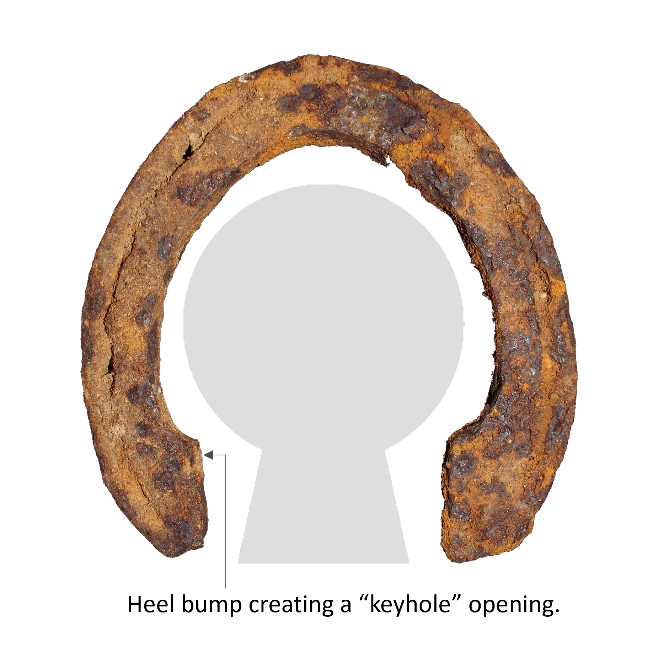
18th-century horseshoes often have a little interior bump near the heels, making an opening that's shaped like a keyhole (Figure 2; Chappell 1973). The absence of this shape does not exclude an 18th century date, but the presence of the style is diagnostic.
One of the first horseshoe-making machines was invented by the engineer Henry Burden in 1835, though it was not until he went on to patent an improved machine in 1857 that the “ready-made” horseshoe really impacted the market (Morris 1988). Chappell (1973) notes that machine-made shoes often exhibit uniform fullering with sharply pointed ends in contrast to the more crude fullering achieved by the chisel on handmade examples. Another diagnostic of a 19th-century horseshoe is a slight outward curve of the heels.
Toe clips that point up at the horse from the foot surface side of the shoe (Figure 1) were apparently introduced by the veterinary surgeon H. Hallen in the mid-19th century, giving this characteristic a post-1850 date (Chappell 1973; Noël Hume 1969).
History and Interpretation
Horses and horseshoes arrived in Maryland and Virginia with English colonists in the 17th century. In England horseshoes were generally considered to be the purview of the farrier, who was like a combination large animal veterinarian and blacksmith for fitting iron shoes to hooves. A variety of horseshoe forms developed to address different ailments of the hoof, or fulfill specific needs, such as traction on icy surfaces. In theory, form should offer archaeologists potential for interpreting how horses were used and problems they may have experienced to warrant corrective shoes.
In practice, however, horses were seldom shod in Maryland and Virginia prior to 1750 because of the soft clay or sandy soils and the absence of metalled roads (Beverly 1855:98; Chenevix-Trench 1970:231; Bruce 1935:239). Horseshoes from pre-1750 contexts may therefore have little to with animal husbandry. Instead, they were often repurposed as magic talismans to ward off evil and deflect witches (Rivers Cofield 2021). After 1750, westward expansion into rockier territory, urban development in places such as Williamsburg and Annapolis, and the improvement of roadways created more demand for horseshoes on the hoof. Folk magic applications also continued, however, leaving archaeologists with at least two potential interpretive angles for every horseshoe.
Context is the most important factor for determining the last use of a horseshoe, though condition is also a factor. For example, new horseshoes were not considered lucky or protective compared to "found" shoes with wear, so unused horseshoes are less likely to be apotropaic. The following lists summarize contexts and characteristics to look for (Rivers Cofield 2021):
| Horse-Related | Apotropaic/Lucky |
|---|---|
| • Found in fields, along roads, or near mills and other industries using horsepower | • Recovered near house/outbuilding openings; windows, doors, fireplaces |
| • Found in or near smithies | • Associated with other apotropaic devices (witch bottles, concealed shoes, etc.) |
| • Associated with other equestrian equipment | • "Found" shoes with some wear |
| • Broken shoes | • Whole; having nails present also is a plus |
When horseshoes are encountered with unusual shapes or add-ons, period literature may be of help in explaining the intended function. For example, in his 1688 Academy of Armory, Randle Holme describes several different types of shoes, including a "lunet" shoe with the ends cut off for use on a horse with weak heels, and a "false quarter shoe" with one heel cut off to accommodate a sore side hoof (Alcock and Cox 2000). Although there are too many variations over time to include here, some helpful source material is available online through websites such as Google Books and archive.org. Illustrations of horseshoe variants are included in Diderot and Alembert's "Marechal Ferrant" encyclopedia entry (1751-1765:Plates V-VI), Garsault (1741:Plate XIX), and Fleming (1869), all of which are available online.
Acknowledgments
The Horseshoe section of Diagnostic Artifacts was funded in part by a grant from the Conservation Fund. Partners contributing collections access for this grant include Colonial Williamsburg, Historic St. Mary’s City, Preservation Virginia’s Jamestown Rediscovery, and the Viginia Department of Historic Resources.
References
2000 Living and Working in Seventeenth Century England: Descriptions and drawings from Randle Holme's Academy of Armory. CD-Rom. London: The British Library Board.
1935 Economic History of Virginia in the Seventeenth Century: An Inquiry into the Material Condition of the People, Based on Original and Contemporaneous Records. Volume I. Peter Smith: New York.
1973 A Study of Horseshoes in the Department of Archaeology, Colonial Williamsburg. In Five Artifact Studies, edited by Audrey Noël Hume, Merry Abbitt, Robert McNutty, Isabel Davies, and Edward Chappell. pp. 100-116. Colonial Williamsburg Foundation: Williamsburg, VA.
1970 A History of Horsemanship. Doubleday & Company, Inc., New York.
1751-1765 Encyclopédie, ou Dictionnaire Raisonné des Sciences: Des Arts et des Métiers. Paris: Chez Braisson, David, Le Breton, Durand. The Robert Charles Lawrence Fergusson Collection, Society of the Cincinnati, Washington, D.C.
1869 Horse-Shoes and Horse-Shoeing: Their Origin, History, Uses, and Abuses. Chapman and Hall, London.
1774 L'Art du Bourrelier et du Sellier. Bibliothèque Nationale de France, https://gallica.bnf.fr/ark:/12148/bpt6k10671826/f7.item.r=garsault%20sellier#, accessed November 11, 2020.
1751 Ecole de Cavalerie, Contenant la Connoissance L'Instruction, et la Conservation du Cheval. Huart et Moreau Fils: Paris. Accessed in the Charles Lawrence Ferguson Collection, the library of the Society of the Cincinnati, Washington, DC.
1988 What the Horse Left Behind: The Archaeological Study of Horseshoes. MA Thesis, University of Nevada, Reno.
1969 A Guide to Artifacts of Colonial America. University of Pennsylvania Press: Philadelphia.
2021 Ho-Hum Hoofwear or Meaningfully Magical? How to Identify and Interpret Apotropaic Horseshoes. Paper prepared for the 2021 virtual Society for Historical Archaeology Conference.