Spurs
Definition and Function
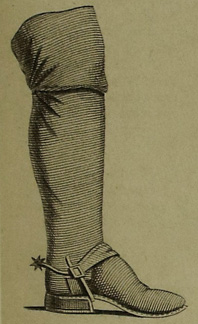
Spurs are devices that were invented over 2,000 years ago to aid in horse-riding. They are generally U-shaped to fit around a person's ankle, and they have a spike or rowel at the end to allow a rider to poke a horse’s haunches. Spurs can be used to get a horse to move or to punish misbehavior. Because spurs are attached to the heel of the rider, however, they have also enjoyed some periods of popularity as a fashion accessory, even for individuals who had no horse and did not ride.
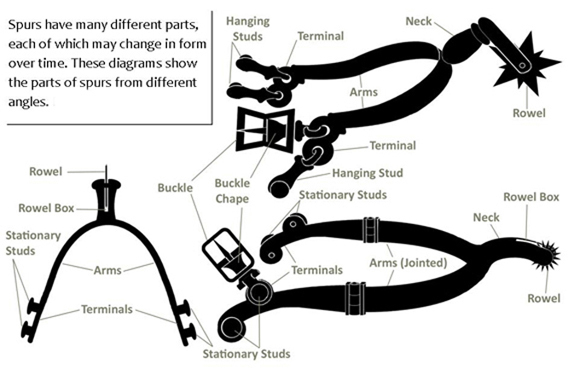
Parts of a Spur
Chronology
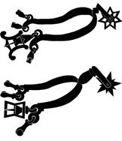
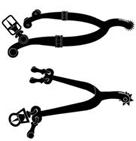
Changes in spurs over time are fairly well documented thanks to portraits, historical accounts, and surviving examples. The following table summarizes some of the most typical attributes of Colonial and Early Federal spurs found in the Middle-Atlantic. Additional chronological information is included in this section of the website in the form of images, measurements, context, and site information for every Colonial and Early Federal spur available at the MAC Lab and cooperating regional repositories.
In the 19th and 20th centuries, the variety of spurs increased, making their inclusion in a simplified table more problematic, and at present, no later spurs have been located in the MAC Lab's collections. Such examples will be added to the website if available in future, however, even though post-1820 spurs are not illustrated in the table below.
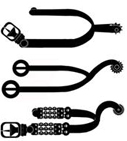
Table 1. Typical English Spur Styles, ca. 1600-1820
| ca. 1630-1660 | ca. 1650-1775 | ca. 1765-1820 | |
|---|---|---|---|
| ILLUSTRATION Click on image to see a larger view. |
|
|
|
| FUNCTION | Riding/traveling Boots and spurs popular for daily wear and walking |
Riding/traveling only | Riding/traveling Boots popular for walking/daily wear, though not always with spurs |
| ROWEL | Often over 1 inch diameter Sometimes ornate Brass or iron |
Less than 1 inch diameter Usually iron |
Very small, sometimes barely protruding from the end of the neck Usually iron |
| NECK | Relatively long; over 1 inch in length Bent or curved downward, often at a 90° angle |
1 inch or less in length Curved slightly downward Often flared at the end |
Length varies Straight neck Swan shaped neck begins (curves up, then down) Flared end less common |
| ARMS/SIDES | Usually curved Sometimes triangular in cross-section Slight taper from neck to terminal |
Straight Slight or significant taper from neck to terminal Sometimes hinged with little taper from neck to terminal |
Straight Minimal tapering from neck to terminal May incorporate chains between the terminal and stud/buckle |
| TERMINALS | Off-set figure-eight with two holes S-shaped with two holes |
Centered figure-eight with two holes S-shaped with two holes S-shaped with stationary studs |
A single stationary stud A stud and buckle connected by brackets and/or chains Openings for straps to pass through |
| STUDS/HOOKS | Looped around holes at the spur terminal; hang and swing freely | Looped around holes at the spur terminal; hang and swing freely Stationary studs attached directly to terminal holes |
A single stationary stud at each terminal None: Straps attach directly to the spur terminal or the spur attaches to the boot without straps at all |
| BUCKLES | Butterfly-shape is popular for spurs of this period, but plain
asymmetrical and symmetrical buckles are also present Looped chape to attach to the spur terminal |
Both asymmetrical and symmetrical buckles used Looped chape to attach to the spur terminal Hinged chape with an attachment for a stationary stud Unhinged chape with a large hole for a stationary stud |
Hinged chape with an attachment for a stationary stud Buckle attaches to spur straps that pass through openings in the terminal, not the spur itself |
| DECORATION | Decoration preferred Jingles possible |
Usually undecorated | Usually undecorated |
References
1751-1765 Encyclopédie, ou Dictionnaire Raisonné des Sciences: Des Arts et des Métiers. Paris: Chez Braisson, David, Le Breton, Durand. The Robert Charles Lawrence Fergusson Collection, Society of the Cincinnati, Washington, D.C.