Stirrups
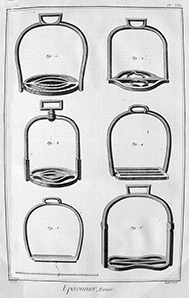
Stirrups are foot supports for horse riders. They are usually made of metal or wood and they hang from a saddle on straps known as stirrup leathers. Riders without stirrups have to stay seated and are subject to the discomfort of their mounts' jolting steps, limiting the distance one can tolerably cover. Riders standing in stirrups, however, can absorb the shock of the moving horse and manipulate their center of gravity to facilitate activities such as archery, swordplay, and jousting (Chenevix-Trench 1970:64-66).
Defining Attributes
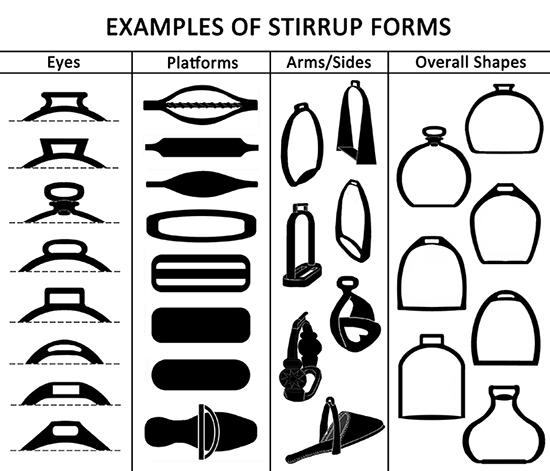
There are many different kinds of stirrups, but collections in the mid-Atlantic region tend to have only basic stirrup forms made in the English riding tradition. These are made of iron or brass, and they have three main parts: an eye for stirrup leathers or straps that attach the stirrup to the saddle, a platform or base to place the foot on, and arms to connect the eye to the base. All three parts may vary in terms of shape and decoration. Some of the shapes are shown in Figure 2.
Examples of Stirrup Forms
Chronology
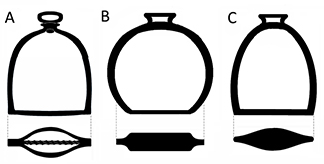
Very little literature exists on changes in stirrups overtime. (Noël Hume 1969:242-243) describes the earliest styles in the colonies as having straight sides, a gridiron (barred) platform, and a swiveling eye (Figure 3A). He says this style was replaced in the later 17th century with stirrups that had solid rectangular platforms, a fixed rectangular eye that flared at the top, and curved sides that gave the stirrup a circular shape (Figure 3B). He suggests that by the end of the 18th century stirrups had less curvature to the sides, and oval platforms rather than rectangular ones (Figure 3C). Although forms matching these descriptions have been recovered in Maryland, there are not enough examples to do a seriation study that would test Noël Hume’s chronology of colonial stirrups.
Unfortunately, there is no single go-to source illustrating stirrups and their changes over time in the 19th century either. By the end of the 18th century, the industrialization of the metal industries increased the number of stirrup styles available for purchase. For example, trade catalogs from Birmingham, England illustrated stirrups in a variety of decorative and plain styles that were available to consumers. Presumably the number of available styles in the 19th century accounts for the absence of similarities among 19th-century stirrups in Maryland’s archaeological collections. Again, there not enough examples to build a seriation study. Instead, for both colonial and post-colonial stirrups, this website offers context and site information on every example illustrated, including the date ranges for sites and features where stirrups were recovered.
Interpretation
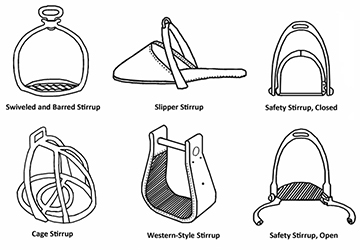
Archaeologists who use stirrups in site analyses can be confident that these artifacts represent riding as an activity. Further interpretive insight is also possible depending on the type or size of the stirrup recovered (Figure 3). For example, “slipper” stirrups that enclose the toe were common on women’s side saddles, and these can be identified by the presence of a platform at the base in the shape of a foot sole. “Cage” stirrups were made to offer extra protection to the foot. “Western” stirrups typically have wide wooden sides that are continuous with the base and a bar for hanging instead of an eye, and “Safety” stirrups of various designs were invented to ensure that a rider’s foot would be released in case of a fall. Few stirrups recovered in the Mid-Atlantic exhibit characteristics that lend themselves to this kind of categorization, but even plain stirrups have further interpretive potential when size is considered.
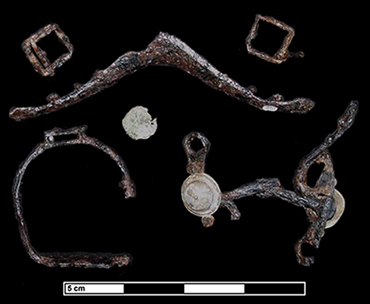
Size is important because stirrups made for women and children were generally smaller than men’s stirrups. Additionally, extra small stirrups were made for use on rocking horses, and extra-large stirrups were needed for postillion riders who drove carriage horses and wore large robust boots to protect their legs from harness rigging and overgrown vegetation. Unfortunately, the sample of stirrups available for measurement is not yet big enough to suggest standard sizes that can be affiliated with these different uses, so more research is needed to determine how much variation in size is to be expected. In some cases, however, context and associated artifacts can narrow down the possibilities. For example, a passageway feature leading to a ca. 1689-1730 cellar at the Addison Plantation (18PR175) yielded an assemblage of saddle and bridle parts that included only one small stirrup (Figure 4). This particular saddle seems to have been deposited whole and its context sealed by fire. Since side saddles have only one stirrup, but all other saddles have two, it is most likely that the single small stirrup in this case was for a woman’s saddle.
Most stirrups cannot be placed in such specialized categories, but the “Stirrup” section of the Diagnostic Artifacts in Maryland website offers many different examples so that finds from different sites can be compared. Hyperlinks to site summaries explain where each stirrup came from, and each site summary includes directions for finding more information.
References
1970 A History of Horsemanship. Doubleday & Company, Inc., New York.
1969 A Guide to Artifacts of Colonial America. University of Pennsylvania Press: Philadelphia.