North American Stoneware
Defining Attributes
North American stoneware is non-porous (vitrified) and stone-like. Paste color generally ranges from grey to tan to reddish browns, and vessels were produced by a variety of methods, including hand throwing, jigger or jolly machines, slip casting and press molding. While properly-fired stoneware is impervious to liquids and does not need glazing, North American stonewares were usually treated with some form of glazing or slip, including salt glaze, Bristol glaze, alkaline glaze and Albany slip. There were many regional stoneware production centers, producing a variety of wares, primarily utilitarian. Within these regions, there are variations in preferred glaze and form types. This essay and its accompanying photographs are not intended to provide a full scope or range of North American stoneware, but document what is in the collections of the Maryland Archaeological Conservation Laboratory.
Chronology
Stoneware potters arrived in the English colonies in the early 18th century and began production in Pennsylvania, Virginia, New York and New Jersey. One of the earliest known dated pieces of North American stoneware was made in 1722 by Joseph Thiekson of New Jersey (Guilland 1971:39). 18th-century North American stoneware production was heavily influenced by both the British and German stoneware traditions (Greer 1981:20). William Rogers, also known as the Poor Potter of Yorktown, produced salt glazed stoneware that looked a great deal like English brown stoneware (Barka 2004). Potters like William Crolius and Johannes Remmey, working out of New York, manufactured blue and grey salt glazed stoneware that imitated Rhenish stonewares. Even into the early 19th century, many pieces of North American stoneware exhibit a blending of British and German stoneware traditions, prior to the development of distinctly American forms and decorative styles (Greer 1981:20).
Stoneware production began at different times in different parts of the United States, as suitable deposits of clay were discovered (Guilland 1971:40). The production of utilitarian stoneware in North America increased dramatically during the 19th century. By the end of the first quarter of the century, there were over half a dozen stoneware potters in the Richmond, Virginia area alone (Hunter and Goodman 2005:37). Other American cities, including New York, Baltimore, Philadelphia, Alexandria and New Brunswick, New Jersey, contained thriving stoneware industries (Kille 2005; Magid 2012; Magid 2013; Veit and Kratzer 2005).
Most production before the Civil War was done by small operations for local sale. For example, potters in South Carolina’s Edgefield District sold their pottery throughout the state and into northern and eastern Georgia in the 1840s and 1850s (Baldwin 1993:1). After the war, stoneware production boomed, with many established businesses expanding and many new potteries opening (Guilland 1971:51). Modes of production changed from wheel thrown to mold made vessels. With the beginning of the 20th century, small stoneware potteries were being forced out of business by larger industrial producers of stoneware (Greer 1981:259). Most stoneware potteries did not survive the Great Depression and the decreasing need for utilitarian stoneware, as metal and glass containers became more widely available (Baldwin 1993:186).
Description
Fabric
North American stonewares have a hard, dense, impermeable body with low porosity. Paste color can vary from buff to browns to greys. Surface colors can vary as well and are discussed in more detail below.
Glaze and Slips
Since properly vitrified stoneware is impermeable, it should not require a glaze to prevent leaking. North American stoneware is, however, generally glazed in some fashion for ease of cleaning and for a more finished overall appearance (Greer 1981:16). Common glaze or surface treatments on North American stoneware include salt glaze, slip or loam glazes, alkaline glaze, volcanic ash and Bristol glaze (Greer 1981:179).
Salt Glaze – Salt glazing was one of the most common forms of glaze used for North American stoneware, resulting in the characteristic dimpled surface or "orange peel" texture on vessels. Salt introduced into the kiln during firing reacted with silicates in the clays, creating a shiny, pitted surface. Surface colors of North American salt glaze stoneware vessels can vary from very pale beige to very dark grey based on kiln firing conditions, as well as on clay inclusions. Clay containing large amounts of iron can cause reddish tones in the finished vessel (Greer 1981:35). The interiors vessels were sometimes coated with brown clay slip or an iron oxide wash to create an impermeable interior surface (Greer 1981:197). Salt glazed vessels usually date prior to the 20th century1 and the absence of slip on the interior usually indicates a vessel made prior to 1860 (Greer 1981:263).
Slip or Loam Glazes – Glazes made from natural clay slip began to be used by North American stoneware potters in the early 19th century and are the second most common glaze on North American utilitarian stoneware (Greer 1981:194, 197). Slip, a creamy mixture of clay and water applied to the surface of stoneware vessels, melts in the high temperatures of the kiln to form a glaze. Slip glazes were especially popular during the last quarter of the 19th century (Greer 1981:197).
Albany Glaze – Perhaps the best known of these treatments is Albany slip. Generally chocolate brown from the high iron content of the clay, the color of Albany slip could vary from black to reddish brown and even olive green, based on various firing factors, such as an oxidizing atmosphere in the kiln, or yellowish bleaching caused by deposits of fly ash during a wood firing (Greer 1981:38). Originally created from alluvial clays mined from New York State, the term has come to refer to any dark brown or black firing slip clay (Greer 1981:265). Use of Albany slip began in the first quarter of the 19th century around the Albany area, but use was widespread by mid-century (Guilland 1971:85; Greer 1981:194). Especially popular during the late 19th and early 20th centuries, Albany slip was was used both on the interior and exterior of stoneware vessels (Greer 1981:194).
Alkaline Glaze – Southern alkaline glazes are durable, shiny transparent glazes made from a combination of wood ash or lime, clay and a silica source like sand, crushed glass or flint (Baldwin 1993:1). They exhibit a range of surface colors, including olive green, yellowish green and dark to pale brown, depending on the presence of minerals, particularly iron, in the glaze and the paste, as well as kiln conditions (Greer 1981; Zug 1986). Alkaline glaze vessels also show a range of surface textures, with some vessels relatively smooth in texture, while other exhibit streaks and runs of glaze. Small grains of sand-like material may be visible in the glaze (Greer 1971:161). On alkaline glazed vessels, the same glaze almost always occurs on both the interior and exterior (Greer 1981:210). Alkaline glazes were used in the United States as early as 1810 and persisted into the 20th century (Greer 1981:202). There were many different regional names for these glazes, which were used from North Carolina south and westward to Texas.
Bristol glaze – Bristol and Bristol-type glazes, first developed in England in the 19th century as an alternative to salt and lead glazes, produce smooth white surfaces on stoneware pastes. Surface colors can range from a creamy white to blueish white. The white coloration was created from a mixture of zinc oxide, calcium, feldspar and china clay. Bristol glaze was used most extensively in North America in the 20th century (Greer 1981:265) and, especially prior to 1920, was used in conjunction with Albany slip.2 After around 1920, Bristol glaze was most often used alone, and sometimes embellished with sponging, stamping, decals or sprayed colors (Greer 1981:212). If applied over a stoneware body that has a high iron content, Bristol glaze will sometimes have a pinkish cast.
Volcanic Ash – Stonewares glazed with volcanic ash were produced beginning in the second half of the 19th century in Idaho, Washington and Oregon. Volcanic ash glazes are not present in the Maryland collections and will not be discussed here.
Decoration
Salt glaze vessels display incised decoration, usually infilled with cobalt, as well as brushed (painted) or trailed cobalt decoration. Design motifs included stylized birds, flowers, swags, loops, fish and other animals, later giving way to more realistic depictions of these same motifs. Applied decoration in the form of patriotic eagles or political busts was less common on salt glazed stoneware than painted or incised decoration. Stamps and stencils were sometimes employed for manufacturer’s name, vessel contents or capacity marks. Other impressed decoration included coggled banding and wheel turned banding. Between around 1870 through the 1890s, stencils were used to decorate stoneware made in southwestern Pennsylvania (Schaltenbrand 1995:131). Alkaline glazed vessels could be slip trailed in brown and white or decorated with rows of incised lines. Bristol glazed vessels, with their white surfaces, were sometimes decorated with sponging, painting, decals or stamped or stenciled advertisements for merchants or products. The use of stencils became more common after the Civil War (Guilland 1971:85). Vessels produced in molds could have molded surface treatments.
Form
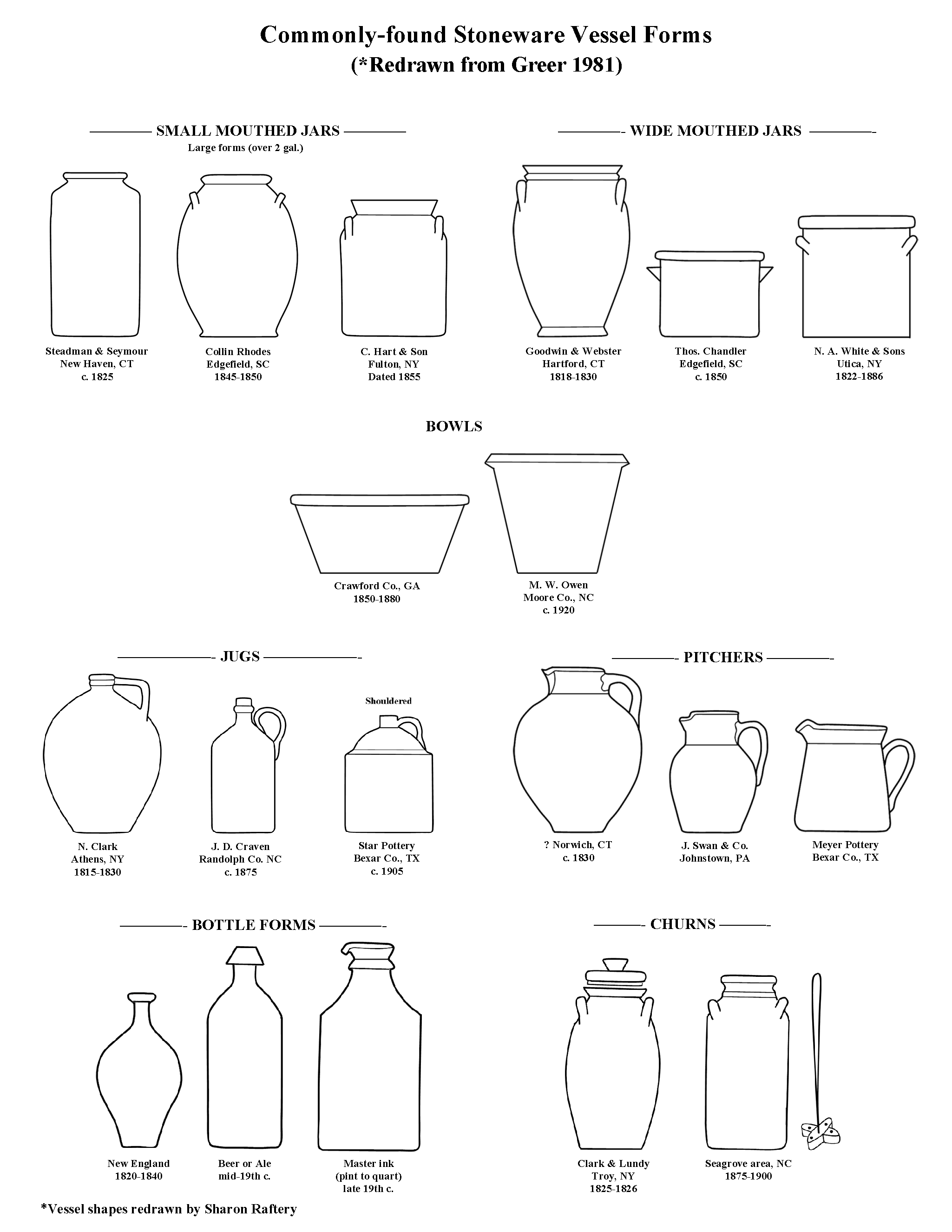
North American stoneware occurs primarily in utilitarian forms (Figure 1). Vessels generally fall into the categories of food preparation or serving (mugs, bowls, churns, pitchers, milk pans) storage/preservation (jars, jugs, beer and ale bottles, preserve jars, storage jars, ring jugs, water coolers), other household items (poultry feeders, flowerpots, ink wells, ink bottles, sewer pipes) and toiletry/chamberwares (spittoons, slop jars, chamberpots). Tableware forms, with the exception of mugs, were not commonly produced. Since stoneware is generally not suitable for cooking due to its highly vitrified body (Greer 1981:16), it is uncommon to see stoneware vessel forms associated with baking.
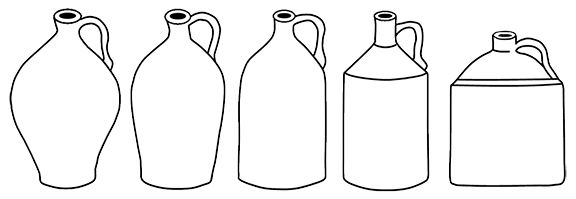
There is a wide range of regional differences in form, and readers will need to consult stoneware sources for more specific information in this regard. Over time, vessels shapes (Figure 2) generally changed from ovoid or globular forms to vessels with straight walls and cylindrical profiles (Greer 1981:55). This change generally occurred around the 1860s, but ovoid forms did persist in some areas, like central North Carolina and central and northern Georgia, until the early 20th century (Greer 1981:55). Jugs or jars with sloping shoulders ending in a flat tooled ledge at the shoulder generally date after 1890 (Greer 1981:263).
Footnotes
1 Central North Carolina potters continued to produce salt glazed wares until around 1930 (Greer 1981:263).
2 Bristol glaze was used in the industrialized potteries of the North and Midwest beginning after 1890, but not produced in the rest of the country until after 1900 (Greer 1981:264).
References
1993 Great and Noble Jar; Traditional Stoneware of South Carolina. The University of Georgia Press, Athens.
2004 Archaeology of a Colonial Pottery Factory: The Kilns and Ceramics of the “Poor Potter” of Yorktown. Ceramics in America 2004. Edited by Robert Hunter. Hanover, N.H.: University Press of New England for the Chipstone Foundation, pp. 15-59.
1981 American Stonewares; The Art & Craft of Utilitarian Potters. Atglen, PA: Schiffer Books, 1999 edition.
1971 Early American Folk Pottery. Philadelphia: Chilton Book Company.
2005 Distinguishing Marks and Flowering Designs: Baltimore’s Utilitarian Stoneware Industry. Ceramics in America 2005. Edited by Robert Hunter. Hanover, N.H.: University Press of New England for the Chipstone Foundation, pp. 93-132.
2012 "Stone-ware of excellent quality, Alexandria manufacture," Part I: The Pottery of John Swann. Ceramics in America 2012. Edited by Robert Hunter. Hanover, N.H.: University Press of New England for the Chipstone Foundation, pp. 111-145.
2013 "Stone-ware of excellent quality, Alexandria manufacture," Part II: The Pottery of Benedict C. Milburn 2013. Ceramics in America. Edited by Robert Hunter. Hanover, N.H.: University Press of New England for the Chipstone Foundation, pp. 77-119.
1995 Stoneware of Southwestern Pennsylvania. University of Pittsburgh Press, Pittsburgh.
2005 Rediscovering the New Brunswick Stoneware Pottery, ca. 1862-1902. Ceramics in America 2005. Edited by Robert Hunter. Hanover, N.H.: University Press of New England for the Chipstone Foundation, pp. 133-140.
1986 Turners & Burners: The Folk Potters of North Carolina. Chapel Hill : University of North Carolina Press.