Chinese Hard-Paste Porcelain
Defining Attributes
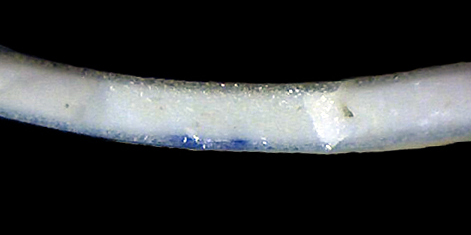
Chinese porcelain has a vitrified, glassy paste with a slight blue to pale grey tint that blends into and is nearly indistinguishable from the glaze.
Chronology
Chinese porcelain from the Ming Dynasty (1364 – 1644) was introduced into Europe in the mid-16th century, initially by the Portuguese and then more extensively by the Dutch. Although porcelain is very rare on 17th-century archaeological sites in the Chesapeake, delicate blue painted, white-bodied Ming sherds are found in contexts from the first half of the 17th century. A coarser ware, Kraak porcelain, was manufactured especially for export and is also found on early 17th-century sites in the Chesapeake region (Curtis 1988; Sperling and Galke 2001). Chinese porcelain became inaccessible to Europeans during the mid-17th century due to internal wars in southern China. The Dutch imported Japanese Imari porcelain in its place after 1650, and occasional fragments of this ware are found on colonial sites (Mudge 1986:33-34, 87). By the end of the 17th century, Chinese porcelain was once again traded to Europe, with sizable quantities not coming into London until the 1690s (Curtis 1989).
This Chinese export porcelain was specifically made for the European market. Common decorative motifs included floral, foliate, waterscapes, Chinese houses, people, birds, insects, and geometric and crosshatched borders. In the 18th century, these motifs were much copied by English potters, while the Chinese were copying many European engravings and paintings, so that at times it is difficult to determine the actual origin of a particular pattern. Through a systematic study of decorations found on marked porcelain vessels and porcelain recovered from datable shipwrecks and tightly-dated archaeological contexts, Andrew Madsen was able to document and define date ranges for certain types of decorative motifs (Madsen 1995; Madsen and White 2011). These decorative motifs and the date ranges when they most commonly occur are discussed in the Decoration section below.
Description
Fabric
An extremely compacted, white body with a clear shiny glaze. The hard paste, composed of white kaolin clay and finely-ground feldspathic rock (petuntse), is fired to temperatures between 1250 – 1500 degrees C.
Glaze
Chinese porcelains have a clear, glossy feldspathic glaze that is usually fused to the paste. Underglaze decorated Chinese porcelain is only fired once (Owen 2002); when overglaze enamels are used, an additional firing at a lower temperature (approximately 800 degrees F.) is needed, making these wares more expensive to produce. Affixing gold gilt required a third firing (Scheurleer 1974:34). Kraak porcelain often has pinholes or small bare spots, 'moth-eaten,' along rim edges where the glaze has shrunk during firing (Rinaldi 1989:69).
Blue and white underglaze decorated vessels will often have a thin brown wash along the vessel rim. Known as a brown washed or brown dressed rim, this treatment was applied, beginning around the 1630s, to strengthen vessel rims and thin out fragile glaze (Nilsson 2016b). This rim wash is not to be confused with Batavian ware, a brown exterior glaze used on teaware and bowls. Batavian brown vessels appear date between c. 1685 and 1793 (Madsen and White 2011).
Decoration
Underglaze Painted
Decorated Chinese porcelain from colonial archaeological sites is always hand painted. Vessels decorated in blue underglaze painting were the most common Chinese porcelain import in the North American colonies, and far exceed the amount of overglaze decorated ware found on most archaeological sites (Noël Hume 1970:261). Some decorative motifs that commonly appear on blue painted Chinese porcelains can be assigned to date ranges, albeit sometimes very broad time spans, as discussed in Madsen and White (2011). Examples of vessels from the Maryland Archaeological Conservation Lab collections that bear these motifs can be accessed through the links below.1
Kangxi and Kangxi–styled (c. 1680-1750) – Typified by floral and other motifs inside paneled compartments. These compartments would be along the rims of plates, surrounding central landscape or figural scenes, and on the outsides of hollow vessels. Also common were octagonal molded cups, saucers and bowls.
Blue and White Floral Reserves (c. 1700-1751) – This motif, which was most popular between c. 1720 and 1751, consisted of a small central floral element (peony or chrysanthemum) surrounded by a repetitive motif of peony and chrysanthemum flowers, branches and leaves (Madsen and White 2011:71).
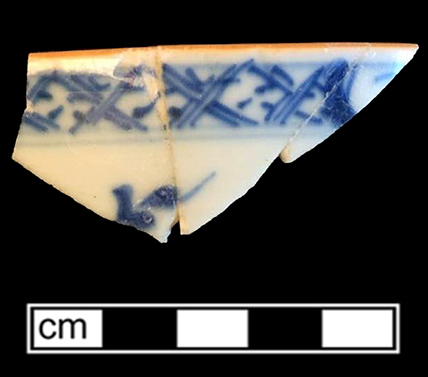
Blue Trellis (c. 1690-1797) – The trellis motif, a secondary decorative motif used along rims and cavettos, was most commonly employed from c. 1715-1790 (Madsen and White 2011:73). It consists of a band of quickly painted overlapping X-shapes; the painting in these bands can vary greatly in quality.
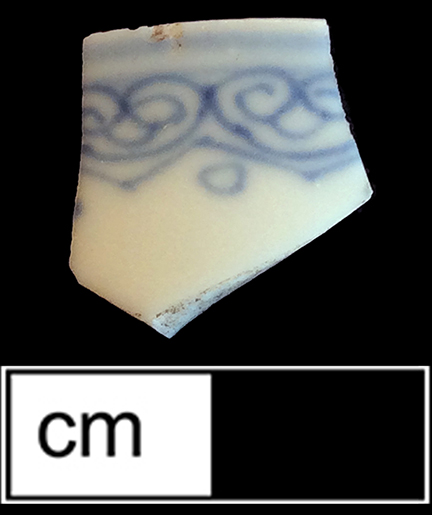
Blue Spearhead (c. 1722-1797) – This shape was also employed as a secondary motif on Chinese blue and white porcelain. It reached a peak of popularity in the 1730s and 1740s and consisted of two scrolls painted back-to-back and joined along the top by a rayed semi-circle (Madsen and White 2011:75). This shape was repeated to form a band used along the rims and cavettos of vessels.
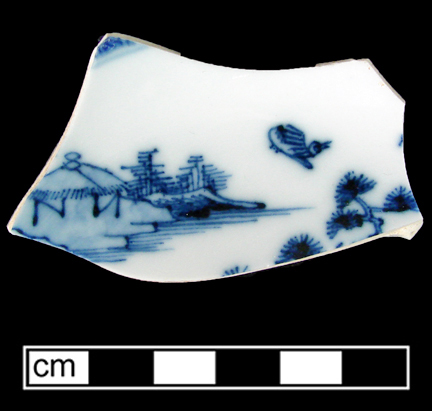
Pavilion Landscapes (c. 1710-1853) – This category of decorative motif was very common and contained a number of recognizable elements, including a one-story structure with a pitched roof (the pavilion), as well as water and usually one or more of these elements: boats, human figures, bridges, trees and birds. Madsen and White (2011:77-87) further refine Pavilion Landscape patterns into four subsets that differ chronologically. The reader is directed to consult this source for guidance on discerning these different subsets. The latest temporal variant of the Pavilion Landscape category encompasses the type most archaeologists call Canton porcelain.
Canton Porcelain2 – Canton porcelains are typically characterized by several variants of a border pattern consisting of a band of blue containing a crisscrossed lattice in a heavier blue, with an inner border of scallops or swags. A second border pattern, consisting of two parallel bands of diagonal lines that meet at an angle (Herbert and Schiffer 1975:20) is also found. Also characteristic of Canton porcelain is a fairly generic landscape design that features a building or pavilion, a bridge, willow trees, a river or stream, boats and distant mountains. Canton wares are typically characterized by a smooth, clear and slightly greenish to greyish glaze (Madsen 1995:179).
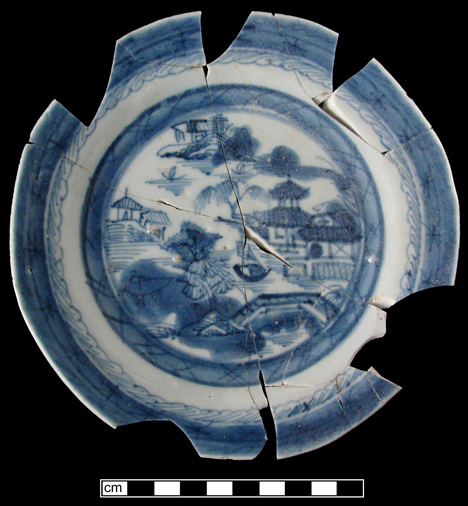
Prior to the American Revolution, Chinese porcelains arrived in the American colonies after having been shipped through England or Holland. But after the 1783 Treaty of Paris ended the Revolutionary War, North America began trading directly with China, importing large quantities of blue and white Canton (Palmer 1976:25; Venable et al. 2000:104). As it became more affordable in the 19th century, Canton porcelain became more common on the tables of families of a widening range of economic levels. Jean Mudge (1986:209) states that both Canton and Nanking (another type of Chinese blue and white painted porcelain)3 became plentiful after the Revolutionary War. Trade with China peaked early in the 19th century, declining after 1830 and continuing until after the Civil War (Palmer 1976:25).
Madsen dates Canton porcelains in North American archaeological assemblages primarily between 1785 and 18534 (Madsen 1995:175), disputing the shorter date spans (circa 1800-1830 and 1790-1840) assigned, respectively, by Ivor Noël Hume (1969:262) and Ann Frank (1969:85). The earliest reference found to date that references shipments of Canton is 1797, in a list of prices of porcelain in Canton written by a now-unknown Rhode Island merchant (Fuchs, personal communication 2012; Mudge 1981:259). The earliest datable pieces known at present were recovered from the wreck of the Diana, which sank in 1807 (Fuchs, personal communication 2012). Canton continued to be made without change into the 20th century (Fuchs, personal communication 2012).
The term Canton was used extensively in period documents to refer to "a common" versus a better quality (i.e., Nanking porcelain) blue-and-white (Mudge 1986:210). There are several means by which to distinguish Canton wares from Nanking porcelains (Table 1). Canton porcelains do exhibit a range of quality, not only in the execution of the painted designs, but also in the ceramic paste and glaze.5
Table 1. Differences in Nanking and Canton Chinese Porcelain
| Characteristic | Nanking | Canton |
|---|---|---|
| Border | Lozenge and diaper with dumbbells and spearheads | Rain and cloud variants or later parallel bands of diagonal lines |
| Painting Quality | Usually greater precision and detail in painting | More hurriedly painted, less detail, particularly in central landscape motif |
| Painted Details | Usually an anthropomorphic figure in teahouse component of landscape motif | No figure in teahouse |
| Gilding | Overglaze gilding can be present | Overglaze gilding generally uncommon |
| From Madsen and White (2011) and Herbert and Schiffer (1975). | ||
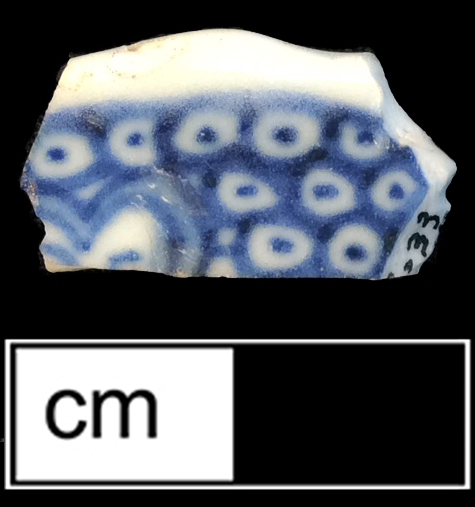
Fish Roe (c. 1740-1770) – The fish roe motif is a cluster of small painted circles touching each with a blue dot in the center of each circle (Madsen and White 2011:94).
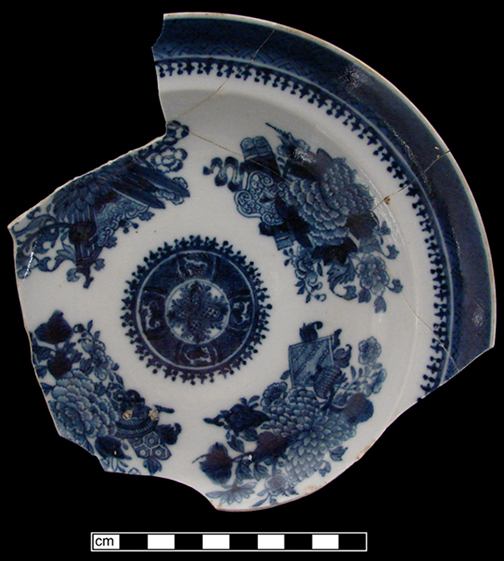
Fitzhugh Pattern (1765-1820) – This pattern, usually seen in underglaze blue, but sometimes in other color combinations, consists of four groups of flowers or plants spaced around the central motif. The rim border has a shaded trellis with spearheads and double dots.
Overglaze Painted
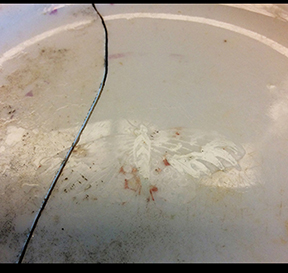
Another form of decoration on Chinese porcelain was the use of painted designs in overglaze enamels, with colors including red, green, pink, purple, brown, yellow, and white. Some Chinese porcelain was sent to England and Europe to be decorated with overglaze enamels (Madsen and White 2011:43, 47). The overglaze colors and gilding tend to become unstable when buried in the ground, and will cling more to the dirt than to the porcelain. Often the overglaze colors are totally absent, and the fugitive designs can only be seen as faint outlines when a sherd is held in the light at an angle.
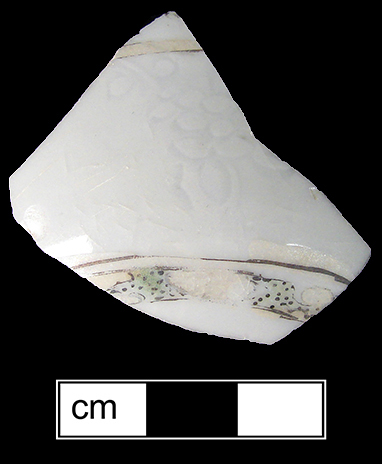
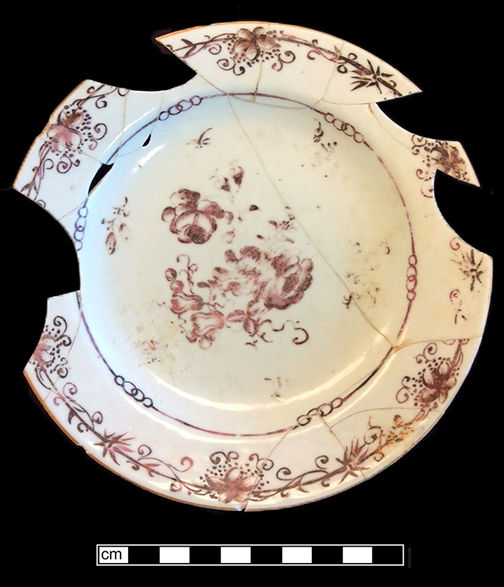
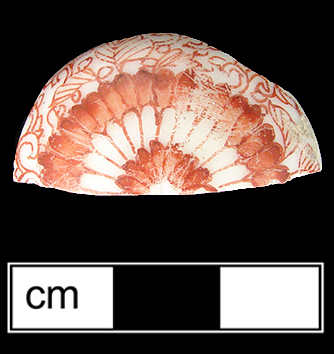
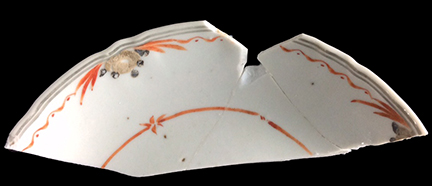
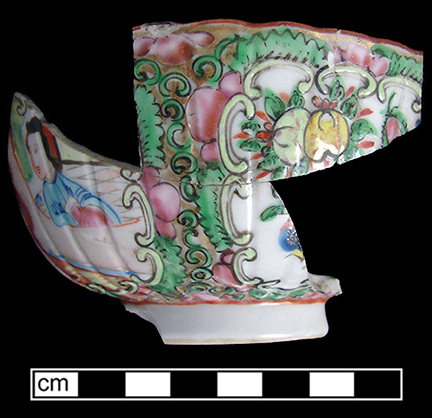
Common decorative motifs on overglaze decorated wares can also be assigned production date ranges. Following is an overview of some of the basic types; for a more extended discussion, see Madsen and White (2011).
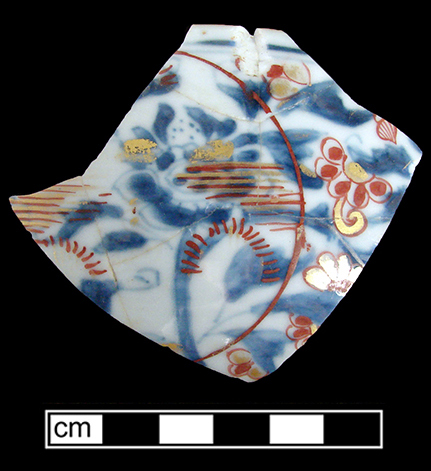
Japanese Imari Style – Chinese export porcelain in imitation of the Japanese Imari style (blue underglaze painting combined with red overglaze painted motifs and gold gilt) generally dates from 1700 – 1760 (Madsen and White 2011). Floral and foliate motifs were common on Imari-style Chinese porcelain. Imari-style Chinese porcelain occurs regularly in mid-18th century archaeological contexts in Williamsburg, Virginia (Madsen and White 2011:112).
Two additional palettes on the Chinese overglaze trade porcelains are identified by collectors: famille verte (c. 1680 – 1730) and famille rose (1720 – 1800) (Madsen and White 2011).
Famille verte – This was characterized by the use of several shades of green enamels (usually the predominant color on the vessel), used in combination with yellow, blue, purple, brown and iron red to create floral and landscape motifs (Madsen and White 2011:103). It could be used in combination with underglaze blue decoration as well. The famille verte palette, which peaked in popularity from circa 1700 to 1720, lost favor around 1730 to the newer and fashionable famille rose palette (Madsen and White 2011:104-105). Porcelain decorated in the famille verte palette is uncommon on North American archaeological sites.
Famille rose – More common archaeologically are vessels decorated in the famille rose palette, so named for the pink overglaze enamels, used in combination with green, purple, red, yellow, turquoise and white enamels. While famille rose enjoyed a long period of production (c. 1720 – 1800), different motifs were popular for different portions of that eighty years. For example, floral sprays were most common from the 1740s through the 1760s, while bamboo motifs were popular in the 1770s (Madsen and White 2011:107).
Rouge-de-fer and en grisaille – Chinese porcelain painted over the glaze in iron red (rouge-de-fer) generally dates between c. 1710 to 1739, while finely-wrought motifs painted entirely in black or sepia enamels (en grisaille or encre de chine) date c. 1728 – 1805, with peak period of popularity between 1740 and 1769 (Madsen and White 2011:114-115). Pieces decorated in this fashion often display romantic, religious or mythological themes (Nilsson 2016a).
In the second half of the 18th century and into the first decade of the 19th century, a number of neoclassical motifs were used as rim decoration on teawares (Madsen and White 2011:116-118).
Neoclassical Motifs – These simple band and line motifs included wavy bands (c. 1780-1790), husk chains (c. 1765-1810), dogtooth (c. 1765-1797), blue bands with gold stars (c. 1785-1805) and half circles with dots (c. 1780-1800).
Rose Medallion – Vessels decorated with the Rose Medallion motif (1860-1910) fashion use panels containing figures, landscapes or floral patterns. The panels are framed with scrolls and C-shaped devices, making for a highly decorated vessel.
Other Forms of Decoration
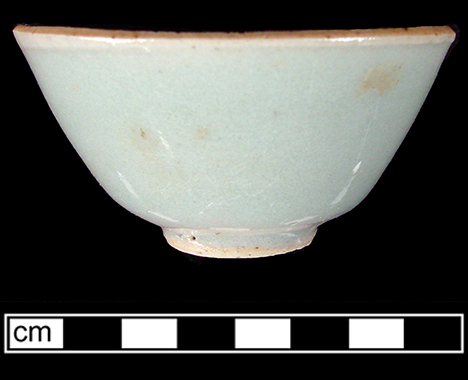
Winter Green – This porcelain is characterized by an overall greenish blue glaze known as Winter Green in period documents. Chinese Winter Green porcelain is common on 19th- and early 20th-century Chinese sites in North America (Ross 2012:19) and continued importation in the U.S. until WWII (Choy 2014). It is also sometimes called celadon, but this term actually refers to a porcelain similar in appearance that dates to the Sung Dynasty (960-1280 A.D.).
Hua – A relatively uncommon form of decoration on Chinese porcelain is known as an hua or "hidden" decoration. It is created when a design is carved or impressed into a leather hard piece of unfired porcelain (Nilsson 2016b). Once glazed and fired, the design appears as white-on-white style decoration when the piece is held up to transmitted light. Pieces decorated in the an hua style generally date from c. 1710 to 1760 (Madsen and White 2011:128).
The vast majority of exported Chinese porcelain is unmarked, though occasionally dynasty marks and other symbols are found. Studies of decorated vessels with marks provide some dating information for various motifs, especially for 18th century wares (Curtis 1988; Cushion and Cushion 1992; Madsen 1995). A common characteristic of 17th-century Kraak porcelain is the lingzhi, or sacred fungus, mark found on the back of vessels.
Form
Porcelain was made in many types of tableware, especially tea wares, and as decorative figurines. Chinese porcelain was first available in typically Chinese forms, but increasingly was manufactured in European forms. As early as the end of the 17th century, the Dutch were supplying wooden block forms for the Chinese to copy. This became even more prevalent with the English trade in the 18th century (Noël Hume 1970; Rinaldi 1989).
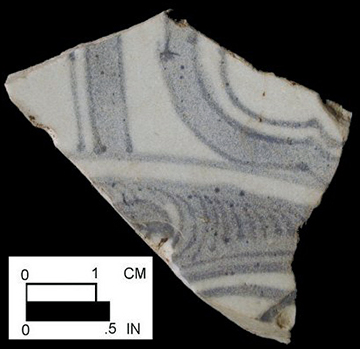
Kraak porcelain was made in four general form categories: dishes, klaptmutsen, bowls, and closed forms such as bottles, wine pots, and covered boxes. Klaptmutsen are deep dishes or bowls with flattened rims, possibly influenced by Dutch forms (Rinaldi 1989:70-191). Footings are often rough from sand scars due to the practice of firing Kraak porcelain on a bed of sand (Rinaldi 1989:66).6
Footnotes
1 This list on this website is not comprehensive. As examples illustrating other motifs discussed in Madsen and White (2011) are found in the collections, these motifs will be added.
2 This term was also used by the British when referring to 19th- and early 20th-century polychrome rose medallion porcelain (Madsen and White 2011:101).
3 Nanking porcelain, according to Frank (1969:85), is generally considered to be of a higher quality than Canton: more elaborately and carefully painted, with a lozenge diaper border with an inner spearhead border. The production of Nanking porcelain is dated between 1790 and 1850 by Frank (1969:85), although Nanking falls from fashion after about 1820 (Fuchs, personal communication 2012).
4 The T'aip'ing Rebellion disrupted the European and American export trade in Chinese porcelain in 1853 (Madsen and White 2011:102), but export of porcelain to America continued in large amounts afterwards, including a few rare armorial sets in the 1860s (Fuchs, personal communication 2012).
5Although Canton porcelain is still manufactured today, it was largely replaced by Japanese porcelain and by French and German china by the turn of the 20th century (Venable et al. 2000: 104). Any Canton porcelain marked "Made in China" or "China" dates after 1891 (Herbert and Schiffer 1975:24).
6 Kraak porcelain was the first Chinese porcelain mass produced for the export market that developed through the Portuguese and Dutch trade networks. The name Kraak is believed to come from carrack, the type of ship used by the Europeans for transport, or from the Dutch word "kraken," which means to break easily (Rinaldi 1989:60).
References
1988 Perceptions of an Artifact: Chinese Porcelain in Colonial Tidewater Virginia. In Documentary Archaeology in the New World, Mary C. Beaudry, editor, pp. 20-31. Cambridge University Press, Cambridge, England.
1992 A Collector’s History of British Porcelain. Antique Collectors’ Club, Ltd., Woodbridge, Suffolk.
1987 Artifacts of the Spanish Colonies of Florida and the Caribbean, 1500-1800, Volume I: Ceramics, Glassware, and Beads. Smithsonian Institution Press, Washington, D.C.
1995 "All sorts of China Ware… Large, Noble and Rich Chinese Bowls": Eighteenth Century Chinese Export Porcelain of Virginia. Unpublished M.A. thesis, Department of Anthropology, the College of William and Mary, Williamsburg, VA.
1986 Chinese Export Porcelain in North America. Clarkson N. Potter, Inc. Publishers, New York.
1970 A Guide to Artifacts of Colonial America. Alfred A. Knopf, New York, NY.
1994 Here Lies Virginia: An Archaeologist’s View of Colonial Life and History. Reprint of 1963 edition with new Preface and Afterword. University of Virginia Press, Charlottesville.
2001 If These Pots Could Talk: Collecting 2000 Years of British Household Pottery. Chipstone Foundation, Milwaukee, WI.
1989 Kraak Porcelain: A Moment in the History of Trade. Bamboo Publishing. Ltd., London.
2001 Phase II Archaeological Investigations at 18ST233 and 18ST329 Aboard Webster Field Annex Naval Air Station, Patuxent River, St. Mary’s County, Maryland. Report to the Department of Public Works, Naval Air Station Patuxent River, St. Mary’s County, MD from Jefferson Patterson Park and Museum, St. Leonard, MD.