Buckley Type
Defining Attributes
A hard brick-red to purplish earthenware paste made by combining red and yellowish clays. Vessels are usually thick, often with ribbed exteriors, and generally glazed with a thick black lead glaze.
Chronology
Mid-17th – 19th centuries. Black lead glazed wares made from mixed red and yellow clays were being produced in Wales and England, particularly Northwest England, by the mid-17th century, and continued to be made into the 19th century. They have been recovered from 1690 – 1720 contexts at kilns in Buckley, Wales, and from late 18th - early 19th century contexts at sites in Merseyside (Davey 1987, 1991; Cresswell and Davey 1989).
Buckley-type vessels are rare on Chesapeake sites dating before the 1720s, when they were heavily imported, and become rare again on sites occupied after the American Revolution (Noël Hume 1970). However, a few examples have been recovered from late 17th century contexts in Maryland (Miller 1983; Hornum et al. 2001).
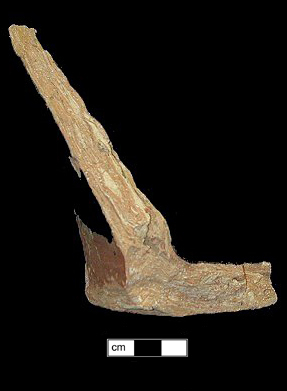
Figure 1. Buckley-Type earthenware paste shot showing striations of red and yellow clay.
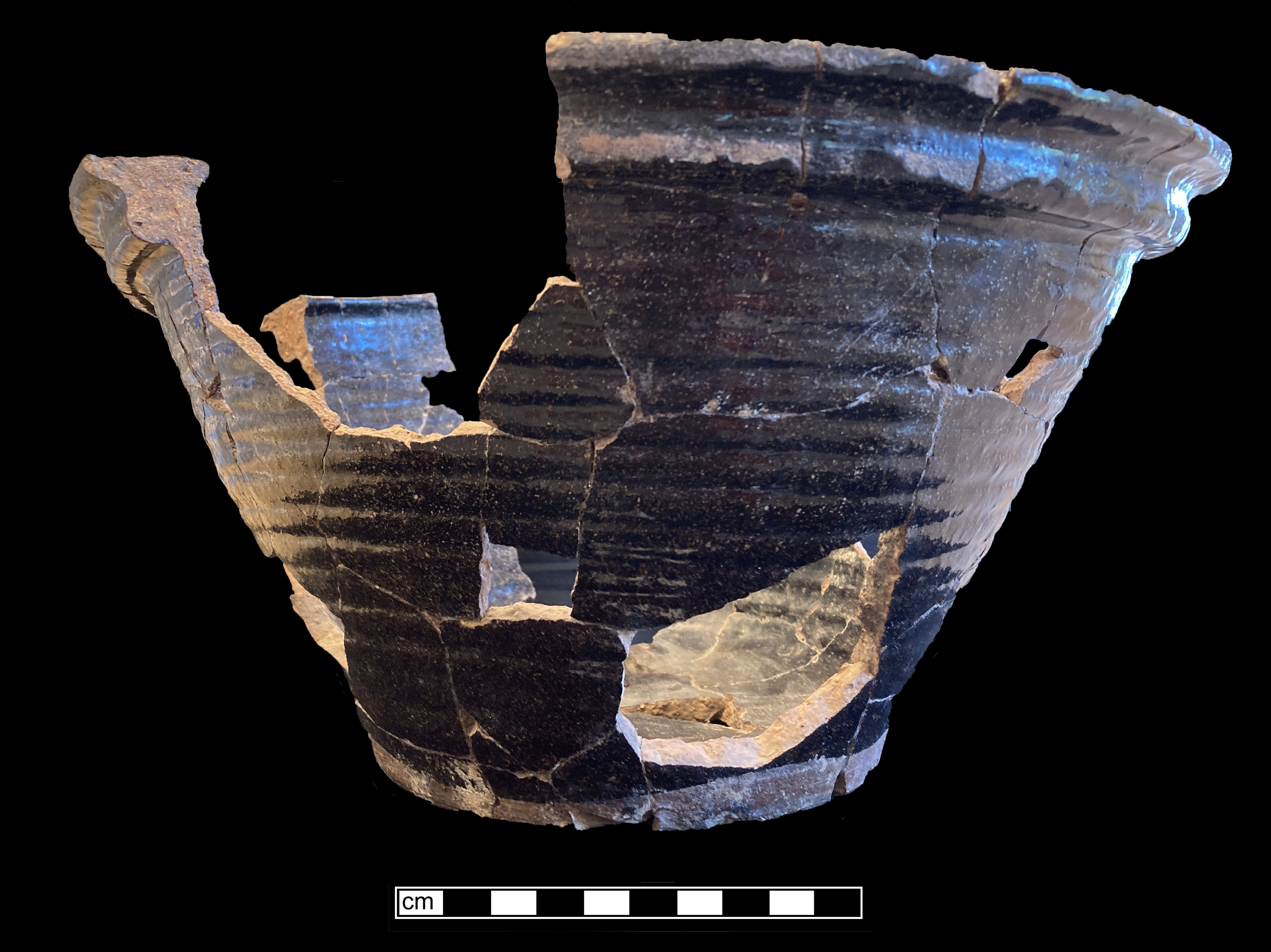
Figure 2. Buckley-type pan.
Description
Fabric
Buckley-type wares are made from a mixture of red and yellow/white clays. The mixture is most often evident in cross-section as striations or lenses of clay, but roundish clay inclusions also occur. The use of two clays tends to be more obvious on utilitarian pieces than on tablewares, which are more finely and completely mixed, but this is not a hard and fast rule (Philpott 1985a:85; Davey 1987:98). Generally, the darker clay predominates, which produces a dark red to purple paste. However, sometimes the lighter clay predominates, and the vessel fires to a light orange color (Philpott 1985a: 85). This variant is occasionally seen on sites in the Chesapeake. Inclusions of small particles of quartz or other stone, as well as grog, can be present in the paste (Philpott 1985a:85).
Glaze
Buckley-type wares are generally covered by a dark brown to black lead glaze. However, variants with a clear lead glaze, which appears brown on the vessel, also occur. Vessels from the 17th century can have a dull dark brown glaze due to over-firing, while a glossy, metallic black glaze was introduced in the mid-to-late 18th century (Philpott 1985a:86). Bowl forms are usually glazed on the interior surfaces only, while storage jars are glazed on both surfaces. A red slip under the glaze covers many vessels, particularly the larger ones (Philpott 1985a).
Decoration
Buckley vessels were not decorated, but throwing marks or ribbing, produced during the manufacturing process, are apparent.
Form
Vessels range from tablewares such as cups, tygs, bowls, and pitchers to large storage vessels, butterpots, milkpans, and even some cooking pots. Rims on the utilitarian vessels are generally large and thick. The tablewares declined in popularity by the early 18th century (Philpott 1985a), and Maryland assemblages are dominated by utilitarian forms.
References
1989 Pottery from Twist’s House, Prescot Site 28). Journal of the Merseyside Archaeological Society, 5:97-101.
1987 Further Observations on a Post-Medieval Kiln Group from Pinfold Lane, Buckley. In Studies in Medieval and Later Pottery in Wales, Blaise Vyner and Stuart Weathall, editors, pp. 93-120. University College, Cardiff.
1991 Merseyside: The Post-Roman Pottery. Journal of the Merseyside Archaeological Society, 7: 121-142.
2001 Phase III Archeological Data Recovery at Site 18ST704, Naval Air Station Patuxent River, St. Mary’s County, Maryland. Report to Tams Consultants, Inc., Arlington, Virginia from R. Christopher Goodwin & Associates, Frederick, Maryland.
1983 A Search for the “City of Saint Maries.” Report on the 1981 Excavations in St. Mary’s City, Maryland. St. Mary’s City Archaeology Series No. 1. Historic St. Mary's City Commission, St. Mary’s City, Maryland.
1970 A Guide to Artifacts of Colonial America. Alfred A. Knopf, New York, NY.
1985a Black Glazed Ware. Journal of the Merseyside Archaeological Society, 4:85-105.